Sunday, 27 November 2016

Lina Sastri, the gold of Naples

Lina Sastri, one of the greatest Italian actress, has performed yesterday at the Mercadante theather, in Altamura.

Io mi chiamo Lina Sastri titles her show.

Accompanied by great musicians, Lina Sastri revisits her long professional carrier, alternating songs to thoughts and memories.


Born in Neaples, she was very young when she begun acting for the Eduardo De Filippo's acting company, who actually soon recognised her talent.


"Acting is a vocation, you are called to do that. In other words, you cannot do anything else than that" Lina states.


"Every time I played Filomena Marturano, a tear came out of my eyes" Lina recalls "And I remember Edoardo disapproving that by saying that the audience would get distracted by my tears. So, Edoardo used to recommend me to work on transmitting such a feeling to the audience and make them crying. I have not succeeded yet in doing that" Lina confesses. 


After theatre, cinema knocked on my door. My first movie was Il prefetto di ferro shot by Pasquale Squittieri. Then, I acted for Nanny Moretti in Ecce Bombo

However the "red carpet" arrived with the Nanny Loy's cult movie Mi manda Picone in which I starred with Giancarlo Giannini, a great actor. 


Lina has a fantastic voice. 

She sings songs not only of the classical Neapolitan repertoire, but also few Pino Daniele's ones such as Chi tene o'mare and Napul'e.

She adores the sea, and what it implies.


"I don't distinguish people in southern and northern, but in those who live on the sea and in the upcountry". 

"People mixing up and cultural contamination generates very interesting things" Lina says.

She seems inviting us on getting rid of fears concerning the massive immigration of people escaping war and starvation. Because as she says "the sea doesn't have barrier nor borders"


Please let me spend few words on the Mercadante theatre, and its  role in propelling the cultural life of Altamura.

Refurbished a couple of years ago after decades of decadence, this wonderful theatre, as stressed by Lina Sastri, hosts great events on weekly basis.


You are highly invited to experience such elegant, tiny theatre. 

Ciao

Thursday, 17 November 2016

Journey to Tuscany

Michele, my beloved cousin, lives in Pisa since almost 20 years. 


He is a lovely person, married, with two pretty daughters.


A couple of weeks ago I went to visit him in Tuscany. I spent two days in Florence too, where we've been hosted by Katia, a good friend of Lucia.

It was a major pleasure for me to spend with Michele some time together, creating with him a sort of complicity, exchanging each other memories of our family. 

As my chief at work says "life is too short". I agree 100% with him.

Michele lives in the countryside, few miles from Pisa.


Michele takes us to visit Pisa, this fantastic city, famous all around the world because of piazza dei Miracoli, where like a flower, it's set the Torre di Pisa (pictured).


"When I first arrived in Pisa, almost 20 years ago, foggiano (born in Foggia, Apulia), was synonymous of being rough" My cousin says.

He continues "Once, I went in a shop in Pisa to buy a shirt. After having dressed one of them, I asked the shop assistant how it looked like. She replied: It makes you looking foggiano. But I'm foggiano, I addressed her. She turned purple, of course".

I burst laughing, and kept laughing for a while. Actually, I still do it when I recall such story.

This was due to the shock caused at the time by the immigration flow in Tuscany from Foggia, as my cousin soon after explained.

Pisa is really cool, I have to say.

With Genova, Amalfi and Venice, Pisa was one of the four Repubbliche marinare which dominated the Mediterranean sea in the Middle Age.

Michele leads us to see the Keith Haring's murales, called Tuttomondo.


This murales was painted on the wall of a church. 

It took Keith four days to complete it. The paint was donated to the New Yorker artist by a local company.

Early in the 80ies, Keith Haring and Jean Michel Basquiat expressed themselves by painting all around the "big apple", covering public spaces of their paintings, mostly the underground.


Tuttomondo, the murales in Pisa was painted in 1989. Keith would have died few months later of AIDS.

His messages of love, hope and peace are nowadays perpetuated by the Keith Haring Foundation .

Michele and Anna, his wife, bring us to visit Lucca, very close to Pisa.

Lucca is a well preserved Medieval town.


What really strikes me is viewing the Roman theatre being incorporated by Medieval urbanisation (pictured).

The day is sunny.

This gentleman takes the opportunity of being cheered up by the sun in the afternoon.


A slow walk within the walls of Lucca is something I definitely recommend of .


You'll discovery so many interesting places and corners, like the one nearby the conservatory.  


On Monday, we leave Michele and his fantastic family, heading to Florence, capital of Renaissance.


Florence is undoubtedly an open air museum, as we have realised by just getting out the train station.

I have seen so many tourists around here. 

From an art perspective, the climax of this journey is the visit at Galleria degli Uffizi.

We'll be spending at Galleria a whole afternoon, admiring the paintings collection made up by the Medici family along centuries.

Caravaggio, Piero della Francesca, Tiziano, Canaletto, Leonardo Da Vinci, Botticelli are just some of the artists exposed there.


Once in the life, you must come to Tuscany.

By the way, concerning Michelangelo Merisi, also called Caravaggio, the National Gallery in London is currently hosting an exhibition called Beyond Caravaggio dedicated to this revolutionary artist.

It will be on till the 15th January 2017.  

Wednesday, 9 November 2016

Botromagno, the art of making wine

“Dear Sir, I'd be pleased to interview you in regard of your activity of wine making...”. 

10 days ago I’ve e-mailed to Botromagno, a cantina located in Gravina in Puglia (Murgia). 

A couple of days later, I get the reply “Hi Antonio, I'm currently in London. I'll call you back once in Italy. Beniamino”.


Beniamino is the owner of Botromagno. We arrange an appointment on the 5th of Saturday morning.

Equipped with my camera, I arrive there in advance.

So, I have chance to talk with Matteo De Rosa, the enologist of Botromagno.


Bear in mind that Gravina in Puglia is famous all around the world because of Verdeca, a fantastic sweet white wine.


“Verdeca dates back to the Middle Age (1200). This wine comes from the combination of Greco, Malvasia and Bianco d'Alessano.” Matteo says.

He continues “In 1973 we applied to obtain the DOC for our Verdeca wine. However, we got the certification only in 1983. Additionally, we had to change its name from Verdeca to Gravina. Since 5 years, we only combine Greco and Malvasia as the Bianco d'Alessano is almost disappeared here in Gravina”.


The enologist seems to me very competent, so I take the opportunity to question him more "I'd like to know your opinion about how the Apulian wines are performing so far. I mean, are they appreciated in Italy as well as abroad?” I enquiry.


“Well, since 20/25 years ago, the Apulian wines were mainly bought by Northern Italy wine makers to adjust their own wines. Since then, things have radically changed.” Matteo De Rosa says.

Indeed, in the last two decades a new wave of Apulian wine entrepreneurs, with the right mindset, have worked hard to promoting their wine by attending international markets.

Meantime Beniamino is arrived. We shake our hands. He takes me in his factory, meanwhile he narrates me his story.


“Since 2009, the Italian wine market has been gradually shrinking due to the ongoing crisis. So, we have been forced to sell abroad an increasing number of bottles” Beniamino says.


“Before the crisis there were so many buyers on worldwide basis. Most of them managed a business on small scale, for clients who wished to find out more about cultura enoica


Nowadays, few buyers have remained. They are tremendously sensitive to the price.” Beniamino adds.

Competition in the wine market is getting higher and higher.
  
“Concerning the new markets such as India and China, things are not easy from a wine-business perspective. First of all, richness is not well distributed in those countries, despite their galloping GDP. Secondly, such countries have a strong food identity. So, it won't be easy to combine our wines with their food” Beniamino states.

Talking about the Italian wines, our strengthen is the tremendous variety of vines, which represents an unicum in the world.


In fact there're 1000 different kind of vitigni (vine variety), 600 of them certified, 300 which are being evaluated and 100 brought to life again.


None like Italy has such richness in terms of vine variety. And Apulia may rightly be considered as a typical example of such fantastic kaleidoscope.

"Would you like to see my nicest vineyard?" Beniamino asks. "Yes, I'd love to" I reply.

He drives me with his car on the bottom of the hill called Botromagno, where the ancient Silvium (now Gravina) was located. 

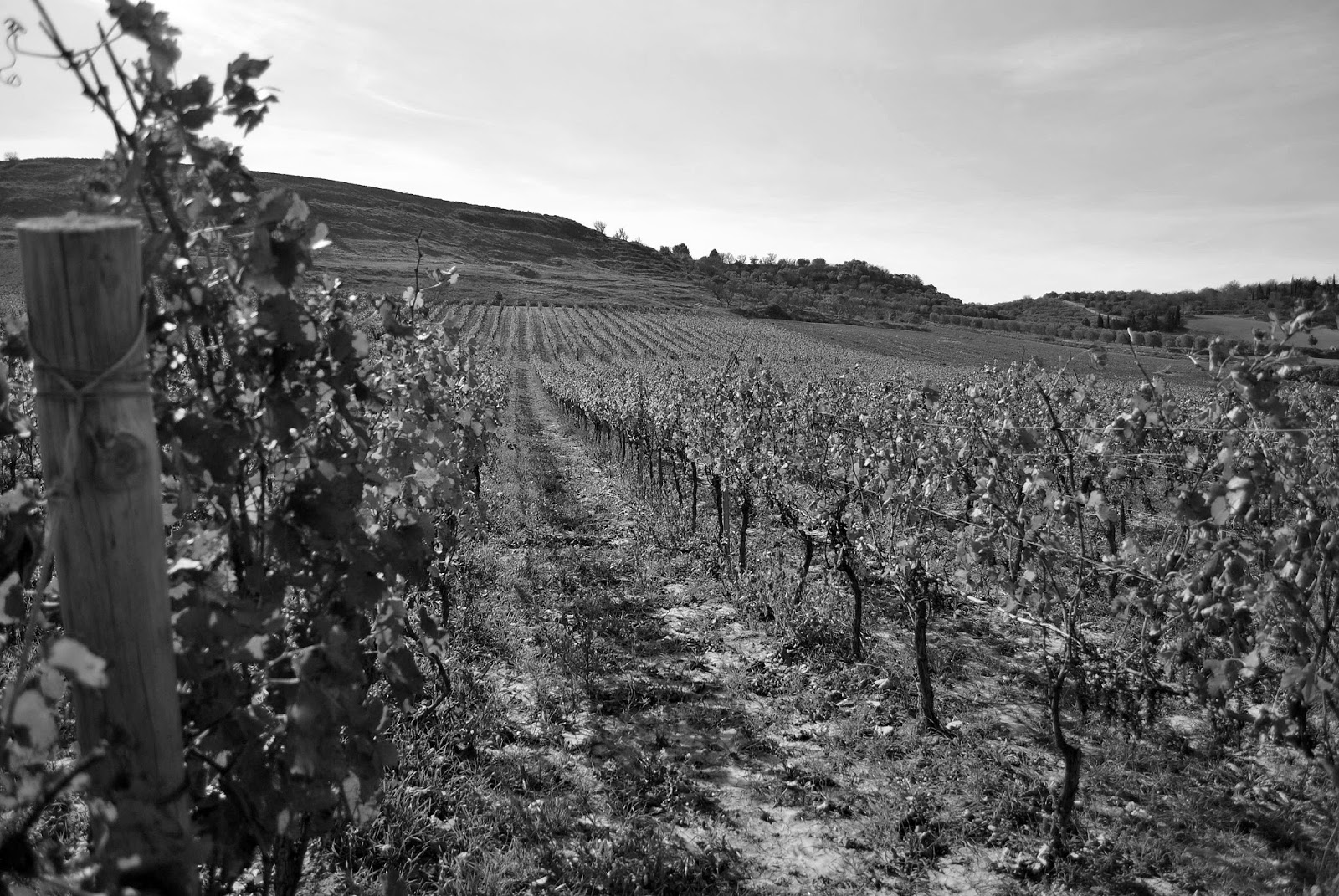
At the bottom of that hill there is his vineyard.


Wine making is carried out over here since the 8th century BC, as testified by archaelogical evidences.


In fact, via Appia passed by Silvium. As result of this, a busy trading of vine plants coming from the Hellenistic world took place here. 

“We in Apulia should develop more and more the wine-tourism” Beniamino suggests. I fully get his precious tips.

It’s 12 o’clock. Time just flies away.

“Thanks Beniamino, your narration was really interesting. Your inputs very much appreciated. I’m going to write the article and send you the link by e-mail.” I say.

“Thanks” He says. “Hold on a moment” he adds. He fetches a bottle of rosè and hands it over me. “This is for you. It’s made by a Nero di Troia vineyard old 50 years”. Beniamino says. I have dedicated to Lucia, my daughter. 


Beniamino, this rosè is marvellous. Blessing Lucia

Ps.
Glug.it has just launched a wine contest #Raccontaciiltuovino Please, narrate your story/wine with pics, words etc.. 


Wednesday, 28 September 2016

A wine opened my mind

Have you ever had the feeling of travelling with your mind by drinking a glass of red wine?


Yesterday night, I came back in Apulia after a couple of days in Florence, where I have been at Galleria degli Uffizi contemplating Caravaggio, Piero della Fracesca, Botticelli, Tiziano, Giotto, Mantegna et cetera.

It was 11 o'clock pm, we didn't have dinner yet, so I asked Lucia "Would you fancy pasta alio, olio and peperoncino"?

"Yes, sure" she replies. I'm a lucky man, I know.

I start cooking, meantime, I open a bottle of Elce Primitivo of Poderi delle Mura, run by Vito Calia and his bride.


After having drunk the first glass, I could not refrain from sending a message to Vito "Ciao Vito, sono tornato stasera da Firenze. Ho letto la tua mail ed ho subito colto il tuo invito aprendo una delle bottiglie generosamente donatemi: il tuo vino apre la mente. Il gusto, il sapore dischiudono orizzonti inesplorati. Complimenti!"

The problem you may encounter when drinking such a wine is that you would drink the entire bottle. 

Fortunately, Lucia, my wife, calls me from the bed "come to sleep. It's late". So, it came that I drink just half bottle of this fruit juice.

Vito owns a vineyard of just three hectares in Altamura and produce a ruby red Primitivo wine and a White Elce wine (70% Malvasia).


I interviewed Vito a week ago. 


I was so curious to know the story behind this wine as it seems that Vito is the only wine maker in Altamura who has decided to promote his wine. Indeed, he's only goal is quality, quality and again quality.

He picks me up at 12.

"Hi Vito, nice to meet you" I say. 

"Ciao Antonio, please, get in" he replies.

We head straight to the Vito's vineyard, located at contrada Parisi, Altamura.

"I inherited this vineyard from my dad who died in 2003. I wine-make since I was a kid. I didn't go on holidays in summer because I had to help my dad to look after the vineyard" he says.


He continues "When I grew up, my main job was as estate agent, which I've carried out for 18 years. Then, in 2013, the crisis arrived. I blessed that crisis because finally my wife and I took the decision to became professional winemaker, focusing just on our wines."

I listen to Vito and I realise how genuine he is.

What probably strikes me more is the passion that his words emanate.

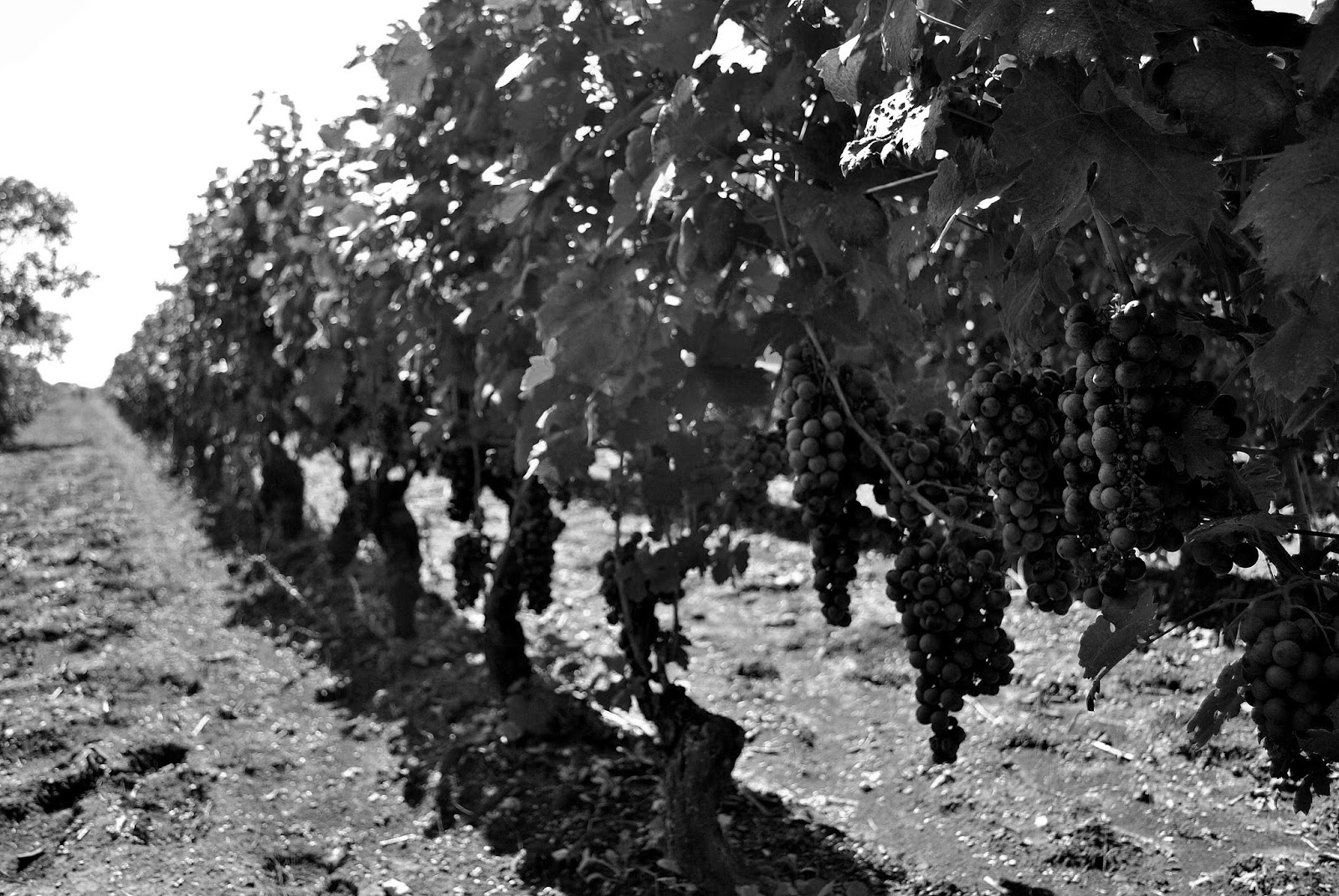
He tells me that this year he has decided to make his wine stronger (15% alcohol instead of the past 14%) by sacrificing some quantity and delaying the harvest at the end of September.


Ladybirds seem appreciating it. 


"Looking after my vineyard means also defend it from diseases such as peronospora (late blight), which may take place especially in May and June. You know, I plant a rose at the head of each row. Roses work like sentinels when peronospora occurs, because they get sick first, so I'd have the time needed to intervene" Vito adds.


"I'm for a clean agriculture" Vito declares. 

"It's seven years that I don't use anymore copper sulphate (vitriol) because I don't want metal flooding the soil" He says.

I invite you to try his wine.

It won't let you down. Guaranteed.


Sunday, 11 September 2016

Barletta and his sons

Friday 2 September, I have met in Barletta a good friend of mine, Massimo Lunardelli.

I know him since I was in Turin,  20 years ago.


He was invited in Barletta to present his documentary Carlo Cafiero, il figlio del sole as the 1 September occurred the 170s anniversary of Carlo Cafiero's birth.


Cafiero was an anarchist. Born in Barletta, he came from one of the most prominent Apulian families. 


To pursue his ideals, Cafiero drove his family to the brink of bankruptcy:  he had subsidised the building of a fantastic villa in Locarno (Switzerland), fronted onto the lake, where Bakunin and other European anarchists convened.

One of the facts unveiled by the Massimo's doc is that Bakunin contributed to drive Cafiero crazy, because of his continuos request of money. Just to make an example, once Bakunin arranged fireworks, again with Cafiero's money, to welcome his own wife. 

Finally, Cafiero will be admitted to mental hospital and interdicted by his own family, in order to avoid that he fully squandered the family's assets.      


Cafiero was close friend of Giuseppe De Nittis, renowned impressionist painter who gained glory and fame in Paris. 


"Would you like to come along with me and visit the De Nittis gallery here in Barletta?" I ask Massimo.

"Yes, sure" he says.


We catch up just outside the Della Motta's building, where the permanent exhibition is hosted.


"In terms of foreign tourists, many French come here. Followed by Germans" The guide admits.

The De Nittis' paints are incredibly fascinating. 

The colours, the light are impressive.


After having seen the exhibition, we get out hunting for some food.

"You know, I'm reading an intriguing book, I Beati Paoli, by Luigi Natoli, published by Sellerio" I address Massimo.


"I Beati Paoli were a secret sect operating in Palermo in 18th century. They meant to defend the poor against the injustices perpetrated by blue-blooded" I continue.

I add "Someone says that mafia roots in such a sect. It may be, nevertheless, the mafia's purposes are gallantless compared to those pursued by Beati Paoli. There is no doubt about it"

It's afternoon. Massimo is tired so he prefers to retire to his B&B and rest for a while.

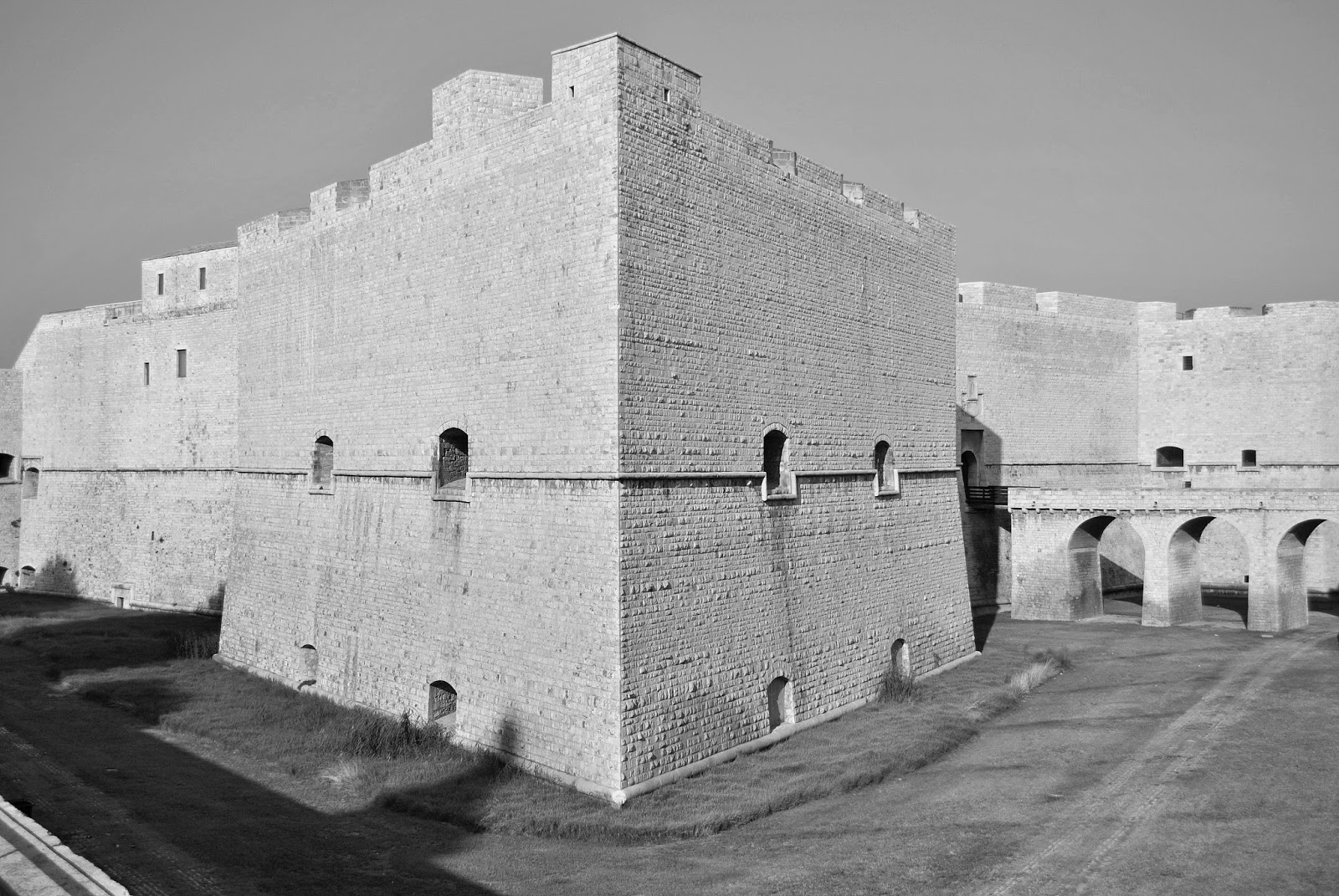
Lucia and I, head to the magnificent castle of Barletta, where is hosted an exhibition dedicated to Hannibal.


Indeed, nearby Barletta, it occurred the battle of Cannae, fought between Romans and Punics led by Hannibal. It's considered the greatest battle (read carnage) of ancient times.

There is an artefact retrieved around Campobasso (south of Italy) which catches my eye. 

It symbolises Tanit, a Punic goddess.

  
It's 7 pm.

Massimo joins us again.

I propose to go to admire the so-called giant of Barletta, a huge statue brought by the sea to the bank between Barletta and Manfredonia. 


Researchers are still unable to identify whom the statue represents.

Other Massimo friend's join us.

We are at the cappero pub, talking till late.

The plaza is plenty of people, not noisy though. 

It's 11 pm. We feel tired. It's time to leave.

I say goodbye to Massimo and others "Ciao Massimo. Take care of yourself".
Sunday, 4 September 2016

Manfredonia, Saint Andrew and procession at sea

Every year on 1 September, the community of Manfredonia celebrates Saint Andrew, protector of fishermen.


This feast follow three days dedicated to Santa Maria di Siponto, portrayed by a Byzantine icon, deeply venerated by the local community.


The celebration of Apulian Patron Saints represents more than just a religious event. It's actually a glue which holds the community together.   

I have come back to Manfredonia the 31 August to stay with my family. 

On 1 September, I take my wife to the Saint Andrew's procession at sea. 

We leave my parents' house at 4.30 and go to the harbour.

Hopefully, we will allowed to get on board.


At 5 pm is expected to begin the procession which will carry the Saint Andrew's statue around the gulf of Manfredonia.


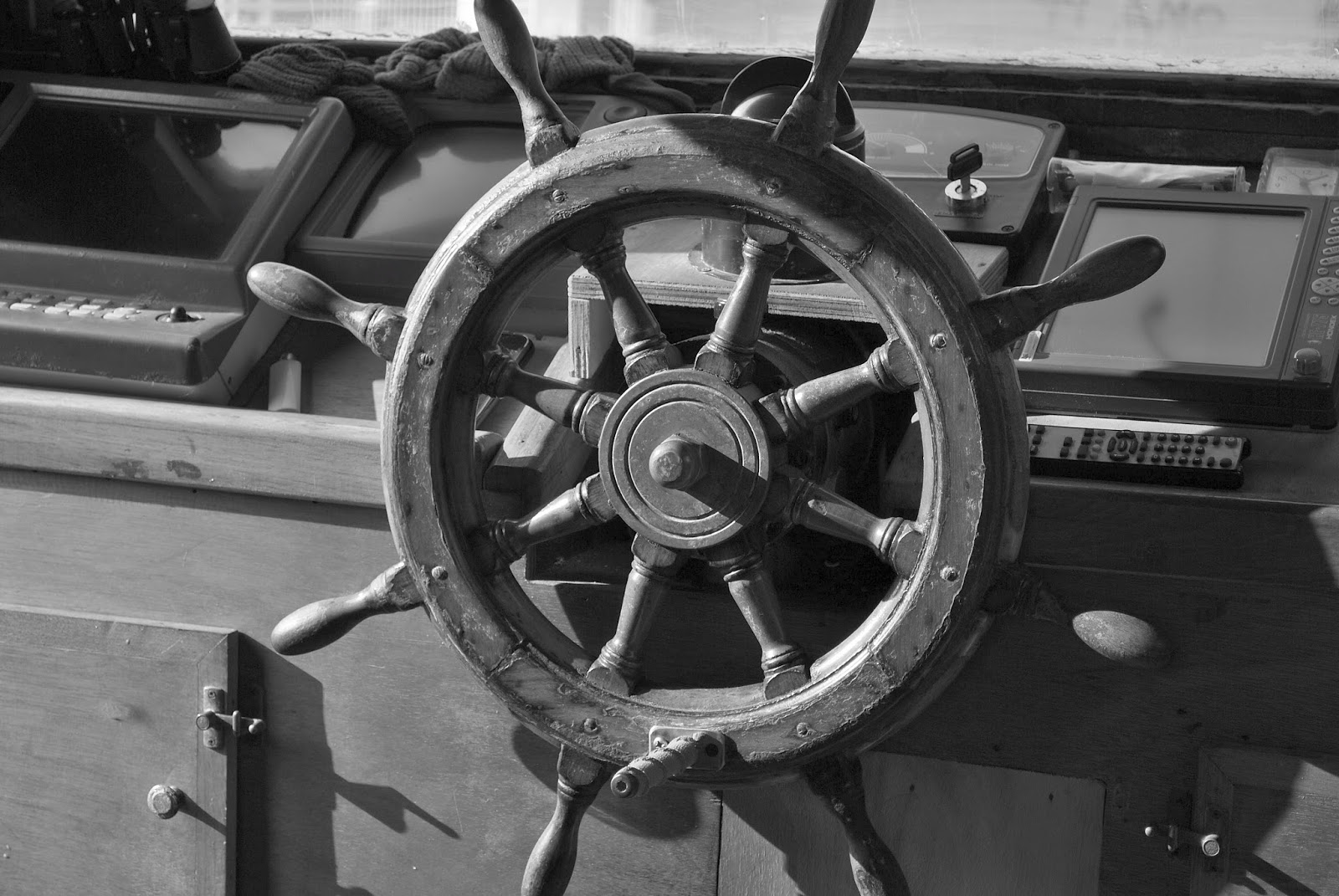
Once at the arbour, I see a fishing boat populated by a big family.

"Good afternoon, Sir. May we join you"? I address the captain.

"Yeah sure" he replies.

A lady gets out the boat, takes my wife's hand and lead her on board.


Fishermen welcome tourists on this special occasion.

Anyone who wants to join them is benvenuto.


Another family with two children embark.

We all look forward to sail away.

I take chance to ask a couple of questions to Giuseppe, member of the crew and captain's son.  


"We fish mainly red mullets, octopus, squids, sepias, basses, gilthread brims and mazzancolle (a kind of shrimp)" He says.


Manfredonia still hosts one of the largest fleet on national scale. Actually, it counts around 250 fishing boats.


Few years ago they were 400. 

Indeed, The European Union is providing funds to all those who dismiss their own boats.

The Mediterranean is deeply suffering the impact of intensive fishing.  

Giuseppe continues "We didn't take part to the procession for a couple of years because of the death of my grandpa". 

Dozens of boats and motorboats follow the one which carries the Saint.


At certain stage, all of them get close at each other and stop.

A wreath is launched from the main boat in memory of those who have lost their life at sea.


A rolling clapping rises to the sky.

Once back to the port, we get out and leave not before having cheered up the entire crew.

I exchange my contact details with Giuseppe.

"Call me in case you need anything" Giuseppe says.

I'll definitely call him when I'll need a couple of kilos of fresh fishes.

Lucia and I don't know why, probably because of the kindness of this humble people, or because of the smell of sea, however, we feel our hearth warmed up.

As Jimi Hendrix used to say "experience it".