Showing posts with label Botromagno. Show all posts

Wednesday, 9 November 2016

Botromagno, the art of making wine

“Dear Sir, I'd be pleased to interview you in regard of your activity of wine making...”. 

10 days ago I’ve e-mailed to Botromagno, a cantina located in Gravina in Puglia (Murgia). 

A couple of days later, I get the reply “Hi Antonio, I'm currently in London. I'll call you back once in Italy. Beniamino”.


Beniamino is the owner of Botromagno. We arrange an appointment on the 5th of Saturday morning.

Equipped with my camera, I arrive there in advance.

So, I have chance to talk with Matteo De Rosa, the enologist of Botromagno.


Bear in mind that Gravina in Puglia is famous all around the world because of Verdeca, a fantastic sweet white wine.


“Verdeca dates back to the Middle Age (1200). This wine comes from the combination of Greco, Malvasia and Bianco d'Alessano.” Matteo says.

He continues “In 1973 we applied to obtain the DOC for our Verdeca wine. However, we got the certification only in 1983. Additionally, we had to change its name from Verdeca to Gravina. Since 5 years, we only combine Greco and Malvasia as the Bianco d'Alessano is almost disappeared here in Gravina”.


The enologist seems to me very competent, so I take the opportunity to question him more "I'd like to know your opinion about how the Apulian wines are performing so far. I mean, are they appreciated in Italy as well as abroad?” I enquiry.


“Well, since 20/25 years ago, the Apulian wines were mainly bought by Northern Italy wine makers to adjust their own wines. Since then, things have radically changed.” Matteo De Rosa says.

Indeed, in the last two decades a new wave of Apulian wine entrepreneurs, with the right mindset, have worked hard to promoting their wine by attending international markets.

Meantime Beniamino is arrived. We shake our hands. He takes me in his factory, meanwhile he narrates me his story.


“Since 2009, the Italian wine market has been gradually shrinking due to the ongoing crisis. So, we have been forced to sell abroad an increasing number of bottles” Beniamino says.


“Before the crisis there were so many buyers on worldwide basis. Most of them managed a business on small scale, for clients who wished to find out more about cultura enoica


Nowadays, few buyers have remained. They are tremendously sensitive to the price.” Beniamino adds.

Competition in the wine market is getting higher and higher.
  
“Concerning the new markets such as India and China, things are not easy from a wine-business perspective. First of all, richness is not well distributed in those countries, despite their galloping GDP. Secondly, such countries have a strong food identity. So, it won't be easy to combine our wines with their food” Beniamino states.

Talking about the Italian wines, our strengthen is the tremendous variety of vines, which represents an unicum in the world.


In fact there're 1000 different kind of vitigni (vine variety), 600 of them certified, 300 which are being evaluated and 100 brought to life again.


None like Italy has such richness in terms of vine variety. And Apulia may rightly be considered as a typical example of such fantastic kaleidoscope.

"Would you like to see my nicest vineyard?" Beniamino asks. "Yes, I'd love to" I reply.

He drives me with his car on the bottom of the hill called Botromagno, where the ancient Silvium (now Gravina) was located. 

At the bottom of that hill there is his vineyard.
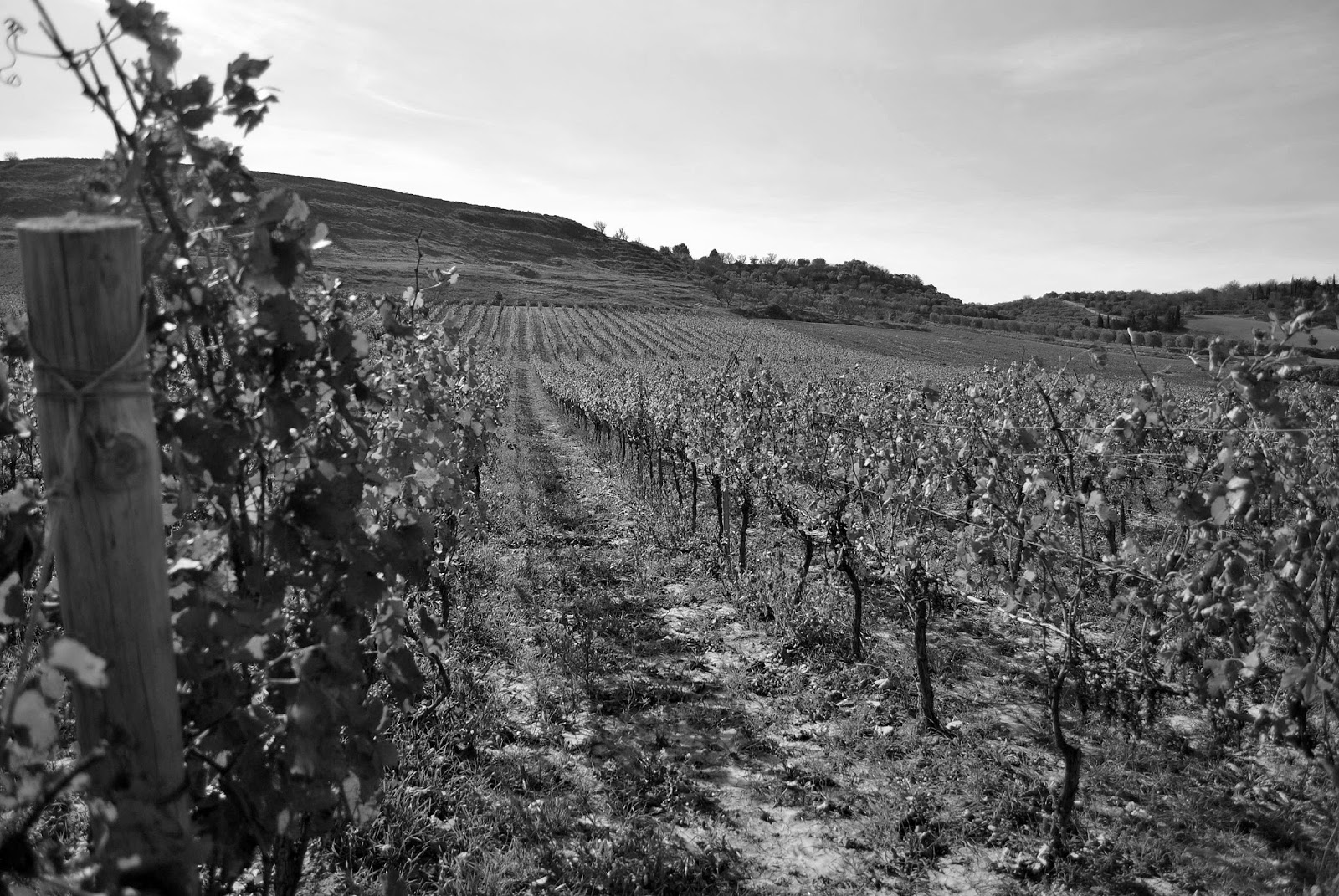


Wine making is carried out over here since the 8th century BC, as testified by archaelogical evidences.


In fact, via Appia passed by Silvium. As result of this, a busy trading of vine plants coming from the Hellenistic world took place here. 

“We in Apulia should develop more and more the wine-tourism” Beniamino suggests. I fully get his precious tips.

It’s 12 o’clock. Time just flies away.

“Thanks Beniamino, your narration was really interesting. Your inputs very much appreciated. I’m going to write the article and send you the link by e-mail.” I say.

“Thanks” He says. “Hold on a moment” he adds. He fetches a bottle of rosè and hands it over me. “This is for you. It’s made by a Nero di Troia vineyard old 50 years”. Beniamino says. I have dedicated to Lucia, my daughter. 


Beniamino, this rosè is marvellous. Blessing Lucia

Ps.
Glug.it has just launched a wine contest #Raccontaciiltuovino Please, narrate your story/wine with pics, words etc.. 


Monday, 11 April 2016

Pomarici Santomasi musuem

After six months I'm back writing a new post.

Why? 

Because when you do things for passion, with Nonprofit purpose, it's your right to take a break, in order to ponder over an easy question such as "where am I going to"? 


Frankly, I have to say that even though I did not add any new posts for a while, people from all over the world has kept reading In Apulia.

So, I realised that people is eager to find out more about this Italian region, Apulia.

Below the figures of audience.


Today, I wish to share with you some discoveries made at the Pomarici Santomasi foundation, located in Gravina in Puglia, of which I have already written about.


The Pomarici Santomasi foundation hosts permanent exhibitions concerning archaeology, art gallery, library, numismatics, majolica and finally, Byzantine frescos.


The Foundation has been established after that Ettore Pomarici Santomasi, a rich baron of Gravina, left a bequest to the municipality of the above town.


As the generous donor did not have any male descendant, he thought better to leave his immense palace (almost 50 rooms!) to the community, in order to promote the culture among his fellow citizens.

There are four of us: Lucia, I and two friends of us, Emma and Marcello. 

We arrive at the museum at around 11:30.

We later realised that we should have come earlier, as there is so much to see and the closing time is just at 1 pm.

We pay the ticket, 3 euros each. A guide is going to lead us through the house museum. 

Our Beatrice is named Rosa Di Benedetto, a lady who does her job with great passion. 

When I tell Rosa that I write a cultural/travel blog, she seems very much enthusiastic about the idea of an article written in English which describes the beauty of the foundation which she works for.

"When are you going to write about us?" she enquiries. 

Her enthusiasm is contagious. 


The first room is dedicated to Pasquale Calderone Martini, deputy of the Italian Parliament, who has helped to set up this foundation.


He was a rich landowner. Indeed, we visualise a cupboard containing a full set of legumes gathered from his lands.


We move on.

"This is the state room" Rosa declares. 

She continues "Look at the roof, it's a flat caisson ceiling, from which descends a Murano chandelier. Talking about the floor, the architect has designed it inspired by Palladio ".


Rosa lead us to the next room, where is displayed an old fashion bed. 


However, the most interesting items are two tallboys enriched with ivory marquetry.


We are now entering the archaeological section.

From an historical point of view, Gravina in Puglia is one of the most important Peucetian site.

Peucetians, Daunians and Messapians belonged to the Iapyges, the pre-roman inhabitants of Apulia. 

"Please, do not take pictures of the archaeological exhibition, as prescribed by the Sovrintendenza of Apulia" the guide warns.

I am struck by the richness of this collections, which mixes up geometric motifs, typical of the Peucetian art, with figurative motifs, as result of the Hellenistic influence. 

These items have been discovered in Botromagno, the archaeological park of Gravina, where excavations have been carried out since 1960.

The Botromagno hill is a site inhabited since the Neolithic. 


I take the opportunity to mention a foreigner researcher, Alastair Small, who has dedicated years and years of hard work to dig out at Botromagno as well as at Vagnari, another archaeological site nearby Gravina.


Botromagno was the location of the pre-roman Sidion, then turned to Silvium during the roman influence.

Talking about the museum, I am struck by a fantastic krater, which dates back to 450 BC, produced by the Boreas painter.

The krater portrays the sacrifice of Agamennon's daughter Iphigenia, which is being accomplished by Diomedes.

"Now we are entering a room dedicated to Numismatics. You see displayed 1608 coins, covering a period of time which goes from Magna Graecia to the unification of Italy". Rosa says.


She continues "the most important pieces are three silver coins, which pertain to Sidion; and a golden Augustalis coined during the Frederick II time".


It's late so Rosa moves on quickly. 


We get in the gallery, which counts on two Francesco Guarini's paints.


Rosa points her finger to the next paint "That is the portray of Cardinal Orsini, who then became Pope Benedict XIII. Born in Gravina, he has given a huge contribute to modernise the Church by breaking off the corruption among Italian cardinals and priesthood". Rosa states.


I struggle to follow Rosa. She proceed quickly while I take pictures around and write down notes.


"I am proud to show you the library" Rosa declares.


"We have here 40.000 books, among which there are four incunabulum as well as 290 cinquecentine." She adds.


Another outstanding section of the museum is the crypt of San Vito, a rocky church with Byzantine frescos, removed from its original site and rebuilt here.


I have to admit that I have never seen a Pantocrator so giant, even though I have appreciated other Byzantine frescos in Massafra, Matera and Mottola.  

The frescos in this crypt are just marvellous.

"The sight of Pantocrator seems to me oblique?". I loudly remark. 

Rosa promptly replies "because He is looking at the Holy Virgin, which is painted on the right side of the crypt".

It is 1:15. 

Unfortunately, we do not have more time to view the majolica exposed there.

"Thank you Rosa" I say. 

We exchange our e-mails. 

Finally, I leave not before having promised her that I would have written the article at the soonest possible.

P.S.
Click here, should you wish to view more pics

Friday, 21 August 2015

The rocky churches of Gravina in Puglia

Gravina in Puglia is an Apulian town very similar to Matera.


Both of them are clinged onto hills (Murgia) with at bottom the Bradano river.

Gravina presents an immense cultural heritage.

Talking about rocky churches, Gravina has 30 of them. 

I strongly wish to visit this Apulian town, so I call the tourist office (IAT) which re-directs me to the cultural association Benedetto XIII.

The association provides a tourist guide which will lead us to visit three rocky churches: Chiesa di St. Maria della Stella, Chiesa di St. Basilio, and eventually, chiesa di St. Michele.

We agree with the guide to catch up at 11 by the Purgatorio church.

We arrive in Gravina at 10.50, just in time for a quick coffea.

It's with me Lucia, with another couple, friends of us, Francesco and Angelica.


At 11 we catch up with our guide, Giuseppe is his name.


After having exchanged pleasantries, I ask Giuseppe whether foreigner tourists have come to tour in Gravina.

"Yes, mainly Germans, followed by French and Austrians." He replies.


We cross the eighteenth-century bridge which link the antique part of Gravina to the most recent one.


The purpose of the bridge is to carry water as well.

It was a crucial infrastructure to the development of the town.

Giuseppe conducts us to see the Chiesa di Santa Maria della Stella.

This church was originally meant to be a Synagogue.


In Gravina used to live peacefully Muslims, Jews and Catholics.

Santa Maria della Stella is located within a complex of rooms, among which we find a heathen cave where the fertility rite was practiced.

Indeed, we see stuck on the wall the Demeter's mask. Beside that, there is an additional statue which symbolizes a pregnant woman.


"Human beings have lived in these caves till the end of the Neolithic included. After that, people have relocated on the top of the hill called Botromagno." Giuseppe points out.

We are told that Gravina (Botromagno) and Gioia del Colle (Monte Sarnace) represent so far the two main locations of Peuceti, a pre-roman population with Illiric roots which inhabited the center of Apulia. 

We move on. This time is the round of the church of San Basilio, located underneath a road.  


This tiny church is dedicated to San Basilio, who was born in Cappadocia (Turkey).


Unfortunately, the frescos have disappered due to water coming down the street. 

We get out the church not before having signed the guestbook.

While walking towards the next church, we pass by the fondazione Pomarici Santomasi, which will definitely be my next destination for a future visit here in Gravina. 

Giuseppe precedes us to go to see the St. Michele church, which originally was a cathedral, the first cathedral of Gravina.

Let me say that this church is outstanding.

If you are fond of such art, you'd be delighted to be here.

The church is wide. 


It still preserves frescos which portray the Christ Pantocrator.


I realize just nearby the church an impressive ossuary, which is the result of the Saracen conquest of Gravina which took place in 999 A.C. 


I'm lost in meditation in this suggestive location.

It's almost 1.30.  It's lunch time.

We have to go back to Altamura where Lucia lives.

Therefore, we come back to the meeting point with our guide.

We give him a donation for his association, shake hands and eventually leave.

However, I have the feeling that I will come back to Gravina pretty soon: there is still a lot which is worth to be admired.