Showing posts with label Manfredonia. Show all posts

Monday, 16 January 2017

Da Balla a Dalla

Sabato 14 gennaio si è scritta ad Altamura una pagina di poesia ispirata dalla stella di Lucio Dalla.


Nell'elegante cornice del teatro Mercadante, Dario Ballantini ha portato in scena il suo spettacolo Da Balla a Dalla.  Storia di una imitazione vissuta.


Supportato da musicisti virtuosi, Dario Ballantini, imitatore e pittore di Livorno, ha alternato ricordi a canzoni del cantautore bolognese.


Da bambino, Dario resta folgorato quando Lucio Dalla  presenta a Sanremo 4/3/43. Ne diviene un fedele fan, tanto da cominciare ad imitarlo.


Ed imitarlo gli riesce egregiamente, visto lo spettacolo presentato ad Altamura


Si conobbero a Livorno prima di un concerto del cantautore bolognese. Poi il caso volle che si sarebbero rincontrati su di un treno. Lì sarebbero diventati amici.

Alcuni anni dopo, alla presentazione di una sua mostra di quadri a Milano, Dario si fa coraggio e chiede a Lucio se gli andava di parteciparvi.

Dalla accetterà l'invito e canterà per l'occasione, onorando così la loro amicizia. Sono tanti gli artisti che debbono qualcosa a Lucio Dalla.

Negli ultimi anni il cantautore bolognese era stato in prima linea a difendere il mare delle isole Tremiti dalla possibilità che venisse estratto il petrolio in Adriatico, proprio nelle vicinanze delle isole Diomedee.


Diceva: "stanno bruciando il mare" citando il suo capolavoro Com'è profondo il mare, scritta proprio nella sua casa delle Tremiti.


L'amore forte, fortissimo di Lucio per il mare è scoppiato in Puglia, quando da bambino trascorse alcune estati in Manfredonia, al seguito della madre che lavorava come sarta


 Il suo primo 33 giri riporta in copertina proprio la città di Manfredi di Svevia, piazza Diomede, con il suo borgo dei pescatori.


Paolo Conte così ricorda Lucio Dalla: "è stato un grande artista. Gli artisti oggi sono meno genuini, meno fantasiosi. Lucio invece aveva una grande fantasia".

Siamo stati in tanti ad avere come amici Anna e Marco che cantano l'ultima luna durante un disperato erotico stomp.

Ma è qui che si è consumata la sera dei miracoli: Dario Ballantini che prende per mano ognuno di noi e ci conduce nella dimensione poetica di Dalla.

Ciao Lucio, non smetteremo mai di sognare con le tue canzoni...


Sunday, 4 September 2016

Manfredonia, Saint Andrew and procession at sea

Every year on 1 September, the community of Manfredonia celebrates Saint Andrew, protector of fishermen.


This feast follow three days dedicated to Santa Maria di Siponto, portrayed by a Byzantine icon, deeply venerated by the local community.


The celebration of Apulian Patron Saints represents more than just a religious event. It's actually a glue which holds the community together.   

I have come back to Manfredonia the 31 August to stay with my family. 

On 1 September, I take my wife to the Saint Andrew's procession at sea. 

We leave my parents' house at 4.30 and go to the harbour.

Hopefully, we will allowed to get on board.


At 5 pm is expected to begin the procession which will carry the Saint Andrew's statue around the gulf of Manfredonia.


Once at the arbour, I see a fishing boat populated by a big family.

"Good afternoon, Sir. May we join you"? I address the captain.

"Yeah sure" he replies.

A lady gets out the boat, takes my wife's hand and lead her on board.


Fishermen welcome tourists on this special occasion.

Anyone who wants to join them is benvenuto.


Another family with two children embark.

We all look forward to sail away.

I take chance to ask a couple of questions to Giuseppe, member of the crew and captain's son.  


"We fish mainly red mullets, octopus, squids, sepias, basses, gilthread brims and mazzancolle (a kind of shrimp)" He says.


Manfredonia still hosts one of the largest fleet on national scale. Actually, it counts around 250 fishing boats.


Few years ago they were 400. 

Indeed, The European Union is providing funds to all those who dismiss their own boats.

The Mediterranean is deeply suffering the impact of intensive fishing.  

Giuseppe continues "We didn't take part to the procession for a couple of years because of the death of my grandpa". 

Dozens of boats and motorboats follow the one which carries the Saint.


At certain stage, all of them get close at each other and stop.

A wreath is launched from the main boat in memory of those who have lost their life at sea.


A rolling clapping rises to the sky.

Once back to the port, we get out and leave not before having cheered up the entire crew.

I exchange my contact details with Giuseppe.

"Call me in case you need anything" Giuseppe says.

I'll definitely call him when I'll need a couple of kilos of fresh fishes.

Lucia and I don't know why, probably because of the kindness of this humble people, or because of the smell of sea, however, we feel our hearth warmed up.

As Jimi Hendrix used to say "experience it".

Thursday, 21 April 2016

Manfredonia, where contemporary art connects to romanico pugliese

Few days ago, I have come back to Manfredonia, my home town.

It was 7 pm and the sky was still bright

Before arriving in Manfredonia, coming from Zapponeta, I passed by the archaeological park of Siponto.


The park includes the basilica di Santa Maria Maggiore di Siponto (11th century) and the ruins of a basilica of the Early Middle Ages (4th century).

The first one is a magnificent example of Romanico Pugliese of which I am going to write about later.

Concerning the oldest basilica, we have inherited ruins and mosaics.


The archaeological park has just been renewed, thanks to the project called dove l'arte ricostruisce il tempo,

The project includes the permanent installation art of Edoardo Tresoldi, who has been commissioned to re-build the basilica through steel grids.


The project costed to the taxpayers 3.5 millions euro (POIn)

Talking about the Edoardo Tresoldi's installation art, Simone Pallotta says: "The Edoardo Tresoldi's project (Milan, 1987) is based upon the desire to portray the relationship between man and surrounding space".

"Tresoldi focuses on the idea of an architecture not as a solid mass but a structure which includes the landscape as an actual part of itself" he continues.

I have to confess that being within the installation is breathtaking.


According to the artist, this is the biggest installation art of steel ever made in the world. 

Since the inauguration held on the 11th of March, the installation is attracting so many tourists, Italian and foreigner.

However, some art critics argue that the installation should be removed.

Why?

Teodoro De Giorgio advises that there are no documents which prove that the original church has the shape forged by Edoardo Tresoldi.

In addition, the installation has been fixed on the ground, where fragile ruins and mosaics might have been damaged. 


"the installation is bulky" the art critic argues "therefore, the chance of reading the archaeological contest has been jeopardised".


The critic points the finger at Soprintendenza per i beni archeologici della Puglia, run by Luigi La Rocca, who has availed the project.

Finally, Teodoro De Giorgio remarks that it doesn't comply with the Italian Constitution (art. 9) which says "La Repubblica [...] tutela il paesaggio e il patrimonio storico e artistico della Nazione".

Therefore, the art critic hope for the removal of the installation.

Beside the Edoardo Tresoldi's work, there is the basilica of Santa Maria Maggiore di Siponto, which was consecrated on 1117.

I have always looked at this church superficially, never focusing on details.

This time, I slowly walk around the basilica and contemplate it.

According to Antonio De Tizio, its cubic shape symbolizes stability.


I'm mainly struck by two themes: firstly, the stiloforo lion sculpted beside the main entry. Secondly, the recurring motif of lozenges.


The lions seem having middle-Eastern traits.

Their eyes, big and well-defined, seem those of the Egyptian pharaoh.   


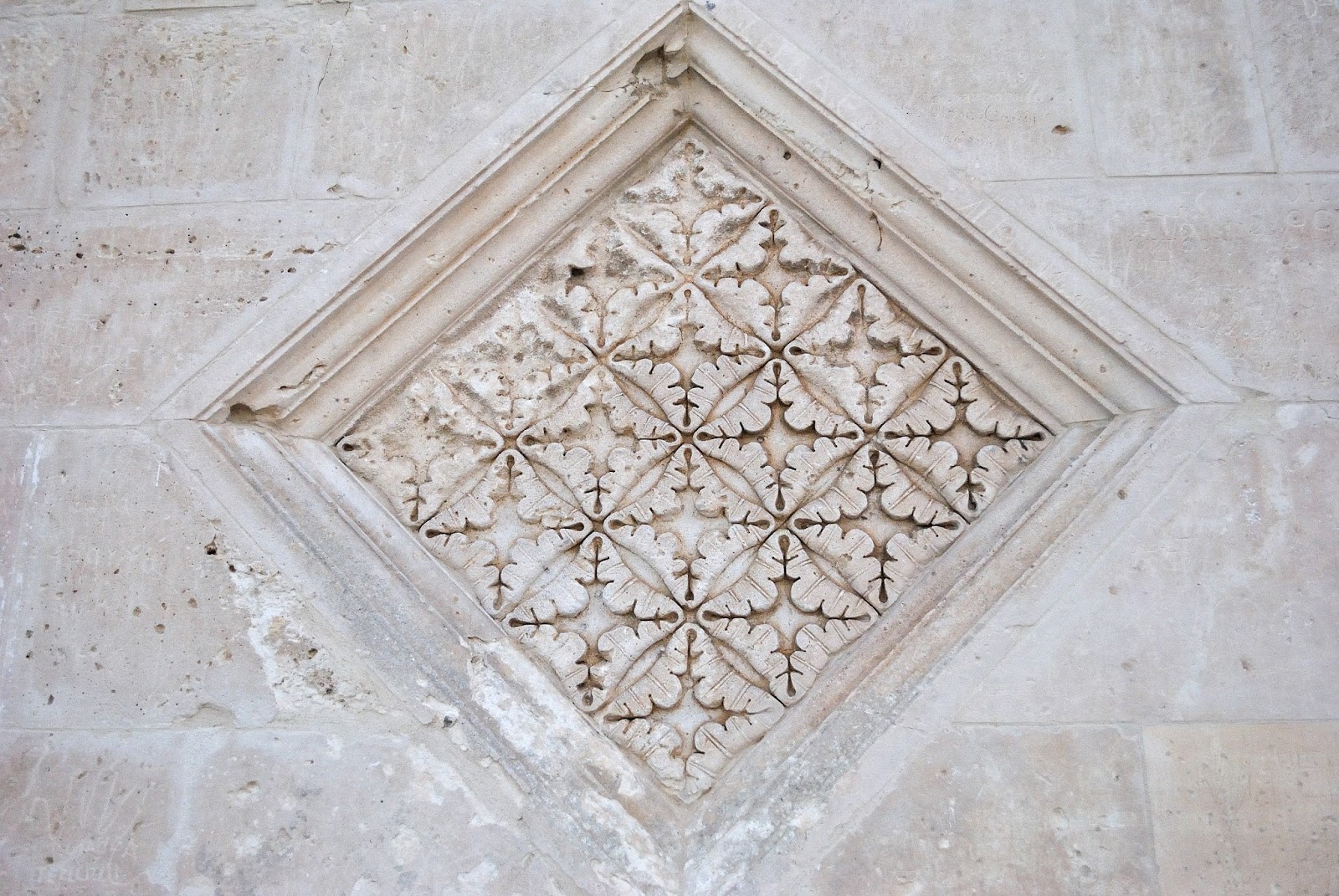
Then, the lozenges, a motif which occur all around the church.


Lozenges symbolize female fertility.

According to the Dean Liprini's book, pathways of the sun (pp. 34), in Christian art lozenge symbolizes the Virgin Mary.

John North states in his book Stonehenge (pp. 504) "The lozenge is a symbol commonly found, from Ireland to Persia and beyond".

Actually, the oldest lozenge representation is the one discovered in South Africa at the Blomblos cave which dates back to 70.000 years ago


One of the lozenges on the exterior wall of the basilica contains a Templar cross.


Templars, Teutonic knights  and other crusade orders choose Apulia to settle down before departing for the holy land. 

Nevertheless, if you are interested in finding out more about the Teutonic Order, then, you definitely must visit the San Leonardo abbey, few miles from Siponto, located between Manfredonia and Foggia.

San Leonardo is another story, though.

And I'm just realising that I should soon write something about it, because it's just so worth to be narrated.

Ciao

Wednesday, 11 February 2015

The Daunians and opium

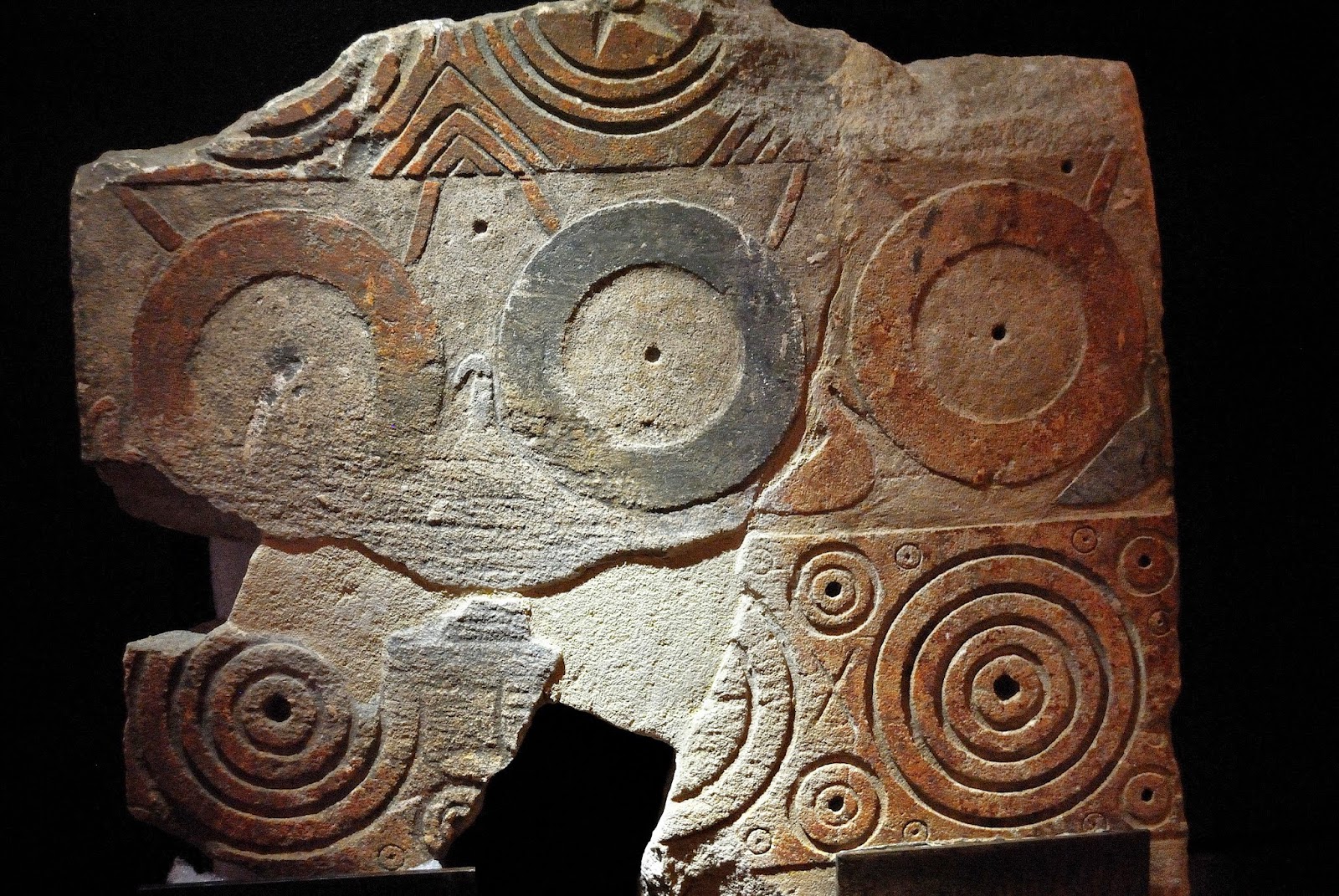
The castle of Manfredonia hosts the permanent exhibition of the Daunian stele (VIII – VI century BC).


The Daunian stele are so intriguing because they unveil the culture, the ordinary life of the Daunians living 2700 years ago.


The stele have been found during the ‘60ies around Manfredonia.


Silvio Ferri, archaeologist and member of Accademia Nazionale dei Lincei, undertook the challenge of deciphering the stele.


He got involved thanks to Matteo Sansone, a chemist from Mattinata, who first realized the importance of such stele.


Silvio Ferri had figured out that the stele were conceived for funerary purposes.

From my point of view, one of the most original interpretation of stele is given by Maria Laura Leone, researcher and founder in 2001 of artepreistorica.com.

Some of the stele are polychrome, like the one below: red and black.


Such Stele can be divided in male and female ones.


The male ones are more simple as they describe males hunting or fighting.


The female stele are pretty sophisticated as they illustrate man sailing or fishing; women talking, or on procession, or even carrying out magic-therapeutic rituals.


A recurring element portrayed in female stele is opium, (papaver somniferum).


According to deamuseum “The earliest reference to opium growth and use is in 3.400 BC. When the opium poppy was cultivated in lower Mesopotamia. The Sumerians referred to it as Hul Gil “the joy plant”.


Opiates reports that Galen lists its medical indications, noting how opium "...resists poison and venomous bites, cures chronic headache, vertigo, deafness, epilepsy, apoplexy, dimness of sight, loss of voice, asthma, coughs of all kinds, spitting of blood, tightness of breath, colic, the lilac poison, jaundice, hardness of the spleen stone, urinary complaints, fever, dropsies, leprosies, the trouble to which women are subject, melancholy and all pestilences."

Daunians used opium for both shamanic and therapeutic purposes.


Therefore, the thesis of stele as funerary objects evaporates, if you consider that:
  • just few stele have been found nearby Daunian tombs.  
  • the surrounding of Daunian tombs have not returned a significant number of stele.
  • the number of women stele overwhelm the male ones.
According to Maria Laura Leone, the stele reveal the Daunian pantheon.

Therefore, her thesis seems to me much more realistic.


Please click here, should you wish to view more pics


Wednesday, 7 January 2015

Frederick II the Swabian, puer Apuliae...


“At that time died Frederick, the greatest among the Princes on earth, stupor mundi and wonderful innovator”.


This is the Matteo da Parigi's quote reported on the above monument donated by German turists, who visited Castelfiorentino (Foggia). 

Castelfiorentino is the place where Frederick passed away.

It is located in north of Apulia, close to Torremaggiore (Foggia).


Nowdays, Castelfiorentino does not exist anymore.

Are left just the ruins of what once was a catle, one of the hundreds built up by the Swabian in the South of Italy.


Frederick was born in Jesi (Marche) the 26th of December 1194. 

He was defined puer Apuliae (Apulian boy) though.


Frederick spoke six languages: Latin, Arabic, Sicilian. German, French and Greek.


He grew up in Palermo, a city in which he got familiar with several cultures.

At that time, the Pope declared war to the Muslims who lived on the Holy land.


Crusade after crusade, the Vatican had in its hands the destiny of the European kingdoms.


Nevertheless, Frederick went to Jerusalem not before having dealt peaceful  agreemends with the Al-Malik Al-Kamil.
Sultan of Jerusalem


Friederick married one of his daughter.

Frederick had four spouses, however, Bianca Lancia was his favourite.


Bianca Lancia gave birth to Manfredi, who actually became his successor.

Frederick II died the 13th of December 1250.


Manfredi, his son, will rule for few more years.


The Swabians will be wiped out by the Pope, who will then impose its power over the South of Italy through the Angevins, French. 

The Holy Inquisition was ready to begin its bloody job in Europe.


Medieval festivals are held in Apulian cities such as Altamura, Manfredonia, Brindisi, Oria, Lucera to remember the Swabian.

Stupor mundi will never be forgotten by Apulians.


Tuesday, 21 October 2014

The Apulian guitar of “Spaghetti western”

In 1964, the audience of the Sergio Leone's for a fistful of dollars heard something original: the electric guitar.


For a fistful of dollars was a low budget movie of the so-called dollars trilogy.

The innovation introduced to the western movies is due to the maestro Ennio Morricone and to the guitar player Pino Rucher.

Pino Rucher was a talented guitarist.

He was born in Manfredonia, Apulia.

In 1933, his father, back from the States, presented a guitar to Pino.

Between 1943 and ’46, Pino Rucher joined several Allied Army orchestras which held concerts in Manfredonia and all around Apulia.


Therefore, he had chance to get familiar with jazz, improving a lot as musician.

Pino was a permanent musician of the Angelini band.

Additionally, he played guitar for so many editions of Sanremo festivals.

However, in this article I am going to write about the Pino Rucher’s contribution to the cinema.


He played guitar for soundtracks of the Italian cinema from the late 50ies till mid 70ies.


He worked with orchestra conductors such as: Nino RotaEnnio Morricone, Riz Ortolani and Luis Enriquez Bacalov


He worked for more than 200 movies.

Let me just point out those movies which for me are the most representative of the Italian cinema of those years: La Grande Guerra,  Otto e mezzo and Il boom