Showing posts with label altamura. Show all posts

Wednesday, 27 March 2019

Torna l'opera al teatro Mercadante di Altamura

"Il barbiere di Siviglia" opera buffa del maestro Gioacchino Rossini, è andata in scena sabato 23 marzo al teatro Mercadante di Altamura.


Non l'avevo mai vista prima. Perciò, quale migliore occasione per chi come me si è affacciato tardi sul mondo magico dell'opera e del teatro tout court?

Pertanto, sabato mattina mi reco al box office: si è prossimi al sold-out! Fortuna che Silvano ed il suo gentile staff trovano due posti tra i palchi.

Certo, bisogna riconoscere gli sforzi sostenuti dall'amministratore del teatro Vito Barozzi per portare ad Altamura un opera così importante, che coinvolge numerosi attori e l'orchestra sinfonica della città di Bari.

Consultando le cronache storiche, la prima rossiniana de "Il barbiere di Siviglia" andò in scena il 20 febbraio 1816, con notevoli polemiche e stroncature nette.
Replicata il giorno dopo, incontrò invece il successo del pubblico. Misteri del successo!

"Il barbiere di Siviglia" è oggi una delle opere più eseguite al mondo.

foto tratta dal profilo Fb del teatro Mercadante

L'opera dura fino a mezzanotte, intervallata da due pause (atti).

In una di queste ne approfittiamo per uscire, io e mia moglie, dal teatro. 

Passeggiamo un po' all'aria fresca.

Tornando, ci imbattiamo nella hall in un banchetto che vende le maglie dell'opera in corso. 

Un po' di sano merchandising non fa mai male, anche perchè non dimentichiamo che siamo in una delle città più dinamiche della Puglia, con un tessuto produttivo ed una classe imprenditoriale di primo ordine, dove ho riscontrato personalmente una grande attitudine all'ascolto nei confronti di chi propone idee e soluzioni innovative.

Ecco devo confessare che mi sento un po' a casa al teatro Mercadante, e sono convinto che questa è la sensazione che avvertono tanti di coloro i quali frequentano questo tempio della cultura.

"Figaro qua, figaro la..."


Monday, 24 December 2018

Rassegna di cabaret "47 corto che parla"


La rassegna di cabaret "47 corto che parla" è una rassegna nazionale giunta alla 16° edizione, la 5° al "Mercadante" di Altamura.


La serata è stata introdotta ed allietata da Silvano Picerno (direttore artistico del festival) e Franco Laico.


Il duo Picerno-Laico ha divertito non poco il pubblico, anche oggi convenuto numeroso.


Le battute e gli sfottò in salsa gravinese-altamurana sono stati a tratti esilaranti.

"Sai come si chiama il tanga a Gravina? U spaccaloffije".

Quando mi torna in mente ci sto ancora a ridere.  

Il Programma presentava un bel trittico di comici appuli: Tommy Terrafino, Antonello Vannucci e Filippo Totaro.


A me son piaciuti molto Vannucci e Terrafino.

Il primo, con una narrazione musicata di una certa Bari, quella delle periferie (il quartiere "Libertà" od il "San Paolo", tra quelli menzionati dall'artista), restituisce al pubblico il lato disumano di chi è costretto a campare in quartieri difficili, magari con pochi servizi e con scarsi collegamenti al resto della città.


E dire che l'attuale governo ha usato i fondi destinati alle periferie per ben altri scopi.


Anche Terrafino ha contagiato il pubblico con la  sua satira verso l'integralismo vegano della sua presunta moglie. 


Per la serie "onore al caciocavallo", come vidi una volta scritto sui muri di Ascoli Satriano, sui Monti Dauni.

La performance di Totaro, invece, non mi ha entusiasmato, facevo fatica a seguirlo.


Un ultimo pensiero desidero rivolgerlo a chi non riesce più a disconnettersi dal web, neanche nel buio del teatro, distraendo pertanto chi come me era seduto nei palchi.


Auguri a tutti di sereno Natale e prospero 2019.

La traviata

"Almeno una volta nella vita bisogna vederla La Traviata..."


Così afferma mia moglie mentre usciamo dal teatro Mercadante di Altamura, ieri 12 dicembre, a mezzanotte.


Certo, è opportuno di tanto in tanto violare orari e consuetudini visto che era un giorno infrasettimanale.


E così sembrano aver pensato in tanti, visti i palchi e la platea gremiti, convenuti a far esperienza di quella magìa che solo il teatro può regalare: l'unicità dell'evento.

Infatti La Traviata sarà pure stata replicata innumerevoli volte nel mondo (in Italiano, la lingua dell'Opera!) ma ogni volta resterà unica.


Dopo l'uscita ci siam fermati presso una vicina pizzeria.
Fanno lo stesso tre dei valenti musicisti dell'orchestra Apulia che hanno musicato l'opera sotto la poderosa direzione del Maestro Antonello Ciccone.

"Complimenti" dico loro.

"Il teatro è molto bello" rispondono.

Imbocchiamo il Corso di Altamura, illuminato a festa.
Nessuno è in giro, se non qualcuno che come noi ha vissuto l'evento.

Ieri abbiamo donato questa esperienza ad una nostra cugina che non aveva mai visto l'Opera.
Era raggiante.


Ebbene non regalate inutili oggetti di cui le vostre case son zeppe ai vostri cari. Piuttosto accompagnateli a vivere un esperienza di questo tipo, forte, coinvolgente, emozionante.
Vi serberà nel cuore per tutta la vita in quanto avrete loro aperto le porte verso un'altra dimensione. 

Gli attori son stati tutti molto bravi, in particolare la protagonista "Violetta" (Aishan Mamedova), "Alfredo" (Sayan Tsympilov) ed il "padre di Alfredo" (Roy Espinoza).

All'uscita dal teatro surprise! 
I protagonisti dell'Opera sono usciti ed hanno atteso il pubblico per ringraziarlo.

Fantastico!


Gli attori di teatro non diventeranno mai ricchi.


Gli attori di teatro fanno questo mestiere per quei cinque minuti di applausi che eventualmente il pubblico, se ci sarà, donerà loro.


Sunday, 26 November 2017

Chi tene 'o mare...al teatro Mercadante

Chi tene 'o mare è fess e cuntend, chi tene 'o mare ossaje, nun tene niend.

Così recita una delle più poetiche canzoni di Pino Daniele, ieri sera reinterpretata dalla sempre verde Teresa De Sio nel suo show "Teresa canta Pino", al teatro Mercadante di Altamura, capitale della Murgia pugliese.


Un'esplosione di energia lo show della De Sio, accompagnata dai suoi brillanti musicisti tra cui l'esuberante violinista H.e.r.

Anche i più scettici convenuti ieri sera, a fine concerto avrebbero forse voluto alzarsi in piedi, saltare ed abbracciare i propri vicini, tanto era il calore, la sana pazzìa che arrivava dal palcoscenico.


"Voi la conoscete la parlèsia? 
La parlèsia è un codice parlato esclusivamente dai musicisti napoletani, un linguaggio usato per non farsi intendere dagli altri.


Vi dedico pertanto una canzone che ho scritto in memoria di Pino intitolata 'o jammone, che in parlèsia significa capo".


Teresa è impegnata da tempo nel progetto culturale di recupero e valorizzazione della cultura musicale del Sud. 


Penso al film documentario Craj girato nel 2005, concepito come un viaggio per la Puglia alla scoperta degli ultimi cantori quali Matteo Salvatore, Antonio Maccarone ed Uccio Aloisi.


Questa volta però Teresa ha inteso riportare a galla della nostra fugace memoria il suo concittadino Pino Daniele, cantautore napoletano e musicista italiano tra i più apprezzati all'estero.


Pino Daniele, e chi se li dimentica i suoi pezzi? Vivono sottopelle di chi li ha amati.

Io ho avuto la fortuna di assistere ad un concerto di Pino, a Torino, quando ero uno studente universitario. Quanti ricordi...

Ieri sera mi salivano le lacrime agli occhi quando ascoltavo Quanne chioveChi tene 'o mare...

...Napule è poi è qualcosa di più di una canzone: è una preghiera, una invocazione.


Chi non ha mai cantato con gli amici Je so pazz? La rivolta, il senso di ribellione verso uno Stato che ha spesso tradito il sud, costringendo con la repressione e la fame milioni di concittadini ad emigrare all'estero. Un po' quello che sta succedendo oggi, in tutta Italia questa volta.

Pino Daniele portò una ventata di aria fresca nella musica italiana. 

Apprezzato molto all'esteso, vanta collaborazioni importanti come Pat Metheny, Eric Clapton, Chick Corea e tanti altri.


4 giorni prima che morisse, lo vidi in tv esibirsi per la Rai, di notte, alla vigilia di capodanno. 

Lo vidi teso, contratto. 

Dissi a mia madre: "Pino Daniele non mi sembra stia bene". Morì il 4 gennaio 2015.

Lui soffriva di cuore, triste destino in comune con Massimo Troisi. 

Ciao Pino, ti porto nel cuore.

Wednesday, 28 September 2016

A wine opened my mind

Have you ever had the feeling of travelling with your mind by drinking a glass of red wine?


Yesterday night, I came back in Apulia after a couple of days in Florence, where I have been at Galleria degli Uffizi contemplating Caravaggio, Piero della Fracesca, Botticelli, Tiziano, Giotto, Mantegna et cetera.

It was 11 o'clock pm, we didn't have dinner yet, so I asked Lucia "Would you fancy pasta alio, olio and peperoncino"?

"Yes, sure" she replies. I'm a lucky man, I know.

I start cooking, meantime, I open a bottle of Elce Primitivo of Poderi delle Mura, run by Vito Calia and his bride.


After having drunk the first glass, I could not refrain from sending a message to Vito "Ciao Vito, sono tornato stasera da Firenze. Ho letto la tua mail ed ho subito colto il tuo invito aprendo una delle bottiglie generosamente donatemi: il tuo vino apre la mente. Il gusto, il sapore dischiudono orizzonti inesplorati. Complimenti!"

The problem you may encounter when drinking such a wine is that you would drink the entire bottle. 

Fortunately, Lucia, my wife, calls me from the bed "come to sleep. It's late". So, it came that I drink just half bottle of this fruit juice.

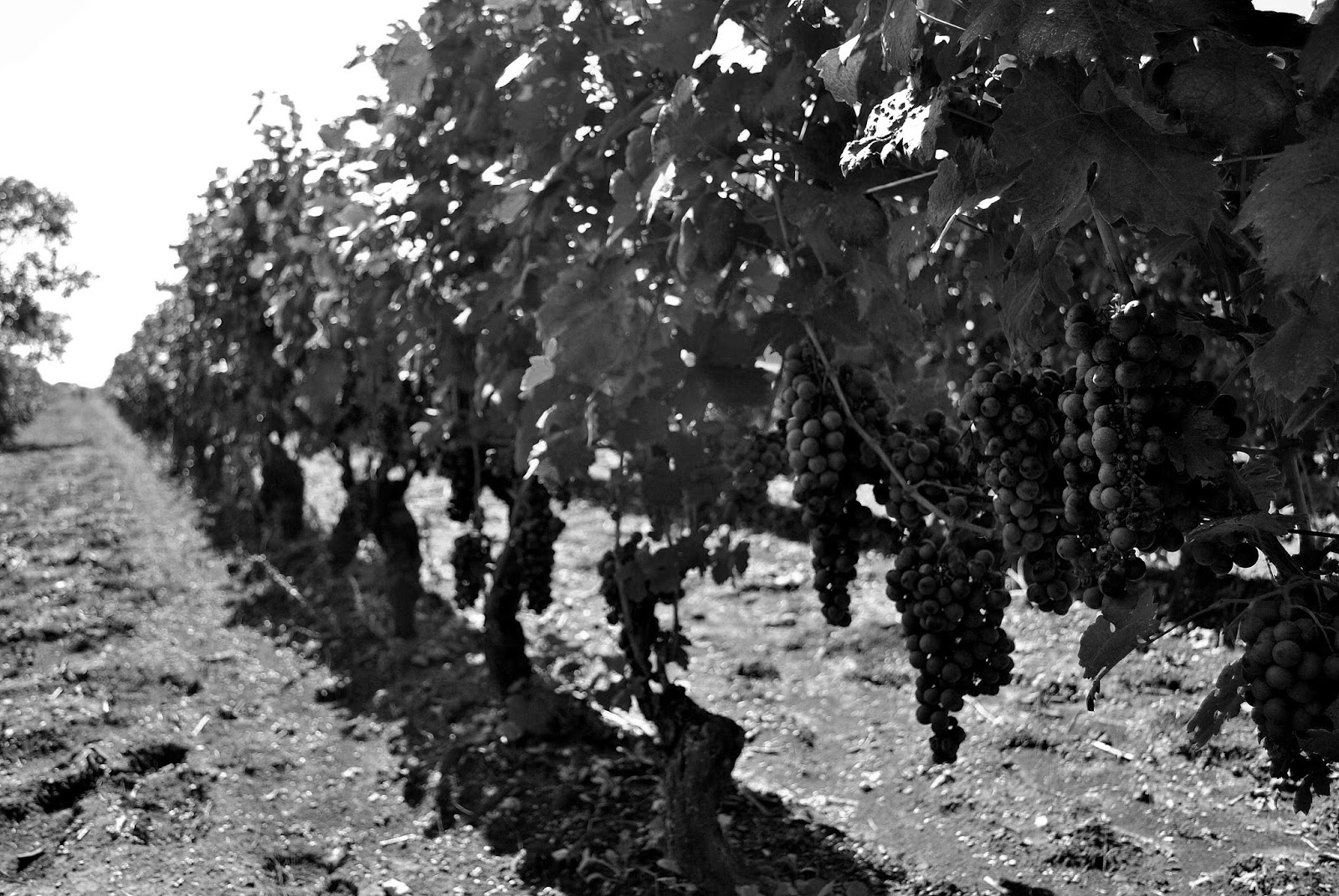
Vito owns a vineyard of just three hectares in Altamura and produce a ruby red Primitivo wine and a White Elce wine (70% Malvasia).


I interviewed Vito a week ago. 


I was so curious to know the story behind this wine as it seems that Vito is the only wine maker in Altamura who has decided to promote his wine. Indeed, he's only goal is quality, quality and again quality.

He picks me up at 12.

"Hi Vito, nice to meet you" I say. 

"Ciao Antonio, please, get in" he replies.

We head straight to the Vito's vineyard, located at contrada Parisi, Altamura.

"I inherited this vineyard from my dad who died in 2003. I wine-make since I was a kid. I didn't go on holidays in summer because I had to help my dad to look after the vineyard" he says.


He continues "When I grew up, my main job was as estate agent, which I've carried out for 18 years. Then, in 2013, the crisis arrived. I blessed that crisis because finally my wife and I took the decision to became professional winemaker, focusing just on our wines."

I listen to Vito and I realise how genuine he is.

What probably strikes me more is the passion that his words emanate.

He tells me that this year he has decided to make his wine stronger (15% alcohol instead of the past 14%) by sacrificing some quantity and delaying the harvest at the end of September.


Ladybirds seem appreciating it. 


"Looking after my vineyard means also defend it from diseases such as peronospora (late blight), which may take place especially in May and June. You know, I plant a rose at the head of each row. Roses work like sentinels when peronospora occurs, because they get sick first, so I'd have the time needed to intervene" Vito adds.


"I'm for a clean agriculture" Vito declares. 

"It's seven years that I don't use anymore copper sulphate (vitriol) because I don't want metal flooding the soil" He says.

I invite you to try his wine.

It won't let you down. Guaranteed.


Monday, 29 August 2016

Re-discovering Via Appia

Via Appia is the Roman road which links Roma caput mundi with Brindisi door to the Orient.


Built up between 4th and 3rd century BC, via Appia went down in history as regina viarum.

The extension of via Appia came along with the Roman military expansion. 

533 kilometres long, the road is covered of smooth volcanic stones (basoli). Cambered in the middle to let the water run off, it was built with ditches on both sides, protected by retaining walls.  


The map shows Via Appia (white), which main places were Capua, Beneventum, Silvium (Gravina in Puglia) and Tarentum


A couple of months ago, Feltrinelli has published Appia by Paolo Rumiz. 

This book is the result of a long walk undertaken by Paolo Rumiz and his companions (Riccardo, Alessandro and Irene) who have covered via Appia on foot.

Italy has an immense cultural and archaeological heritage, it's so huge that the Italian institutions seem not always able to preserve it.

As result of this, Philippe Daverio has urged the world to get involved in assisting Italy to save its immense cultural heritage.

Indeed, he has promoted years ago the project Save Italy, stating that the Italian cultural heritage belongs to the whole western world, not just to Italy.

According to enhancemyvocabulary.com, 60% of English words have Latin roots.

As occurred to via Appia, Italy has deliberately sold off its cultural heritage to private interests, linked mainly to property investment.

Antonio Cederna was the first to defend via Appia against politicians, speculators, architects and functionaries implicated in the via Appia plunder.


On 8th Septemebre 1953, Il Mondo published the Antonio Cederna's j'accuse "Via Appia should have been religiously saved because for centuries talented men from all around the world have loved, described, painted, sung it […] Via Appia should have been saved like the Acropolis of Athens".

On 25 August 2016, Masseria Jesce (Altamura), a fantastic masseria which was once a roadhouse of via Appia, has hosted Paolo Rumiz and the filmmaker Alessandro Scillitani to discuss about their trip discovering and mapping Via Appia.


"A journey like this, made on foot, gives you the feeling that the space turns expanded, deep". Paolo Rumiz begins.


"By living a sedentary life, we do not cultivate the skill of reading the body language of people we encounter. Talking about this journey, when we came across the locals, they first looked at us suspiciously, then turned calmed, finally they became interested in what we were doing". He continues. 


"The best moment to undertake a long walk is when your head and hearth is full, when you have had enough" In other words, walking is therapeutical, and I fully agree with Paolo Rumiz.

He says "During a meeting in Matera, someone said that this journey had a strong political implication, in the sense that it shifts the barycenter to the South of Italy". 

"Via Appia is unique. It makes sense to walk from Rome to Brindisi and vice versa. In other words, the Roman legions came down to Brindisi as well as in the Middle-age the crusades walked along via Appia to reach Brindisi and departing for the Holy land. On the other hand, Catholicism arrived in Rome from the South."

"We have met so many peasants. It was great to talk with them. I remember one of them in Gravina in Puglia. He thought we were grave robbers. "Here the soil conceals so many graves ascribable to Silvium times" he justified himself". Paolo says.

"The South requires a new narration, free of stereotypes. It must be done also because of the current historical and geopolitical situation". 


Alessandro has made a documentary from this journey.


"It took us 30 days to cover via Appia. I was struck by the sound of dialects, by random encounters, by the beauty of the landscape. I have filmed the communities we came across" Alessandro says. 

The talk goes on till midnight.

Outside is dark, and a fresh air grabs our senses.

We are invited to visit the crypt of masseria Jesce, adorned by frescos which echo the Byzantine ones.

In this awesome scenario, a musician duo is going to play music to entertain the audience.

They are Massimiliano Di Carlo&Veronika Otto, respectively from Ascoli Piceno and Berlin.


Their mission is discovering songs from old people and propose them to their audience.

Massimiliano begins singing a Mongolian song, made by just one note. It's an ancestral sound.

Then, they offer us a fantastic tammurriata, explaining us its cultural roots. Just to clarify, tammurriata is the Neapolitan version of  tarantella, "a sound brought by ancient Greeks in the south of Italy. It spread till Ancona, though" Massimiliano points out.

Finally, the duo offer us a typical song called Saltarello, a kind of tarantella typical of center Italy.

After their fantastic performance, I get closer to Massimiliano and ask his name "you know, I write a blog and I'd like to mention you guys because you really do a great job".

While talking with Massimiliano, Paolo Rumiz gets closer and listen to us.

"Of course, I will write about Paolo Rumiz and his great book either" I say.

Paolo Rumiz replays "Well, Massimiliano needs to be reported more than me".

I answer: "Well, I need it too".

Both of them burst laughing. I laugh too.

It's 1 o'clock. Outside it's getting cold but the fire burns inside me.

Tonight I have had great time and learned a lot.


Tuesday, 26 April 2016

Altamura, "Federicus" and Philippe Daverio

On 23rd, 24th and 25th April, Altamura hosts the 5th edition of "Federicus", a Medieval festival dedicated to Frederick II the Swabian.


So, Altamura pays tribute to the king who actually has rebuilt the town, as reported in the banner of the municipality (Federicus me reparavit).


In my opinion, the main goal scored through this festival is having the community more aware of her own roots.

Rediscovering our roots make us more aware of our identity. 

Identity is an awkward topic, in a globalized world, with millions of human beings leaving their own country to move either to Europe or America.

The leit motif of the ongoing festival is superstition.

Therefore, a panel of eminent guests were invited on 20th April to debate about it at the Mercadante theater: Rosanna Galantucci, Giacinto Forte, Francesca Ferrulli, Philippe Daverio, Alessandro Amapani and Fabrizio Vona.


Among them, there is Philippe Daverio (pictured), very popular in Italy thanks to his personal way to communicate art: smart and never pedantic. 


Additionally, he has presented for years passepartout, a successful television program broadcasted by RAI.

Once on stage, Philippe, surrounded by flags red and white, colours which symbolize the Municipality of Altamura, turn to the Mayor and ask him: "what do red and white mean? Do they represent the compromesso storico?"

Coming back to Frederick II, Philippe Daverio says "according to Le Goff, in the 13th century, beside the two powers represented by army and church, a third category called scriptorium (intellectuals) took place in France and quickly spread all around Europe".


"This represents a turning point which Frederick II acknowledges immediately, and applies it to his own kingdom". 

He continues "However, if the South of Italy has remained stuck to agriculture, instead of developing towards the rising capitalism, that's the Swabian's fault".


He says "I wish to mention a brilliant book, Uncommon sense. According to the author, in the past there were two figures, prophets and philosophers. Ancient Greece has given the birth to philosophers, whom thinking has forged the European culture".


"During the Middle Age, Arabics were forward-thinking. Indeed, among them superstition was forbidden, whereas science and philosophy were incentivated. Just to make an example, zero was introduced to Europe by the Arabics." Philippe adds.

He says "Finally, when Frederick II realizes that his ascendence may not be enough to rule over the Arabics of Sicily, then he persecute them, either killing or deporting them to Lucera, in Apulia".

The conference goes on for a couple of hours.

I quit the theater with so many causes for reflection.

The festival reaches its climax on the 24th, though.

The locals feels very much responsible for the positive outcome of the historical reenactment.

The atmosphere is sparkling: musicians, jugglers, walkers-on, twirlers. 

There is everything which tourists may look for.


Finally, I strongly recommend you to experience Federicus next year.


Ps.
Click here, should you wish to view more pics