Showing posts with label swabian. Show all posts

Tuesday, 26 April 2016

Altamura, "Federicus" and Philippe Daverio

On 23rd, 24th and 25th April, Altamura hosts the 5th edition of "Federicus", a Medieval festival dedicated to Frederick II the Swabian.


So, Altamura pays tribute to the king who actually has rebuilt the town, as reported in the banner of the municipality (Federicus me reparavit).


In my opinion, the main goal scored through this festival is having the community more aware of her own roots.

Rediscovering our roots make us more aware of our identity. 

Identity is an awkward topic, in a globalized world, with millions of human beings leaving their own country to move either to Europe or America.

The leit motif of the ongoing festival is superstition.

Therefore, a panel of eminent guests were invited on 20th April to debate about it at the Mercadante theater: Rosanna Galantucci, Giacinto Forte, Francesca Ferrulli, Philippe Daverio, Alessandro Amapani and Fabrizio Vona.


Among them, there is Philippe Daverio (pictured), very popular in Italy thanks to his personal way to communicate art: smart and never pedantic. 


Additionally, he has presented for years passepartout, a successful television program broadcasted by RAI.

Once on stage, Philippe, surrounded by flags red and white, colours which symbolize the Municipality of Altamura, turn to the Mayor and ask him: "what do red and white mean? Do they represent the compromesso storico?"

Coming back to Frederick II, Philippe Daverio says "according to Le Goff, in the 13th century, beside the two powers represented by army and church, a third category called scriptorium (intellectuals) took place in France and quickly spread all around Europe".


"This represents a turning point which Frederick II acknowledges immediately, and applies it to his own kingdom". 

He continues "However, if the South of Italy has remained stuck to agriculture, instead of developing towards the rising capitalism, that's the Swabian's fault".


He says "I wish to mention a brilliant book, Uncommon sense. According to the author, in the past there were two figures, prophets and philosophers. Ancient Greece has given the birth to philosophers, whom thinking has forged the European culture".


"During the Middle Age, Arabics were forward-thinking. Indeed, among them superstition was forbidden, whereas science and philosophy were incentivated. Just to make an example, zero was introduced to Europe by the Arabics." Philippe adds.

He says "Finally, when Frederick II realizes that his ascendence may not be enough to rule over the Arabics of Sicily, then he persecute them, either killing or deporting them to Lucera, in Apulia".

The conference goes on for a couple of hours.

I quit the theater with so many causes for reflection.

The festival reaches its climax on the 24th, though.

The locals feels very much responsible for the positive outcome of the historical reenactment.

The atmosphere is sparkling: musicians, jugglers, walkers-on, twirlers. 

There is everything which tourists may look for.


Finally, I strongly recommend you to experience Federicus next year.


Ps.
Click here, should you wish to view more pics


Monday, 20 July 2015

The Mesagne's castle

Yesterday evening I took the opportunity to visit the Norman-Swabian castle of Mesagne.
Mesagne is just 10 km far from Brindisi.


So, I called the tourist information office of Mesagne (+39 0831 738898).

A professional lady answered my call advising that have been scheduled a tour at 8 pm, and a second one at 9.30.

Lucia and I choose the earlier one.

Such event is one of the hundreds which take place every Saturday night in Apulia (#pugliaopendays).

Culture is one of the key factor of Apulia’s appeal.

Tourists keep appreciating Apulia so much, that again this year it leads in terms of number of tourists hosted, followed by Tuscany and Sardinia.  

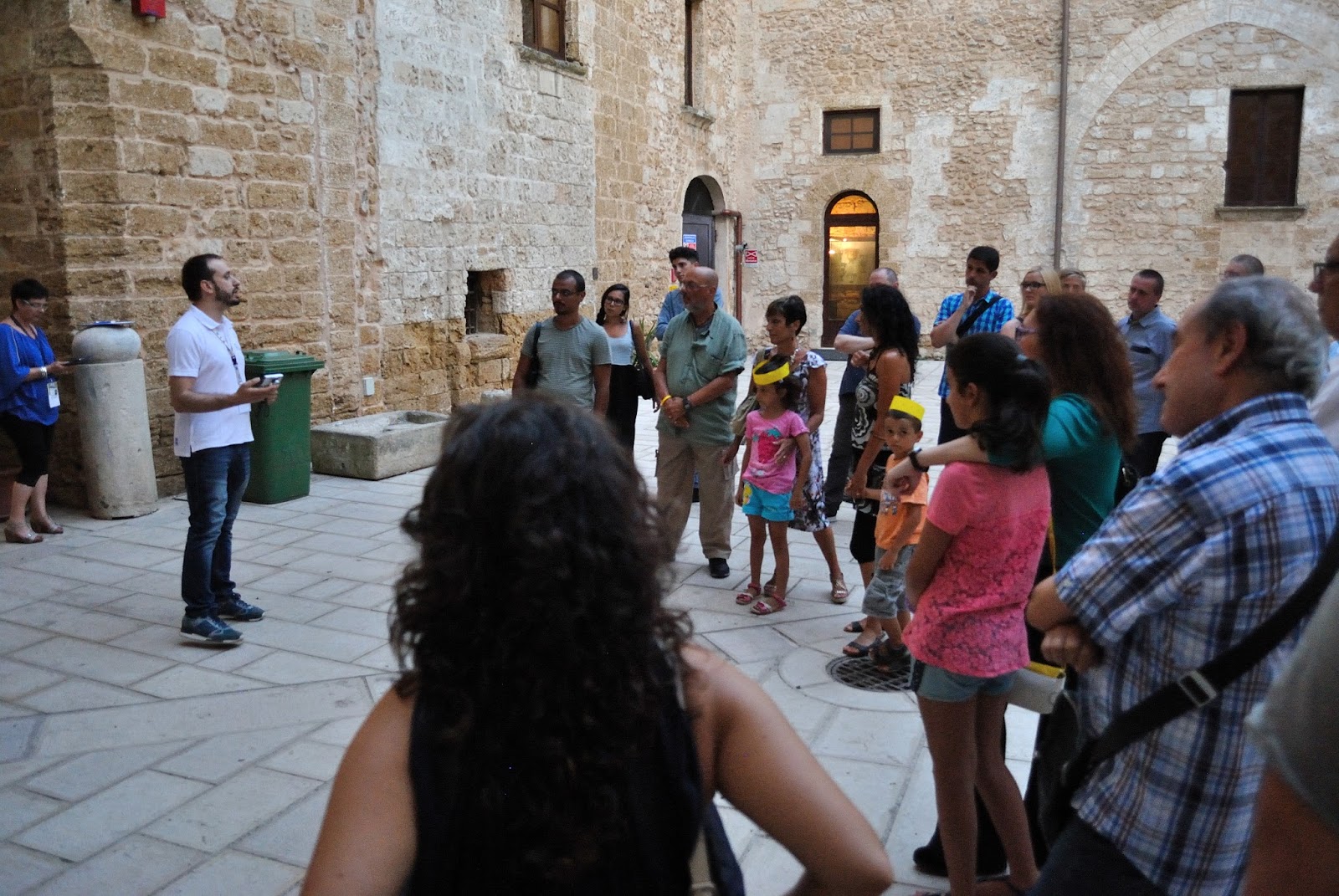
We arrive at the castle at 8.10, just in time to listen to the guide introducing the event.


We are around 25 people.


I notice two German families. There has always been a speciali feeling with Germans, a historical connection which linked Germany to Apulia and vice-versa.

In other words, we’ll never forget how important  have the Swabians (Frederick II and Manfred) been for Apulia and for the entire South of Italy.

The castle of Mesagne. According to documents which date back to 1060, there was a already a castrum  with military pourposes.

Then, the Swabians have developed it further.

Actually, the castle has been gradually modified till the 17th century.   


Lucas, our guide, is Argentinian “We are in the tower built up by Orsini Del Balzo in the 15th century. He was enormously rich”.


The guide continues “you see here a bathroom, which is quite unusual for that time. However, the oldest European bathroom is in Castel Del Monte (Apulia!), a Frederick II’s innovation taken by Arabs.


We continue our visit at ground floor. This immense room was till the 60ies the so called cinema Italia.


Then, we go downstairs to view the rooms where two kind of olive oils used to be stored: the alimentary oil and the lampante oil. The latest one was used as combustible, to enlight streets and rooms.

The lampante oil made the fortune of Salento.

The eruption of baroque in Salento corresponds to the economical boom of such oil.  

Indeed, Gallipoli was the port from which lampante oil departed for Instanbul and many other destinations.


We get back at ground floor to admire an amazing Messapian tomb.


This tomb was meant to bury just one person, whose we nowadays would call VIP.

The equipment discovered it is outstanding.


Few fantastic  kraters catch my eyes.


However, I’m astonished by seeing a crown of golden leaves, with a golden rose right in the middle. 


Amazing. I’ve never seen anything like this so far.

After having completed the tour in the castle, Lucas guides us to view the city centre of Mesagne.
This city center is very well preserved.

A pizzeria called Nedina, name of a Messapian queen, has a glass groundfloor which enable us to admire few more Messapian tombs.


We continue our tour till the St. Leonard’s church, which belonged to the Teutonic knights (Germans) since the 13th century.

While walking trough the San Cipriano quarter, I can’t believe to my eyes: a Fascist advise of 1929 which invite the guests of nearby brothel to avoid to piss outside, by the wall. 


It’s 10.30.

We begin to be hungry.

Therefore, after having exchanged smiles and said bye to the people met tonight, we stop at the first pizzeria, sit down and order pizza with a glass of Peroni beer.


Cheers.   

Wednesday, 7 January 2015

Frederick II the Swabian, puer Apuliae...


“At that time died Frederick, the greatest among the Princes on earth, stupor mundi and wonderful innovator”.


This is the Matteo da Parigi's quote reported on the above monument donated by German turists, who visited Castelfiorentino (Foggia). 

Castelfiorentino is the place where Frederick passed away.

It is located in north of Apulia, close to Torremaggiore (Foggia).


Nowdays, Castelfiorentino does not exist anymore.

Are left just the ruins of what once was a catle, one of the hundreds built up by the Swabian in the South of Italy.


Frederick was born in Jesi (Marche) the 26th of December 1194. 

He was defined puer Apuliae (Apulian boy) though.


Frederick spoke six languages: Latin, Arabic, Sicilian. German, French and Greek.


He grew up in Palermo, a city in which he got familiar with several cultures.

At that time, the Pope declared war to the Muslims who lived on the Holy land.


Crusade after crusade, the Vatican had in its hands the destiny of the European kingdoms.


Nevertheless, Frederick went to Jerusalem not before having dealt peaceful  agreemends with the Al-Malik Al-Kamil.
Sultan of Jerusalem


Friederick married one of his daughter.

Frederick had four spouses, however, Bianca Lancia was his favourite.


Bianca Lancia gave birth to Manfredi, who actually became his successor.

Frederick II died the 13th of December 1250.


Manfredi, his son, will rule for few more years.


The Swabians will be wiped out by the Pope, who will then impose its power over the South of Italy through the Angevins, French. 

The Holy Inquisition was ready to begin its bloody job in Europe.


Medieval festivals are held in Apulian cities such as Altamura, Manfredonia, Brindisi, Oria, Lucera to remember the Swabian.

Stupor mundi will never be forgotten by Apulians.


Tuesday, 23 September 2014

Lucera, an Arabic town of the Middle Age


Today I am going to narrate Lucera, a city in the province of Foggia.


Lucera, located on three hills, has always played a strategic role of door to the Tavoliere delle Puglie.

Archaeological excavations proved the fact that the area was inhabited since the 3rd millennium BC.


However, Lucera became very important under the Roman rule.


In 321 BC,  the Roman army while moving to Lucera to assist their allies, walked into an ambush and were defeated by the Samnites at the battle of Caudine Forks.


However, it is in the middle age that Lucera turns into something unique in the history of Europe: an Arabic city.

How did it happen?


Frederick II the Swabian, in order to tackle the Arabic uprisings in Sicily, transferred many of them to Lugêrah (as it was pronounced in Arabic).

The Swabian guaranteed them freedom of religion.

Luceria Saracinorum became a prosperous town.

Vito Salierno, who wrote I Musulmani in Puglia e Basilicata (ed. Lacaita, 2000), states that the Arabics living in Lucera were around 40.000.

The Arabics were great artisans. 

They used to work leather and Arabic-Sicilian ceramic. 


Additionally, they grew olive trees, durum wheat, barley, legumes and grapes. Muslims also kept bees for honey.


The Arabics became the most faithful fighters under the Swabians.

I am so fascinated by this story that once in Lucera, I investigate about the remains of the Arabic age. 

A gentle lady, who works for the tourist information helped me a lot on this.

I keep walking, following the indications.

First of all, I see the immense Swabian-Angevin fortress.

Inside, there is a small Arabic castle where Frederick II used to rest, surrounded by his court.


After having left the fortress, I head to what was supposed to be the Harem of Luceria Saracinorum.

Nowadays, it is a church.


The Mosque was located where now the cathedral is. 

The Angevins destroyed it.

Then, I see two Arabic towers, incorporated by newest buildings.


While quickly moving to the Archaeological Museum, I realize that many people in Lucera have Arabic features.

The Museum is rich of Daunian and Roman objects.

However, I am there mainly to view the exhibition related to the Arabic age.


When, I see them, I feel all the beauty and the richness of this land, where so many civilizations have left important proofs of themselves.

I begin talking with an enchanted visitor.“you know, once I found in Italy a golden ring and small statue” he confides to me. “I can not describe you what I felt when I found them” he adds.

He is an admirer of the Arabic art.

I get out the Museum with great thoughts.

I stop by a restaurant for a quick lunch. So, I decide to order a bottle of local Cacc’e Mmitte di Lucera.

A great red wine, with intense flavors.


This wine is made from Uva di Troia grape (35-60%), with the addition of Montepulciano, Sangiovese and Malvasia Nera, which collectively make up between 25-35% of the blend.

In terms of food, I have a wide range of healthy dishes, typical of the peasant cuisine.

Therefore, I go for cikatielle k’a rukele e k’i fenucchjette (homemade pasta with few fresh tomatoes, local rocket and a pinch of aromatic herb name finocchietto.

I finish this post not before having mentioned an immense Italian actor, Massimo Troisi.


He has shot the movie Le vie del Signore sono finite here in Lucera.


Ciao Massimo
R.I.P

Friday, 5 September 2014

Medieval armours, an Apulian job

The 28th of August, I attended a Medieval festival held in Manfredonia, north of Apulia.


I was there, taking pictures of a Saracen encampment within the Medieval castle of Manfredonia. 

By the way, the Saracens were tough fighters, faithful to Frederick II the Swabian. 

According to Vito Salierno author of I Musulmani in Puglia e in Basilicata (Ed. Laicata, 2000), Friederick II had relocated around 40.000 Saracens from Sicily to Lucera, north of Apulia.

Indeed, this Apulian town will turned its name to Luceria Saracinorum


Let's come back to the Medieval festival

I was captured by the archers who brilliantly showed their skills.


Meantime, I am told that outside the castle, it is going to be held a Medieval fight.

Therefore, I quickly move away, heading to the combat zone.

I really like to see fighters protected by armour battling each other.


In this circumstance, I have the opportunity to know Matteo Riccardi.

During the Medieval fight, Matteo covers the role of referee. I catch his eye as I sneakily try to gain the best position for taking pictures.

He tells me: “mind to not get hurt”, Then, he adds: “why don’t you come to visit me?”.

Matteo Riccardi is an artisan, who produces Medieval armours.


He inherits this passion from his father Michele, who started creating small armours for puppets of the Sicilian theater.

At the beginning, Matteo made armours for hobby, as his job was bricklayer.

However, he quit  his job in 1988. Since then, he dedicated all his energies to make armours. So, his hobby turned in a job.

The artisans represents the spine of the Italian manufacturing system.


“In the Middle age, the best armour makers were Italians, particularly the Missaglia’s family from Milan” Matteo says.


The Missaglia’s family exported their armours all around Europe. They competed against German armour makers located in Augusta and Nuremberg.

Matteo states that the armours were at that time a status symbol. 

Just noble and aristocrats could afford to buy it.


“Once a gay man asked me to make a chastity belt for man” he confides to me.

“So, I made it for him. 

However, I thanked him several times, because I sold almost 100 chastity belt like that”.


Matteo is currently setting up a show room, which is supposed to be ready in a couple of months.

He can not keep talking with me as he needs to complete an armour for a hourse. So, he apologizes and I apologize too.

So, before leaving, I offer him my support as English speaker for business purposes.

Ciao Matteo, see you soon 


Post Scriptum
If you wish to view more pics, please click here