
Yesterday evening I
took the opportunity to visit the Norman-Swabian castle of Mesagne.
Mesagne is just 10 km
far from Brindisi.
So, I called the tourist information office of Mesagne (+39 0831 738898).
A professional lady
answered my call advising that have been scheduled a tour at 8 pm, and a second
one at 9.30.
Lucia and I choose the
earlier one.
Such event is one of
the hundreds which take place every Saturday night in Apulia (#pugliaopendays).
Culture is one of the
key factor of Apulia’s appeal.
Tourists keep
appreciating Apulia so much, that again this year it leads in terms of number
of tourists hosted, followed by Tuscany and Sardinia.
We arrive at the
castle at 8.10, just in time to listen to the guide introducing the event.
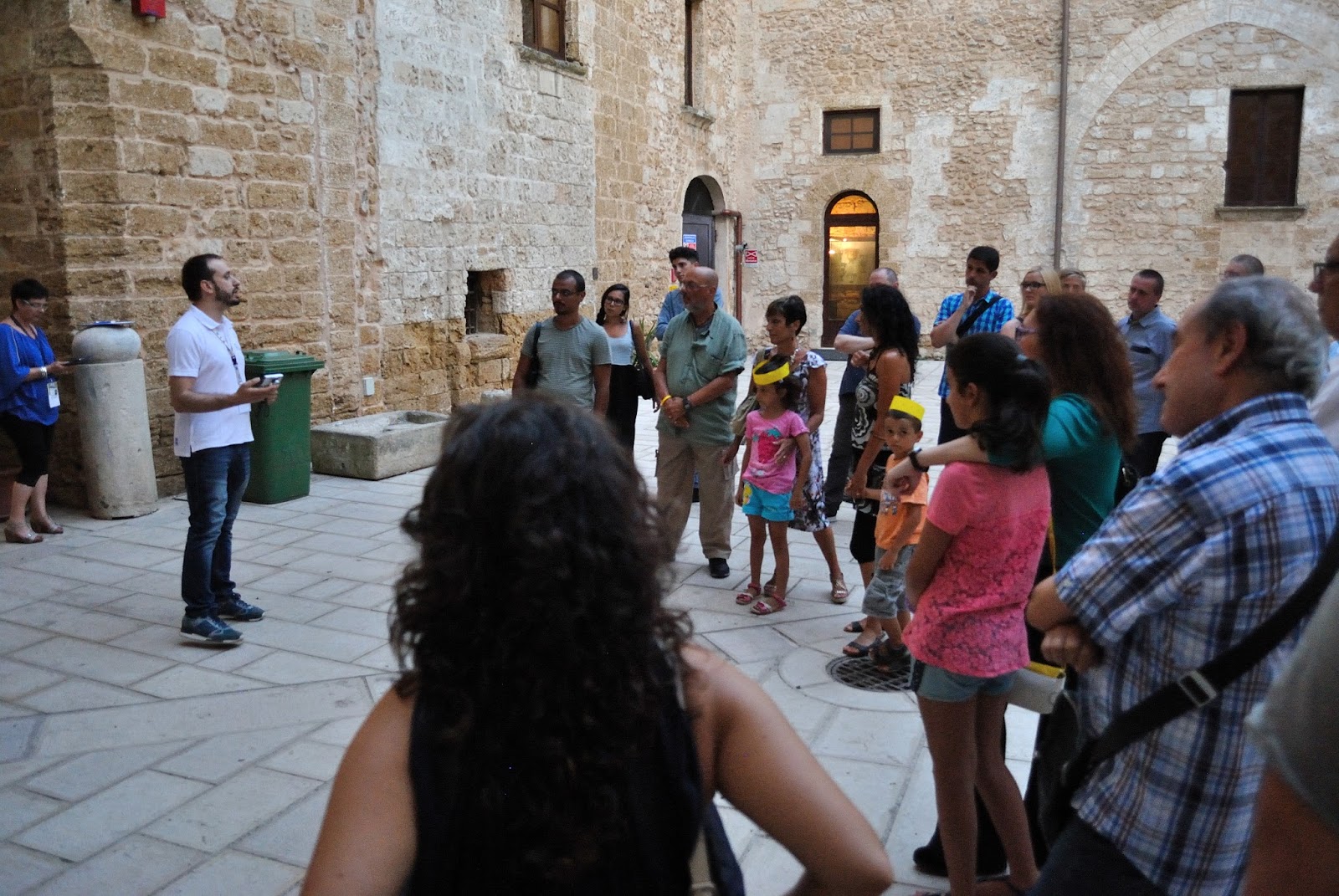
We are around 25
people.
I notice two German
families. There has always been a speciali feeling with Germans, a historical
connection which linked Germany to Apulia and vice-versa.
In other words, we’ll
never forget how important have the
Swabians (Frederick II and Manfred) been for Apulia and for the entire South of
Italy.
The castle of Mesagne.
According to documents which date back to 1060, there was a already a castrum with military pourposes.
Then, the Swabians
have developed it further.
Actually, the castle has
been gradually modified till the 17th century.

Lucas, our guide, is Argentinian “We are in the tower built up by Orsini Del Balzo in the 15th century. He was enormously rich”.

The guide continues “you
see here a bathroom, which is quite unusual for that time. However, the oldest
European bathroom is in Castel Del Monte (Apulia!), a Frederick II’s innovation
taken by Arabs.
We continue our visit
at ground floor. This immense room was till the 60ies the so called cinema Italia.

Then, we go downstairs to view the rooms where two kind of olive oils used to be stored: the alimentary oil and the lampante oil. The latest one was used as combustible, to enlight streets and rooms.
The lampante oil made the
fortune of Salento.
The eruption of
baroque in Salento corresponds to the economical boom of such oil.
Indeed, Gallipoli was
the port from which lampante
oil departed for Instanbul and many other destinations.

We get back at ground floor to admire an amazing Messapian tomb.
This tomb was meant to
bury just one person, whose we nowadays would call VIP.
The equipment
discovered it is outstanding.

Few fantastic kraters catch my eyes.

However, I’m
astonished by seeing a crown of golden leaves, with a golden rose right in the
middle.
Amazing. I’ve never seen anything like this so far.
After having completed
the tour in the castle, Lucas guides us to view the city centre of Mesagne.
This city center is
very well preserved.
A pizzeria called
Nedina, name of a Messapian queen, has a glass groundfloor which enable us to
admire few more Messapian tombs.

We continue our tour
till the St. Leonard’s church, which belonged to the Teutonic knights (Germans)
since the 13th century.
While walking trough
the San Cipriano quarter, I can’t believe to my eyes: a Fascist advise of 1929
which invite the guests of nearby brothel to avoid to piss outside, by the
wall.

It’s 10.30.
We begin to be hungry.
Therefore, after
having exchanged smiles and said bye to the people met tonight, we stop at the
first pizzeria, sit down and order pizza with a glass of Peroni beer.
Cheers.


