Showing posts with label Brindisi. Show all posts

Monday, 29 August 2016

Re-discovering Via Appia

Via Appia is the Roman road which links Roma caput mundi with Brindisi door to the Orient.


Built up between 4th and 3rd century BC, via Appia went down in history as regina viarum.

The extension of via Appia came along with the Roman military expansion. 

533 kilometres long, the road is covered of smooth volcanic stones (basoli). Cambered in the middle to let the water run off, it was built with ditches on both sides, protected by retaining walls.  


The map shows Via Appia (white), which main places were Capua, Beneventum, Silvium (Gravina in Puglia) and Tarentum


A couple of months ago, Feltrinelli has published Appia by Paolo Rumiz. 

This book is the result of a long walk undertaken by Paolo Rumiz and his companions (Riccardo, Alessandro and Irene) who have covered via Appia on foot.

Italy has an immense cultural and archaeological heritage, it's so huge that the Italian institutions seem not always able to preserve it.

As result of this, Philippe Daverio has urged the world to get involved in assisting Italy to save its immense cultural heritage.

Indeed, he has promoted years ago the project Save Italy, stating that the Italian cultural heritage belongs to the whole western world, not just to Italy.

According to enhancemyvocabulary.com, 60% of English words have Latin roots.

As occurred to via Appia, Italy has deliberately sold off its cultural heritage to private interests, linked mainly to property investment.

Antonio Cederna was the first to defend via Appia against politicians, speculators, architects and functionaries implicated in the via Appia plunder.


On 8th Septemebre 1953, Il Mondo published the Antonio Cederna's j'accuse "Via Appia should have been religiously saved because for centuries talented men from all around the world have loved, described, painted, sung it […] Via Appia should have been saved like the Acropolis of Athens".

On 25 August 2016, Masseria Jesce (Altamura), a fantastic masseria which was once a roadhouse of via Appia, has hosted Paolo Rumiz and the filmmaker Alessandro Scillitani to discuss about their trip discovering and mapping Via Appia.


"A journey like this, made on foot, gives you the feeling that the space turns expanded, deep". Paolo Rumiz begins.


"By living a sedentary life, we do not cultivate the skill of reading the body language of people we encounter. Talking about this journey, when we came across the locals, they first looked at us suspiciously, then turned calmed, finally they became interested in what we were doing". He continues. 


"The best moment to undertake a long walk is when your head and hearth is full, when you have had enough" In other words, walking is therapeutical, and I fully agree with Paolo Rumiz.

He says "During a meeting in Matera, someone said that this journey had a strong political implication, in the sense that it shifts the barycenter to the South of Italy". 

"Via Appia is unique. It makes sense to walk from Rome to Brindisi and vice versa. In other words, the Roman legions came down to Brindisi as well as in the Middle-age the crusades walked along via Appia to reach Brindisi and departing for the Holy land. On the other hand, Catholicism arrived in Rome from the South."

"We have met so many peasants. It was great to talk with them. I remember one of them in Gravina in Puglia. He thought we were grave robbers. "Here the soil conceals so many graves ascribable to Silvium times" he justified himself". Paolo says.

"The South requires a new narration, free of stereotypes. It must be done also because of the current historical and geopolitical situation". 


Alessandro has made a documentary from this journey.


"It took us 30 days to cover via Appia. I was struck by the sound of dialects, by random encounters, by the beauty of the landscape. I have filmed the communities we came across" Alessandro says. 

The talk goes on till midnight.

Outside is dark, and a fresh air grabs our senses.

We are invited to visit the crypt of masseria Jesce, adorned by frescos which echo the Byzantine ones.

In this awesome scenario, a musician duo is going to play music to entertain the audience.

They are Massimiliano Di Carlo&Veronika Otto, respectively from Ascoli Piceno and Berlin.


Their mission is discovering songs from old people and propose them to their audience.

Massimiliano begins singing a Mongolian song, made by just one note. It's an ancestral sound.

Then, they offer us a fantastic tammurriata, explaining us its cultural roots. Just to clarify, tammurriata is the Neapolitan version of  tarantella, "a sound brought by ancient Greeks in the south of Italy. It spread till Ancona, though" Massimiliano points out.

Finally, the duo offer us a typical song called Saltarello, a kind of tarantella typical of center Italy.

After their fantastic performance, I get closer to Massimiliano and ask his name "you know, I write a blog and I'd like to mention you guys because you really do a great job".

While talking with Massimiliano, Paolo Rumiz gets closer and listen to us.

"Of course, I will write about Paolo Rumiz and his great book either" I say.

Paolo Rumiz replays "Well, Massimiliano needs to be reported more than me".

I answer: "Well, I need it too".

Both of them burst laughing. I laugh too.

It's 1 o'clock. Outside it's getting cold but the fire burns inside me.

Tonight I have had great time and learned a lot.


Monday, 20 July 2015

The Mesagne's castle

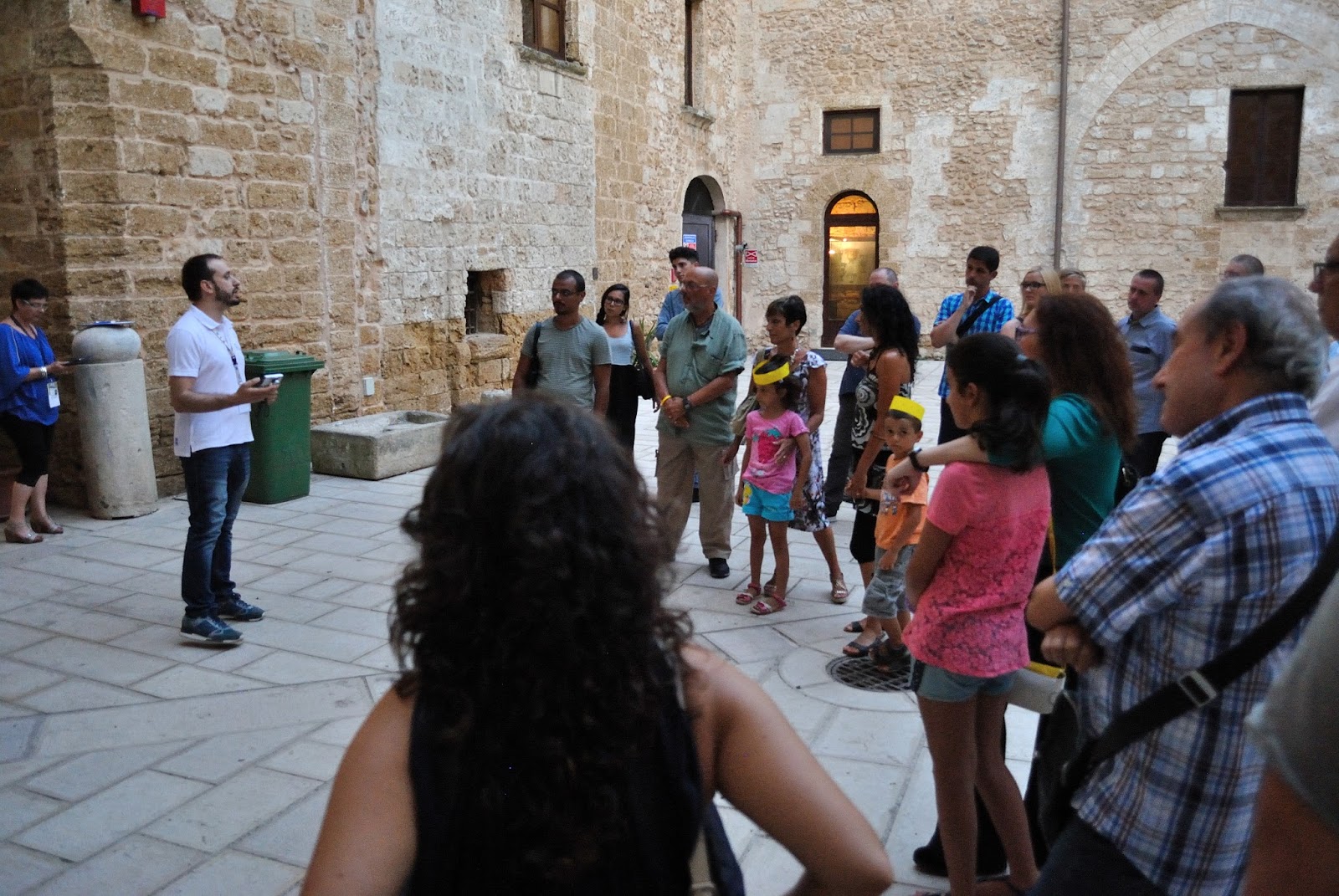
Yesterday evening I took the opportunity to visit the Norman-Swabian castle of Mesagne.
Mesagne is just 10 km far from Brindisi.


So, I called the tourist information office of Mesagne (+39 0831 738898).

A professional lady answered my call advising that have been scheduled a tour at 8 pm, and a second one at 9.30.

Lucia and I choose the earlier one.

Such event is one of the hundreds which take place every Saturday night in Apulia (#pugliaopendays).

Culture is one of the key factor of Apulia’s appeal.

Tourists keep appreciating Apulia so much, that again this year it leads in terms of number of tourists hosted, followed by Tuscany and Sardinia.  

We arrive at the castle at 8.10, just in time to listen to the guide introducing the event.


We are around 25 people.


I notice two German families. There has always been a speciali feeling with Germans, a historical connection which linked Germany to Apulia and vice-versa.

In other words, we’ll never forget how important  have the Swabians (Frederick II and Manfred) been for Apulia and for the entire South of Italy.

The castle of Mesagne. According to documents which date back to 1060, there was a already a castrum  with military pourposes.

Then, the Swabians have developed it further.

Actually, the castle has been gradually modified till the 17th century.   


Lucas, our guide, is Argentinian “We are in the tower built up by Orsini Del Balzo in the 15th century. He was enormously rich”.


The guide continues “you see here a bathroom, which is quite unusual for that time. However, the oldest European bathroom is in Castel Del Monte (Apulia!), a Frederick II’s innovation taken by Arabs.


We continue our visit at ground floor. This immense room was till the 60ies the so called cinema Italia.


Then, we go downstairs to view the rooms where two kind of olive oils used to be stored: the alimentary oil and the lampante oil. The latest one was used as combustible, to enlight streets and rooms.

The lampante oil made the fortune of Salento.

The eruption of baroque in Salento corresponds to the economical boom of such oil.  

Indeed, Gallipoli was the port from which lampante oil departed for Instanbul and many other destinations.


We get back at ground floor to admire an amazing Messapian tomb.


This tomb was meant to bury just one person, whose we nowadays would call VIP.

The equipment discovered it is outstanding.


Few fantastic  kraters catch my eyes.


However, I’m astonished by seeing a crown of golden leaves, with a golden rose right in the middle. 


Amazing. I’ve never seen anything like this so far.

After having completed the tour in the castle, Lucas guides us to view the city centre of Mesagne.
This city center is very well preserved.

A pizzeria called Nedina, name of a Messapian queen, has a glass groundfloor which enable us to admire few more Messapian tombs.


We continue our tour till the St. Leonard’s church, which belonged to the Teutonic knights (Germans) since the 13th century.

While walking trough the San Cipriano quarter, I can’t believe to my eyes: a Fascist advise of 1929 which invite the guests of nearby brothel to avoid to piss outside, by the wall. 


It’s 10.30.

We begin to be hungry.

Therefore, after having exchanged smiles and said bye to the people met tonight, we stop at the first pizzeria, sit down and order pizza with a glass of Peroni beer.


Cheers.   

Saturday, 27 June 2015

Migrants and Mediterranean, the Apulia's answer

The role of Apulia in helping and assisting the new immigrants from Africa is getting bigger and bigger.


The goal is to treat the migrants with humanity and respect.

The exodus has taken place since few years.

Migrants risk their life for a better future.

Sadly, In Italy as well as in Europe, the recent immigration is being tackled by far-right political parties such as Front National in France and Lega Nord in Italy.

Xenophobia and racism seems growing among people.

Therefore, citizens and associations in Brindisi (CobasANPILiberaEmergency...), have gathered together in order to give the birth to the Comitato Migranti e Mediterraneo.


The mission of such Comitato is to stay beside the migrants, giving them support.

There is an Apulian motto which says: come tratti vieni trattato. In other words, “what goes around comes around”.

It means that migrants can be a great resource or become a big problem.

If we treat them right we may expect something good from them.

The 13th of June, the Comitato has met up in San Vito dei Normanni, few miles from Brindisi.


The meeting has been held in the ex-Fadda.


Anna Chiara, spokesperson of the Comitato, says: “racism and xenophobia are inoculated into the national body through TV and newspapers “.

Davide, a Nigerian immigrant who lives in Ostuni, says: “I am a volunteer in the local old folk’s home. Sometime, I arrange with African friends gigs to entertain the local elderly. I have founded an association called Le Monde.


After having listened to Davide, I thought to myself: "Dear Davide, thank you very much".

He continues: “The problem is ignorance. It has happened to me to be called marocchino (Moroccon), even though I’m Nigerian”.

Giovanni, volunteer of Emergency, says that Italy had promulgated years ago a law, named  Bossi-Fini, which introduced the crime of illegal immigration (clandestinità).


The Bossi-Fini law was openly against the principles of International laws.

The Comitato Migranti e Mediterraneo has meet up again the 23rd of June in Tuturano, a small village close to Brindisi.


the meeting has been held in a villa confiscated years ago to Salvatore Buccarella, a local mafia boss.


The villa currently hosts Asylum seekers and Refugees.

Five Nigerian families have recently been given a flat.

They will be allowed to stay here for 6 or 12 months.

So, the migrants are involved in a project called SPRAR (Sistema di protezione per richiedenti asilo e rifugiati).

The European Union is financing such project to assist migrants on a short-medium term.   

Maurizio Guadalupi, chief of the cooperativa "Solidarietà e Rinnovamento",has invited the associations of Tuturano to join the Comitato in order to arrange a welcome party in honour of the African guests.


The party will be held on the 11th of July.

Red wine, frise and melonata will be offered to those who will attend it.

So, you all are very welcome to join us.


PS.
Please click here, should you wish to view a reportage on the migrants hosted in Taranto


Sunday, 26 April 2015

two partisans to celebrate the Liberation from Nazi-fascism


Yesterday, 25th of April, Italy has celebrated the 70° anniversary of national liberation from Nazi-fascism.

In Brindisi, two partisans took part to the celebration.


However, I am going to talk about them later.

The official celebration took place in P.zza S. Teresa.

Il Sindaco (major) and the Prefetto of Brindisi have spoken.

They have said nice words.

However, I would have liked to talk to them.

In other words, I would have liked to ask them their opinion about the crimes occurred during the G8 of Genova (Diaz, Bolzaneto etc..).

Who is responsible for the humiliations of hundreds people who dreamt a better world? 

The partisans did not risk their life to hand us such a country which has no respect of its youth.


Nevertheless, today is a day of pride and hope for a better future.


So, I stop thinking of criticisms and I turn my eyes to the people in the square.


 From a cinematography perspective, none movie but C’eravamo tanto amati better portray the disenchant of those who once were partisans. It is an Ettore Scola’s movie.


I see the crocerossine. They are gorgeous with their white uniform.


I see so many students, and I find it great.


After the official ceremony, it is time to let the protagonists speak: the partisans.

So, we move beside palazzo Nervegna.

Meantime, I talk with a soldier. He is retired now. His name is Franco Cappelli.

Well, he tells me the incredible story of his father, an Italian officer killed on the Greek island of Kos.

His father along with 102 Italian officials, was slaughtered by the Germans, after the Italian betrayal in 1943.

“The Italians of Kos called the Italian headquarter asking for aeroplanes support” Franco says. “The denial arrived six hours later, when everything was already jeopardised”.

I feel the sorrow of this man who has never met his father.

Suddenly, It comes to my mind the Hemingway’s Firewall to arms. War is inhuman.

The partisans begin to speak.


It is the turn of Pietro Parisi.


He was a soldier. After the 8° September 1943, he managed to escape from the Nazis.

Therefore, he joined the partisans on the mountains  (Appennini tosco-emiliani).

He was member of the 176° Brigata Garibaldi.

The Brigate Garibaldi included socialists and communists.

Of course, the partisans were not just socialists and communists.

After Pietro, it’s the round of Alfredo Buzzerio.

He says: “I wish to say just a couple of things. first of all, I am proud for having been a partisan. Viva l’Italia”.

He was member of the 23° Brigata Garibaldi.

I come close to Alfredo as I wish to interview him.

“You know, the SS were afraid of us. Once, as we tackled the Nazis though the guerrilla, we have surprised the SS by standing up suddenly from the ground.” Alfredo reveals with a smile on his face.

Who knows how many times he has sung Bella Ciao.