Tuesday, 7 October 2014

Acquedotto Pugliese, the Camillo Rosalba's dream

Today, I am going to talk about the Acquedotto Pugliese (the Apulian aqueduct).


The Acquedotto Pugliese represented a tremendous improvement for the life of Apulians.

Even the Latin poet Horace, had written about the drought of Apulia (siderum insedit vapor siticulosae Apuliae).

Indeed, Apulia was eternally affected by a chronic drought due to its karstic landscape, which does not retain water.


As result of this, the Apulians suffered extreme poverty.

Additionally, in the countryside, water was being taken from swamplands, which caused the spreading of plagues such as typhus fever, dysentery and cholera.

The project of building the Acquedotto Pugliese was strongly supported by Apulian members of the Parliament such as Imbriani, Salvemini and many others.


However, Camillo Rosalba, a smart engineer from Foggia, was the first to devise in 1868 the project of transporting water to Apulia from the Sele river.


Works started in 1906.

Acquedotto Pugliese is made by interconnected infrastructures.

The very end of the Acquedotto is in Santa Maria di Leuca, de finibus terrae.


According to documents published in 1926, the Acquedotto Pugliese was the longest and the largest of the world.

Actually, it still remains the longest in the world.

In 1926, It supplied water to 2 millions and half people spread in 20.000 square kms.


The first gush of water came out in Bari at 11 o’clock, on the 24th April 1915.

Hundreds of people attended the event.

Over the next days, thousands of people, like new pilgrims, will move to Bari from the neighboring cities to contemplate the miracle: unlimited water.


Brindisi, Taranto, Lecce and Foggia had to wait till the end of first world war before being served by water.

In 2005, the Apulian club of cicloamici, has proposed to turn the Acquedotto infrastructures into an immense greenways.

On the 12th and 13th June 2011, 26 millions of Italians declared by a national referendum that water is a common good belonging to everyone.

Therefore, it is immoral to profit from its sale.

Tuesday, 30 September 2014

Welcome to Manduria, land of the Primitivo wine


I have arranged an appointment at 10 with Anna, public relator of Consorzio Produttori vini di Manduria.


I have learned the Consorzio through Alceo, a magazine of enological culture edited by the Consorzio itself.


The magazine takes its name from Alcaeus of Mytilene, Greek lyric poet who wrote drinking songs.


My girIfriend Lucia and I leave Brindisi at 8 o’clock, heading to Manduria.

My plan is to visit firstly the immense archaeological park of Manduria, of which I’ll talk about in one of the next posts.

I am excited at the idea of visiting the Consorzio, which has been founded in 1932.


The Consorzio is a team of Primitivo wine makers.

Primitivo di Manduria wine is a DOC (quality assurance label).

The Primitivo grape probably arrived In Apulia with the Illyrian people more than 25 centuries ago.

The Illyrians came from the Balkans. They colonized the entire Apulia.

Those who settled down in Salento (south of Apulia) were given the name of Messapians by the Greeks. 

Therefore, Manduria hosted one of the largest Messapian community.


We arrive at the Consorzio at 11 o’clock. 

We are enchanted by seeing how beautiful and elegant is this place.


Anna is temporarily busy with some Swedish tourists.

So, Lucia and I begin to talk with Monica, a professional and smiley sommelier.


“would you like to taste some of our wines?” she asks. 

“Yes, please” we reply pleasantly surprised.

Monica let us taste the Memoria wine. 

Then, she pours in our glasses the Amoroso (rosé). 

After that we drink a glass of Madrigale. Finally one of Sonetto.


At this stage, I have to admit that I feel merry. The Primitivo wine is between 14% and 15%. I should not forget it.


I’m happy to be here.

The magic of conviviality has infected us. 


I start talking with Antonietta, a lady who comes form Milan.


She is so fond of Apulia that she has bought a property in Ostuni. “what I love of Apulia is its colors. 

Moreover, it is plenty of olive trees around here. They grow in a soil which looks to me a carpet.”

Then, we talk with some tourists who come from Torre Annunziata (Naples).


A French lady is with them. 

She speaks an excellent Italian. 

“I have had the disgrace of marrying an Italian from Torre Annunziata” she says smiling. 


Meantime, Anna joins us. We shake hands. I congratulate her on the amazing atmosphere here.  

Therefore, Anna leads us to see the Museo della civiltà del vino Primitivo.

I have the strong feeling that Anna and her colleagues are just a great team. 

Actually, they don’t just sale wine.

Their aim is higher, much higher. Anna leads people to a journey through the culture of the Primitivo wine.


“The tragic events of 1986 have given a great lesson to our country. Nowadays, Italian wine makers fully guarantee the consumers in terms of quality. “ Says Anna.

In 1986, 26 people died because of methanol added to wine by Ciravegna, a firm located in Piedmont.

Anna is a great public relator. She would be able to make anyone at ease.

We are reaching the end of the Primitivo wine tour.

Frankly, I have had great time here. I tasted excellent wines. I met very nice people, with whom I even exchanged mobile number and e-mail address.

I strongly recommend you to come to Manduria.

You definitely won’t be disappointed. 

Salute
If you wish to see more pics, please click here

Tuesday, 23 September 2014

Lucera, an Arabic town of the Middle Age


Today I am going to narrate Lucera, a city in the province of Foggia.


Lucera, located on three hills, has always played a strategic role of door to the Tavoliere delle Puglie.

Archaeological excavations proved the fact that the area was inhabited since the 3rd millennium BC.


However, Lucera became very important under the Roman rule.


In 321 BC,  the Roman army while moving to Lucera to assist their allies, walked into an ambush and were defeated by the Samnites at the battle of Caudine Forks.


However, it is in the middle age that Lucera turns into something unique in the history of Europe: an Arabic city.

How did it happen?


Frederick II the Swabian, in order to tackle the Arabic uprisings in Sicily, transferred many of them to Lugêrah (as it was pronounced in Arabic).

The Swabian guaranteed them freedom of religion.

Luceria Saracinorum became a prosperous town.

Vito Salierno, who wrote I Musulmani in Puglia e Basilicata (ed. Lacaita, 2000), states that the Arabics living in Lucera were around 40.000.

The Arabics were great artisans. 

They used to work leather and Arabic-Sicilian ceramic. 


Additionally, they grew olive trees, durum wheat, barley, legumes and grapes. Muslims also kept bees for honey.


The Arabics became the most faithful fighters under the Swabians.

I am so fascinated by this story that once in Lucera, I investigate about the remains of the Arabic age. 

A gentle lady, who works for the tourist information helped me a lot on this.

I keep walking, following the indications.

First of all, I see the immense Swabian-Angevin fortress.

Inside, there is a small Arabic castle where Frederick II used to rest, surrounded by his court.


After having left the fortress, I head to what was supposed to be the Harem of Luceria Saracinorum.

Nowadays, it is a church.


The Mosque was located where now the cathedral is. 

The Angevins destroyed it.

Then, I see two Arabic towers, incorporated by newest buildings.


While quickly moving to the Archaeological Museum, I realize that many people in Lucera have Arabic features.

The Museum is rich of Daunian and Roman objects.

However, I am there mainly to view the exhibition related to the Arabic age.


When, I see them, I feel all the beauty and the richness of this land, where so many civilizations have left important proofs of themselves.

I begin talking with an enchanted visitor.“you know, once I found in Italy a golden ring and small statue” he confides to me. “I can not describe you what I felt when I found them” he adds.

He is an admirer of the Arabic art.

I get out the Museum with great thoughts.

I stop by a restaurant for a quick lunch. So, I decide to order a bottle of local Cacc’e Mmitte di Lucera.

A great red wine, with intense flavors.


This wine is made from Uva di Troia grape (35-60%), with the addition of Montepulciano, Sangiovese and Malvasia Nera, which collectively make up between 25-35% of the blend.

In terms of food, I have a wide range of healthy dishes, typical of the peasant cuisine.

Therefore, I go for cikatielle k’a rukele e k’i fenucchjette (homemade pasta with few fresh tomatoes, local rocket and a pinch of aromatic herb name finocchietto.

I finish this post not before having mentioned an immense Italian actor, Massimo Troisi.


He has shot the movie Le vie del Signore sono finite here in Lucera.


Ciao Massimo
R.I.P

Sunday, 21 September 2014

Come to Trani and have a glass of Moscato wine


Trani is one of the most appealing Apulian sea towns.


The night life is sparkling. 

People from the provinces of Bari, Foggia and BAT go there to have good time.

You find many pubs and restaurants along the quay (marina).


Many fishing boats are docked there. Therefore, if you wish to eat fresh fish you know where to go to.

I walk around the inner city and I find an interesting advise which says that Trani is a città slow. 

It adds: città del vivere bene (town where you can live well). 


This movement is inspired by the slow food organization.


The main aims of the città slow are:
  •         Making life better for everyone living in an urban environment. 
  •      Improving the quality of life in the  cities. 
  •      Provide inspiration for a healthier lifestyle.  
  •      Protecting the environment

Talking about the history, Trani has lived its golden age during the middle age.

Its port, well placed for the crusades, developed greatly, becoming the most important one on the Adriatic sea.

In the 12th century, some important families from the Italian Maritime Republics such as Venice, Pisa, Amalfi established themselves in Trani.


Trani hosts one of the largest Jewish community of Southern Italy.

By the 12th century, Trani already housed a large Jewish community.

We have to remember that under the Swabians, the entire South of Italy lived a time of prosperity. 

Additionally, Jews, Muslims and Catholics used to live all together in peace.

Trani was the birthplace of one of the greatest medieval rabbis of Italy: Rabbi Isaiah ben Mali di Trani (1180 - 1250)

Then, under the Anjou and Aragonese rule, the Jewish community was persecuted by the Dominicans, who notoriously played a key role during the Holy Inquisition.


For example, the Scolanova Synagogue was built in the 13th century. 

Then, it was confiscated around the 1380, and converted for use as a church.

In 2006, the building was de-sanctified by the church and returned to the Jewish community.


From a cultural and religious perspective, Apulia seems to me like Andalusia in Spain. 

Both these regions worked as connections between East and West.  

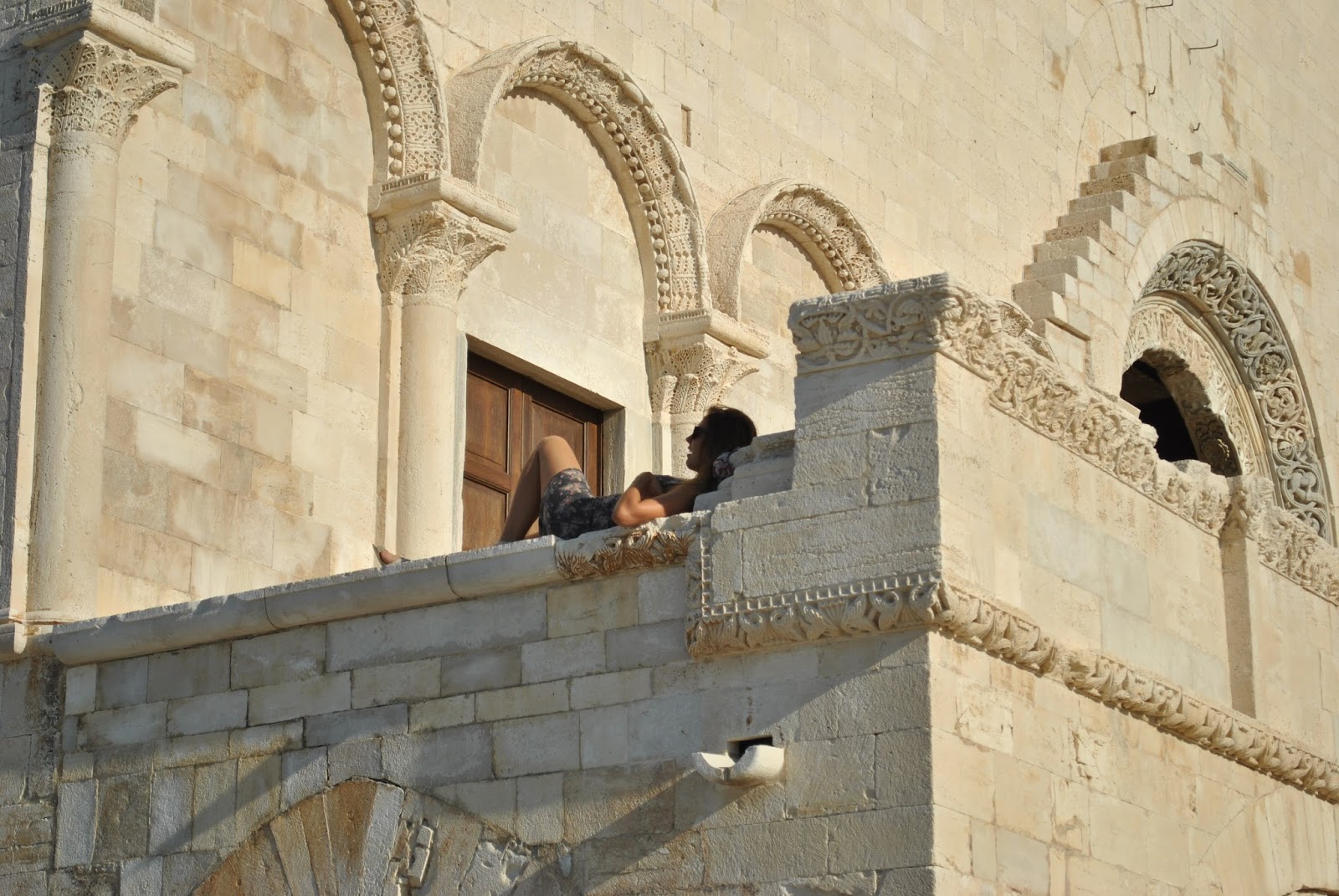
Now, let’s talk about the symbol of Trani, the Cathedral, dedicated to Saint Nicholas the pilgrim.


Built in the characteristic white local limestone, it lies on a raised open site near the sea.


The arches of the Romanesque portal are beautifully ornamented, in a manner suggestive of Arab influence.


The Swabian castle of Trani is a small jewel.


Trani is well known for its sweet white wine: Moscato di Trani.

I guarantee you that this is a faboulus wine, ideal to accompany sweets, particularly those made by almonds.


If you wish to see more pictures, please click here

Take it slow


Thursday, 18 September 2014

An Englishman at "La Notte della Taranta"

It is less than one month since we went to Melpignano, south of Lecce.


Melpignano is located in an area of the Lecce province called Grecia Salentina.

People there speak Griko, a variant of Greek.

We went there the 23rd of August to attend the latest night of the itinerant festival La Notte della Taranta.


La Notte della Taranta is one of greatest folk festival in Europe.


The music played there is pizzica, which has Greek influence.

Aaron is from Bristol, in the UK.


He came to Brindisi, south of Apulia, in July 2013 to work.

He loves music, he likes very much music festival.

Last year I promised him: “I will take you to Melpignano at La Notte della Taranta, an amazing folk festival.”.

Mervyn, a funny friend of ours from London joined us.

The 23rd of August 2013 we were in Melpignano.

I still remember their faces when they saw the huge crowd under the stage, filling the entire square.

Almost 30.000 people dancing and singing.


I consider it a bath of energy, pure energy.


Mervyn was supposed to come this year as well. Unfortunately, he could not make it.

 So Aaron and I went there again this year, to celebrate what seems to me a therapeutic rite.

Aaron, I, Lucia and her friends from Milan have been this year at La Notte della Taranta.

I asked Aaron:“Why do you like this music festival”. He replied: “because it is so trivial”.

Aaron has been dancing the entire night. He has even bought a tamburello.

Then, at the end of the night he comes to me and says: “do you know why I really like this festival?

Because it makes me think that I have to let it go” I have never understood very well what he meant.

But I guess he meant something personal, something which belongs to his own story.


Aaron will go back to UK soon.

His life experience in Apulia has almost come to an end.

I wish you all the best, dude.


I'm sure that I will see you next year in August, of course at Notte della Taranta.