Showing posts with label Trani. Show all posts

Thursday, 4 December 2014

The Franco's Estasi wines

A couple of months ago, soon after having written about Trani, I got a call.


“Good morning, am I speaking to Mr. Antonio Esposto?”.

“Yes” I reply, pretty curious to know with whom I was speaking to.

He adds: “My name is Franco, Franco Di Filippo. I am calling from Trani”.


Franco had red In Apulia, in which I described Trani and the amazing Passito wine made there.

“I am a wine maker. I make Passito wine and Spumante. The set of my wines is named Estasi”.

“Estasi?” It seemed to me like if I was talking with an angel, or someone from the Paradise.


“I’d like to ask you if you have had chance to drink my wine in Trani.” He said.


I got fascinated by the way he spoke, calm and slow.

“Frankly, I don’t remember what kind of wine I had drunk”. I admit.

Franco and I talked for almost half an hour on phone.

I close the conversation saying: “I promise you to come to Trani and interview you. I am keen to find out more about you and your wine”.

In one of my tours across Apulia, I manage to arrange an appointment with Franco.

He is a skinny man, with blue eyes, I guess over 50.


Franco, as Virgilio did with Dante, took me on a tour across Trani and the Moscato wine.


Trani was synonymous of wine-shop in Milan. 

Indeed, Giorgio Gaber wrote a song named Trani a gogo.


Moscato reale is a typical wine variety ("vitigno" in Italian) from Trani.

The legend says that Moscato reale was brought in Italy by the Greeks (“thank you Greeks!”).

Since the middle-age, the Venetians used to trade the Moscato reale made in Trani.

The Venetians found it so profitable, that some of them even relocated to Trani with their own families.

Franco had inherited three hectares of vineyards from his father.

Franco used to harvest the grapes and sell it to the national wine makers.

This went on till the 2005, when the prices fell down. 

In other words, Franco got paid 30 euros for 100 kilos of grapes. It was not worth it anymore, Franco thought.

Nevertheless, Franco is a visionary. So he begun to make his own wine in his own way.

Franco make the harvest every year at the end of October which is madness, but it works.

Recently, the Passito di Pantelleria has become world heritage, according to the UNESCO.

Franco is a strong believer. He is very gentle.

He lost his mum when he was a kid.

“I thank the Divine Providence for what I do, and for what I can’t do” Franco says.


Franco does not make wine just for profit.


He is very satisfied when he gets feedback form those who tastes his wines.

Like for example in Piacenza, during a wine exhibition, a lady confides: “Franco, I wanna kiss you, I wanna hug you”.

Franco sells the 85% of his production in Italy. The remaining 15% between Germany and Belgium.

A bottle of Passito Estasi (here is the link to the website) costs in Italy € 18. 

A bottle of Spumante Brut € 30.


Salute Franco!


If you wish to view more pics of Trani, please click here

Sunday, 21 September 2014

Come to Trani and have a glass of Moscato wine


Trani is one of the most appealing Apulian sea towns.


The night life is sparkling. 

People from the provinces of Bari, Foggia and BAT go there to have good time.

You find many pubs and restaurants along the quay (marina).


Many fishing boats are docked there. Therefore, if you wish to eat fresh fish you know where to go to.

I walk around the inner city and I find an interesting advise which says that Trani is a città slow

It adds: città del vivere bene (town where you can live well). 


This movement is inspired by the slow food organization.


The main aims of the città slow are:
  •         Making life better for everyone living in an urban environment. 
  •      Improving the quality of life in the  cities. 
  •      Provide inspiration for a healthier lifestyle.  
  •      Protecting the environment

Talking about the history, Trani has lived its golden age during the middle age.

Its port, well placed for the crusades, developed greatly, becoming the most important one on the Adriatic sea.

In the 12th century, some important families from the Italian Maritime Republics such as Venice, Pisa, Amalfi established themselves in Trani.


Trani hosts one of the largest Jewish community of Southern Italy.

By the 12th century, Trani already housed a large Jewish community.

We have to remember that under the Swabians, the entire South of Italy lived a time of prosperity. 

Additionally, Jews, Muslims and Catholics used to live all together in peace.

Trani was the birthplace of one of the greatest medieval rabbis of Italy: Rabbi Isaiah ben Mali di Trani (1180 - 1250)

Then, under the Anjou and Aragonese rule, the Jewish community was persecuted by the Dominicans, who notoriously played a key role during the Holy Inquisition.


For example, the Scolanova Synagogue was built in the 13th century. 

Then, it was confiscated around the 1380, and converted for use as a church.

In 2006, the building was de-sanctified by the church and returned to the Jewish community.


From a cultural and religious perspective, Apulia seems to me like Andalusia in Spain. 

Both these regions worked as connections between East and West.  

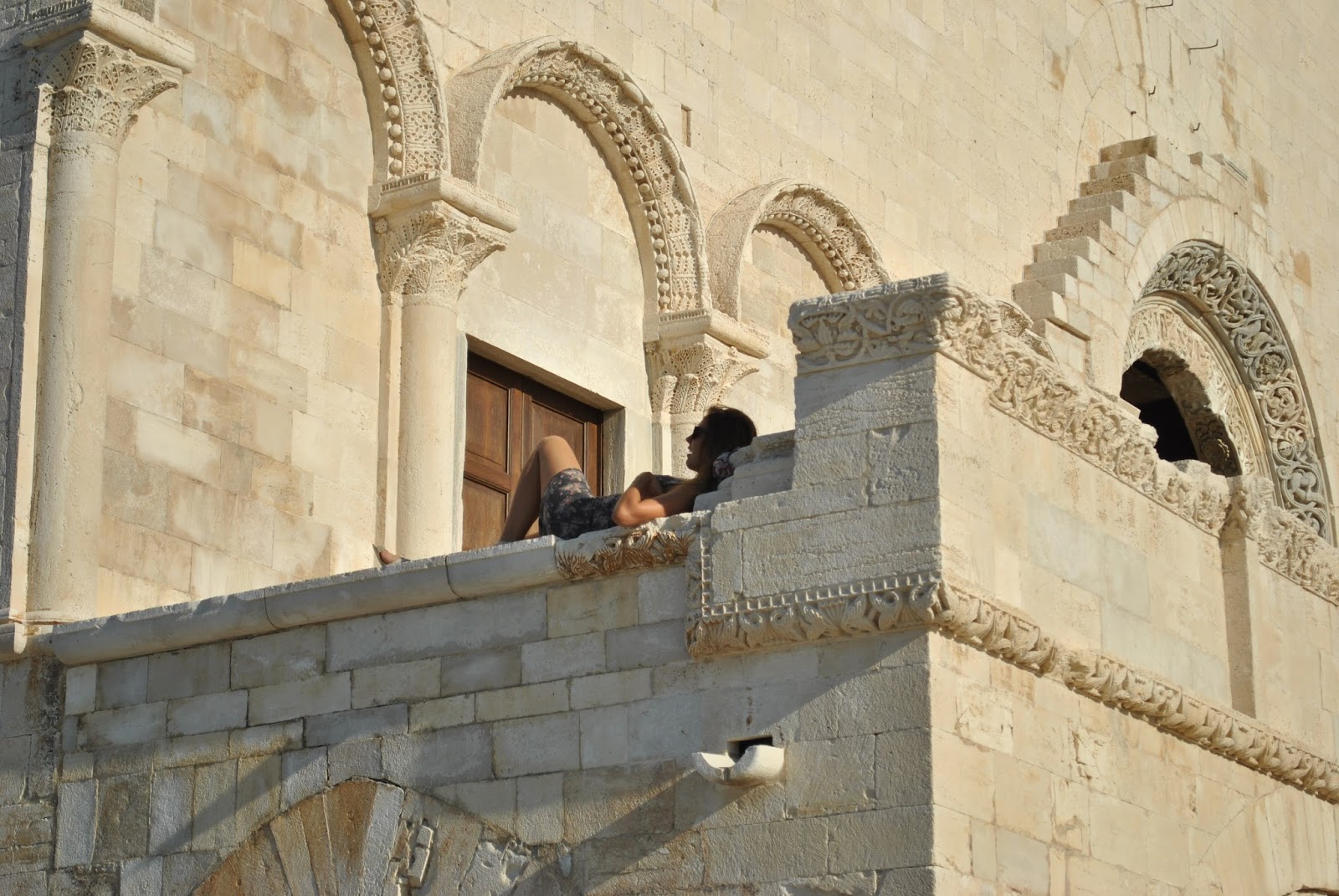
Now, let’s talk about the symbol of Trani, the Cathedral, dedicated to Saint Nicholas the pilgrim.


Built in the characteristic white local limestone, it lies on a raised open site near the sea.


The arches of the Romanesque portal are beautifully ornamented, in a manner suggestive of Arab influence.


The Swabian castle of Trani is a small jewel.


Trani is well known for its sweet white wine: Moscato di Trani.

I guarantee you that this is a faboulus wine, ideal to accompany sweets, particularly those made by almonds.


If you wish to see more pictures, please click here

Take it slow