Showing posts with label Daunia. Show all posts

Thursday, 22 January 2015

Iapyges, the Pre-Roman inhabitants of Apulia

When I was student, I remember that I was due to study mainly the history of the Roman empire.


My teachers did not even mention the civilisations which preceded the Romans in Apulia.

I acknowledge that the Roman empire was something which to be proud of.

Nevertheless, the civilisation in Apulia did not commence with Romans at all.

So, today I am going to write about the Iapyges, who inhabited Apulia since the 11th century BC.

The Iapyges had got different names according to the Apulian area in which they have developed: Daunians at north (Foggia), Peuceti at centre (Bari) and Messapians settled down in the south (Lecce and Brindisi).


According to the Roman erudite Varro, the Iapyges descend from the melting pot of Illyrians (Balkans), Cretans (Greece) and natives.


The Illyrians were predominant, though.


What above does not apply to Taranto, funded by the Spartans in 706 BC.

Therefore, Taranto was Greek.

Recently, I have red a book written by Ettore De Julius, (Gli Iapigi, Storia e civiltà della Puglia preromana. Longanesi, 1988, Milano)


One of the main Iapygian cultural trait, can be found in the way they buried their deceased: by side, with flexed arms and legs.

Such an entombment is identical to those discovered in Dalmatia and Istria, Balkans (Illyria).

I have visited few Apulian archaeological museums: Manduria, Taranto, Latiano, Egnazia, Ruvo, Altamura, Canosa, Ascoli Satriano, Manfredonia, Foggia).

In my opinion, the most beautiful artifacts among the Iapyges belong to the Daunians.


Concerning the Messapians, what have struck me is their defensive system.

In other words, the Messapians had built up impressive megalithic walls to defend themselves from Taranto, the Spartan city.

Manduria provides the best example of this defensive system.


The war between Taranto and Messapians erupted in 473 BC.

Peuceti and Daunians joined the Messapians.

On the other hand, Reggio (Reggio Calabria) got allied with Taranto.


According to the Greek historian Herodotus, that was the worst defeat inflicted to Greeks: almost 3000 soldiers of Reggio and even a higher number of Tarantini had been killed.


After that, Taranto fell into a deep crisis.

The Spartan city evolved to a democratic regime, due to the massacre during the war of a tremendous number of aristocrats.


Talking about the Daunian stele, they were funerary monuments made by stone.


The Daunian stele remind me the giants of Mont'e Prana, in Sardinia.


The giants belong to the Nuragic culture, one of the most extraordinary prehistoric cultures.

John Hooper on the the guardian: The Giants of Monte Prama include statues of archers, wrestlers and boxers carved in sandstone probably between the ninth and eight centuries BC, before Rome was even founded. They belong to the Nuragic civilisation, which flourished on Sardinia for two millennia until the second century AD.

However, this is another story...

Thursday, 11 September 2014

Canosa di Puglia, the “little Rome”

When I was 23 years old, I went to London.


I spent three weeks there in order to attend an English class.

One day, my Polish friend and I decided to not go to school. We took a day off because we had planned to visit the British Museum.

Once in, we entered the exhibitions of Greece and Rome. 

Well, I was just so astounded by seeing so many objects from Canosa, in Apulia.

“I come from this area!” I proudly said to my friend, pointing the finger at the map.


Canosa is a town located in north of Apulia.

It has roughly 5000 years of history.

Canosa was called the “little Rome” because it is located on the top of seven hills, like Rome.


The grandiose appellation was given for an historical reason as well.

The Romans, defeated by Hannibal during the 2nd Carthaginian war, were rescued by Canosa.

Finally, the Romans managed to beat Hannibal and Canosa was well rewarded: it became colonia. 

Additionally, the Via Traiana passed by Canosa. 

While driving toward Canosa, I just realize that there are vineyards everywhere.


It is September, so it is time to harvest grapes.


The Rosso Canosa is a very good wine, made by Nero di Troia a red grape variety grown just in Apulia.


I arrive at Canosa at 12 o’clock, quite late because of the heavy rain which I have encountered.

Therefore, I have little time to see two things: the Archaeological museum hosted in Palazzo Sinesi and the S. Sabino cathedral.

By the way, Canosa has much more to offer in terms of archaeological and cultural heritage.

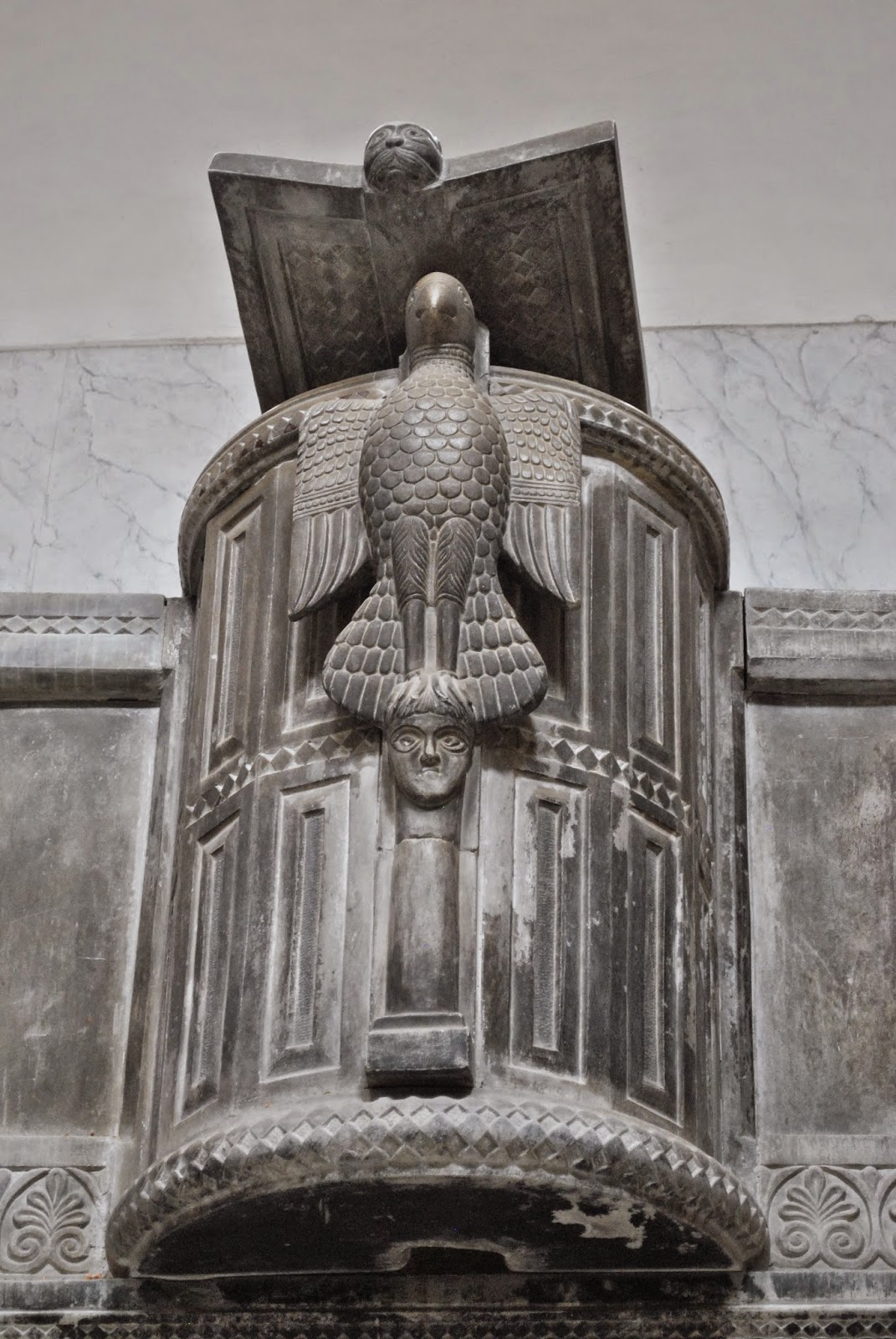
After having parked the car, I quickly move to the Cathedral, which hosts two amazing objects: the ambone and the throne with elephants.

The ambone was made by Acceptus, an Apulian Master who adorned the Cathedrals of Siponto and Monte S. Angelo as well.


On the other hand, the marble throne was manufactured by Romualdo. 

The throne has evident Oriental influence, typical example of the Romanico-Pugliese culture.


I feel shivers down my back looking at it. The throne is just so beautiful.

I would have liked to contemplate the Boemondo mausoleum, which is beside the cathedral.

Unfortunately, I do not have time. So, I promise myself to come back soon.

I get out the cathedral.

I quickly move toward Palazzo Sinesi. I look forward to see the archaeological exhibition.

I have half an hour time.

I enter Palazzo Sinesi and talk with the manager.

She says: “Canosa were manufacturing ceramic from the 8th till the 2nd century BC. In other words, it stopped with the Roman age.”


From my point of view, the nicest ceramic which I see here it is the Daunian ones. Canosa was Daunian.

The bright pink color was extracted by natural processes.  


Another unique object hosted here is the armour (4th century BC), coming from a tomb in Lavello.


Apparently, there are just 24 armours from that age spread around the world. 

Some of them come from Canosa di Puglia.

I have completed my visit. I cheer the manager and I get out.

Now, I easily walk toward the car.

I feel tired but serene.

If you wish to view more pics, please click here