Showing posts with label Taranto. Show all posts

Thursday, 14 April 2016

Majolicas of Laterza

This morning I moved to Laterza, a small town located in the province of Taranto.


As the Lucia's mum had to buy a new dress there, I have driven both of them to the shop.

I am not really interested in fashion maters, therefore, I quit the shop after few minutes and head straight to the city center.

Italian city centers are like an open air museum, where it's possible to view their historical stratification.  

I have been told that Laterza has something unique: a place called taverna degli spagnoli as well as the recent MuMa, museum of majolicas.

Taverna degli spagnoli, which may be translated to "Spanish tavern".

The IAT (tourist office), located within the local castle, it's warm and cozy.


"Good morning, I have called yesterday because I'd like to visit taverna degli spagnoli" I say.

"Sure, no problem" Nicola replies.

"The ticket costs 5 euros. We can go there whenever you wish. Additionally, we have here the MuMa which hosts a permanent exhibition of majolicas made in Laterza, from 14th to 19th century. It's free entry" he states.


"Cool!" I think to myself. 

"I wish to see first the MuMa, then, the taverna" I tell him.


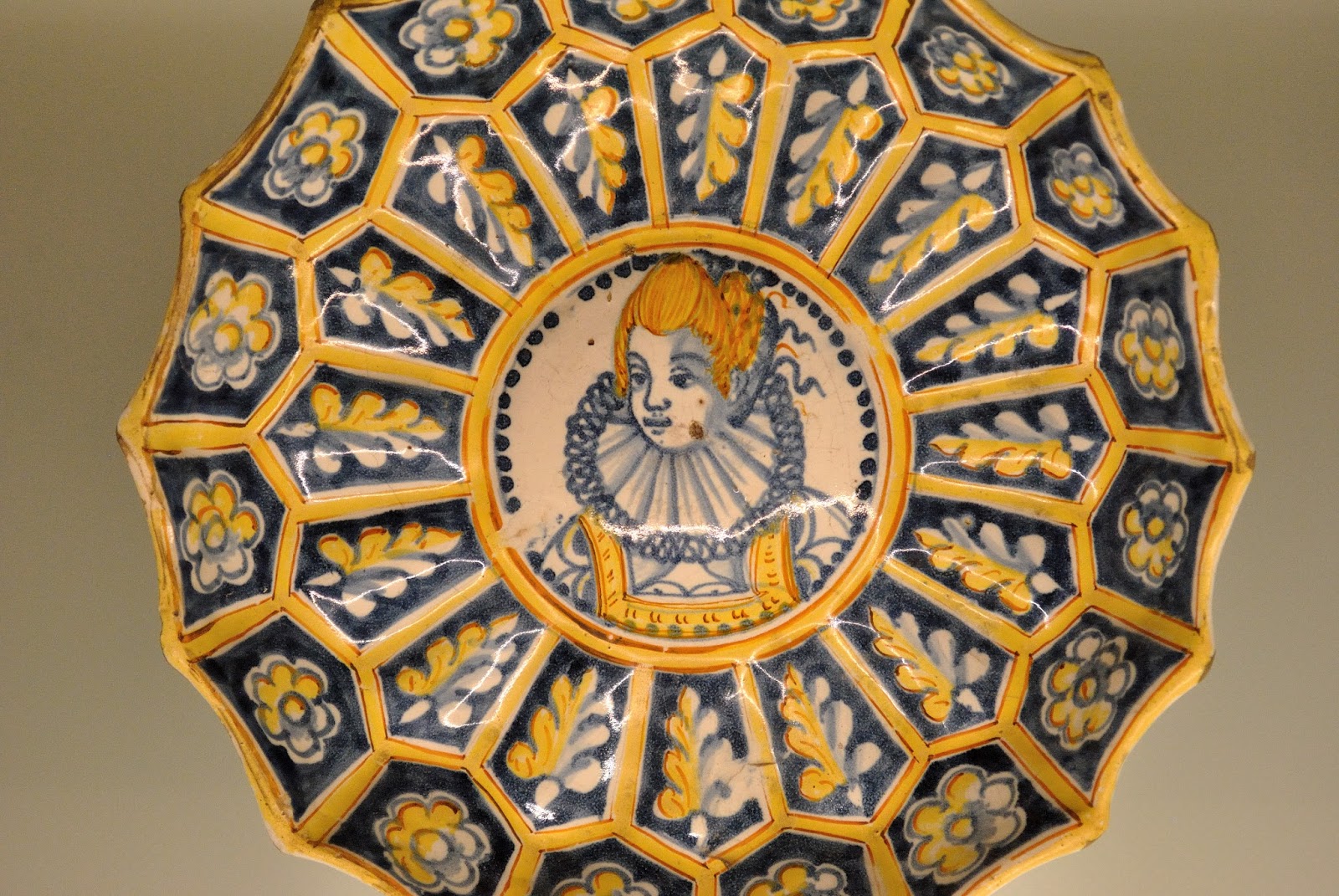
I have always heard about the beauty of majolicas made in Laterza. However, I would have never expected to see so outstanding artifacts.

The ones below are just a taste of what is displayed.


According to Wikipedia, majolicas have been invented by Egyptians.

The first artisans to produce majolica in Italy were in Palermo in the 10th century.

Arabs introduced it in Sicily. 

A couple of centuries later, Faenza became one of the worldwide center of majolica. 

According to Nicola, during the 18th century, there were in Laterza around 40 maiolicari (artisans who manufacture majolicas).

Today there are just 4 left.

At that time, the buyers were families in the upper class. So, this explains why the local majolicas were so sophisticated, so enchanting.


According to the book La Ceramica di Laterza nella collezione Tondolo (edited by Guido Donatone, published by Mario Congedo Editore) the items displayed at MuMa have been collected by Riccardo Tondolo.  


 Riccardo Tondolo (pictured on the left) has been seeking Laertian majolicas all around the world for decades.


The local community owes a lot to this man.

The oldest items shown at MuMa date back to the 14th century.


After having completed the tour at MuMa, I still feel inebriated.

"Ah, what a nice sensations art let you experience" I think to myself.

"Nicola, I am ready to view the taverna" I address him.

"Ok, let's go" the guide replies.


A blonde lady is with us, her name is Wanna. 

Like Nicola, she is from Laterza too (both of them pictured).  


Walking through the city center, we bump into some interesting places: 


a building owned by aristocrats  


The oldest public fountain


finally, an emblem which echoes the Borboni one 


We arrive at Taverna degli Spagnoli.

"This is supposed to be the ancient Byzantine church of St. Pietro" Nicola says.

"Then, this place turned to be a place of initiation of the Spanish dinasty Perez-Navarrete, which inherited Laterza in 1655".

Perez-Navarrete was a Spanish-Neapolitan family

Nicola adds "We suppose that the Spaniards used this place to recruit new soldiers".

Indeed, we see written on the top of the wall: chi vol haver il soldo, Hor qui s'accosti al capitano, which stands approximately for "Those who seek for money, come here close to the captain".

The taverna is plenty of frescos which our guide ascribe to local artists of the 17th century.


If you wish to find out more about this place, I suggest you this book La "cantina spagnola" di Laterza. I Perez Navarrete feudatari ed il Viceregno spagnolo, edited by Raffaella Beniamino, published by Congedo editore.


The below two pictures show:


a lady (centre) dancing with two men...


and Spanish soldiers


The tour is going to end up.

I have chance to exchange few words with Wanna. 

She is back in Laterza after having worked a couple of years abroad.

Our land strongly needs educated and experienced people.

Please, let me spend few words on how great people of tourist office are. Nicola and his colleagues, young and well trained, are great professionals who work with passion.

Additionally, I wish to highlight the efforts of Laterza administration in promoting its immense cultural and environmental heritage. Well done!  

Enjoy Laterza, then.

Ciao


Ps. 
Click here, should you wish to view more pics


Saturday, 2 May 2015

Labour day 2015 in Taranto

To celebrate yesterday the labour day, Lucia and I went to Taranto.


We have joined some friends from Altamura, who have come to Taranto as well.

Thanks to Michele Riondino, an Italian actor, Taranto hosts since a couple of years a whole day of music.

According to what I saw yesterday, I confirm that the event has been fully successful.


Let’s remember that Taranto hosts ILVA, the largest steel factory of Europe.


The factory is poisoning the entire city, though. Particularly, among the people who live in Tamburi, area attached to the factory, the average of those who suffer of cancer is higher than any other Apulia city. 


Some ILVA workers, fed up of seeing colleagues and relatives dying of cancer, have established the Comitato lavoratori e cittadini liberi e pensanti.  


The 2nd of August 2012, during a public meeting held in Taranto, the Comitato was denied the chance to deliver a speech.

As outcome, the Comitato broke through the assembly stopping the Union leaders’ speech, blamed of betraying the citizens and working class’s interests.

Actually,Taranto is going through difficult times: high unemployment, pollution and so on.

This is the reason for which so many Italian artists such as Caparezza, Marlene Kuntz, Mannarino, Subsonica and many others have accepted to come to Taranto and sing for free.

I pay huge respect to them.

The atmosphere yesterday was just great.


So many young people coming from not only Apulia, but from the rest of the country convened here to address a message: Taranto can change in better.

Taranto, a city founded by the Spartans, has an immense archaeological heritage.

Moreover, Taranto vecchia is just so beautiful and picturesque. 

Additionally, let’s not forget that Taranto is currently hosting hundreds of African people who have just crossed the Mediterranean.

Indeed, yesterday an asylum seeker from Gambia, invited by Mietta and Andrea Rivera on stage revealed: “I had a good life in my country. I was an English teacher. Then, I begun to be persecuted due to my opposition to the President of my country, who is a dictator. I teach English now, and play football with Hellas Taranto. I love you Taranto”.


The audience applauded enthusiastically.

I do not know how many people there were yesterday. 

However, I guarantee you that there we were a lot.


Riconversione mentale. Giustiza per Taranto      

Thursday, 22 January 2015

Iapyges, the Pre-Roman inhabitants of Apulia

When I was student, I remember that I was due to study mainly the history of the Roman empire.


My teachers did not even mention the civilisations which preceded the Romans in Apulia.

I acknowledge that the Roman empire was something which to be proud of.

Nevertheless, the civilisation in Apulia did not commence with Romans at all.

So, today I am going to write about the Iapyges, who inhabited Apulia since the 11th century BC.

The Iapyges had got different names according to the Apulian area in which they have developed: Daunians at north (Foggia), Peuceti at centre (Bari) and Messapians settled down in the south (Lecce and Brindisi).


According to the Roman erudite Varro, the Iapyges descend from the melting pot of Illyrians (Balkans), Cretans (Greece) and natives.


The Illyrians were predominant, though.


What above does not apply to Taranto, funded by the Spartans in 706 BC.

Therefore, Taranto was Greek.

Recently, I have red a book written by Ettore De Julius, (Gli Iapigi, Storia e civiltà della Puglia preromana. Longanesi, 1988, Milano)


One of the main Iapygian cultural trait, can be found in the way they buried their deceased: by side, with flexed arms and legs.

Such an entombment is identical to those discovered in Dalmatia and Istria, Balkans (Illyria).

I have visited few Apulian archaeological museums: Manduria, Taranto, Latiano, Egnazia, Ruvo, Altamura, Canosa, Ascoli Satriano, Manfredonia, Foggia).

In my opinion, the most beautiful artifacts among the Iapyges belong to the Daunians.


Concerning the Messapians, what have struck me is their defensive system.

In other words, the Messapians had built up impressive megalithic walls to defend themselves from Taranto, the Spartan city.

Manduria provides the best example of this defensive system.


The war between Taranto and Messapians erupted in 473 BC.

Peuceti and Daunians joined the Messapians.

On the other hand, Reggio (Reggio Calabria) got allied with Taranto.


According to the Greek historian Herodotus, that was the worst defeat inflicted to Greeks: almost 3000 soldiers of Reggio and even a higher number of Tarantini had been killed.


After that, Taranto fell into a deep crisis.

The Spartan city evolved to a democratic regime, due to the massacre during the war of a tremendous number of aristocrats.


Talking about the Daunian stele, they were funerary monuments made by stone.


The Daunian stele remind me the giants of Mont'e Prana, in Sardinia.


The giants belong to the Nuragic culture, one of the most extraordinary prehistoric cultures.

John Hooper on the the guardian: The Giants of Monte Prama include statues of archers, wrestlers and boxers carved in sandstone probably between the ninth and eight centuries BC, before Rome was even founded. They belong to the Nuragic civilisation, which flourished on Sardinia for two millennia until the second century AD.

However, this is another story...

Wednesday, 16 July 2014

MARTA, the splendor of Taranto

MARTA is not just a female name

In this case, MARTA stands for Archeological Museum of Taranto.


Renewed in 2007, the Museum displays a permanent exhibition which embraces Prehistory and Proto-history, Greek period, Roman age till the Middle Age


Let me say that the best part of it is the Greek period. At that time, Taras (greek name of Taranto), a Spartan colony, became rich and powerful.

Bought the ticket, I begin to follow the path.

The the first room is big, very big.

Right in the middle there is a large amphora. Just at the bottom of it, there is an advise which says that it was returned by the USA.


It was previously displayed in an American Museum, which probably bought it from the black market.

Grave robbers are a big problem for a country like Italy, which has an archeological site almost in every village.

However, the Italian governament managed to get it back. And this is what counts.


According to the exhibition, Taranto was supposed to be very rich. I have never seen so many golden artifacts like I did in MARTA: hair slides, rings, necklaces, bracelets.

The aristocratics were supposed to be plenty of money; moreover, very sensitive to be good looking


The golden artifacts are very well made. Undoubtedly, there were at the time expert goldsmiths. Additionally, I assume there was a huge quantity of gold in Taranto.


The Roman section of MARTA is an additional reason to come here and visit it.

The mosaics look so great that they seem carpets.


I have always been told that MARTA is a great Museum. Now, I know why.

Therefore, if you wish to have an idea about Magna Graecia, now you know where to go to.


Saturday, 12 July 2014

Taranto, the Spartan city

I have travelled a lot accross Apulia. However, I have never been in Taranto.

That's a shame, I acknowledge it.

The 5th of July, me and Lucia get on our small car and head to Taranto.

Taranto is a city rich of history, with a glorious past. It was founded by the Spartans in 706 century BC.


A fascinating legend goes that Taras, the son of Poseidon and of the nimph Satyrion, arrived in the harbour of Taranto riding a dolphin. The flag of Taranto city seems to agree with the myth.


Taranto soon became strong and rich. After several wars, it turned into the capital of Magna Grecia.


We have one day to spend in Taranto, so we decide to visit firstly the MARTA (Archeological Museum of Taranto); then, Taranto vecchia.

Taranto vecchia (literally "old Taranto") is ancient core of the city. This is the oldest part of Taranto, accessible from the rest of the city just by a revolving bridge.

After having parked the car, we walk along the main road, which leads us to the ruin of Doric Greek temple.


Taranto vecchia is very much different from the rest of Taranto. People there belongs mainly to the working class. It is the fishermen's quarter.


The kids play in large number along the narrow streets. The shadow of the ILVA's factory looms over them.


Taranto vecchia is plenty of old buildings and churches.

Some of them are abandoned, still untouched though.

From my point of view, the relaunch of the city goes through the regeneration of Taranto vecchia.

This part of the city has a great potential.


The sun is setting. We begin to feel tired.

It is time to have dinner, so we stop by a seafood restaurant to eat mussels, one of the symbol of Taranto.


The next post will deal with the MARTA, the Archeological Museum of Taranto.

The Museum has been renewed since a couple of years.

The artifacts displayed there are unique.
See you soon

If you wish to view more pics, please click here