Showing posts with label salento. Show all posts

Sunday, 16 August 2015

Danza dei coltelli, Torrepaduli and San Rocco

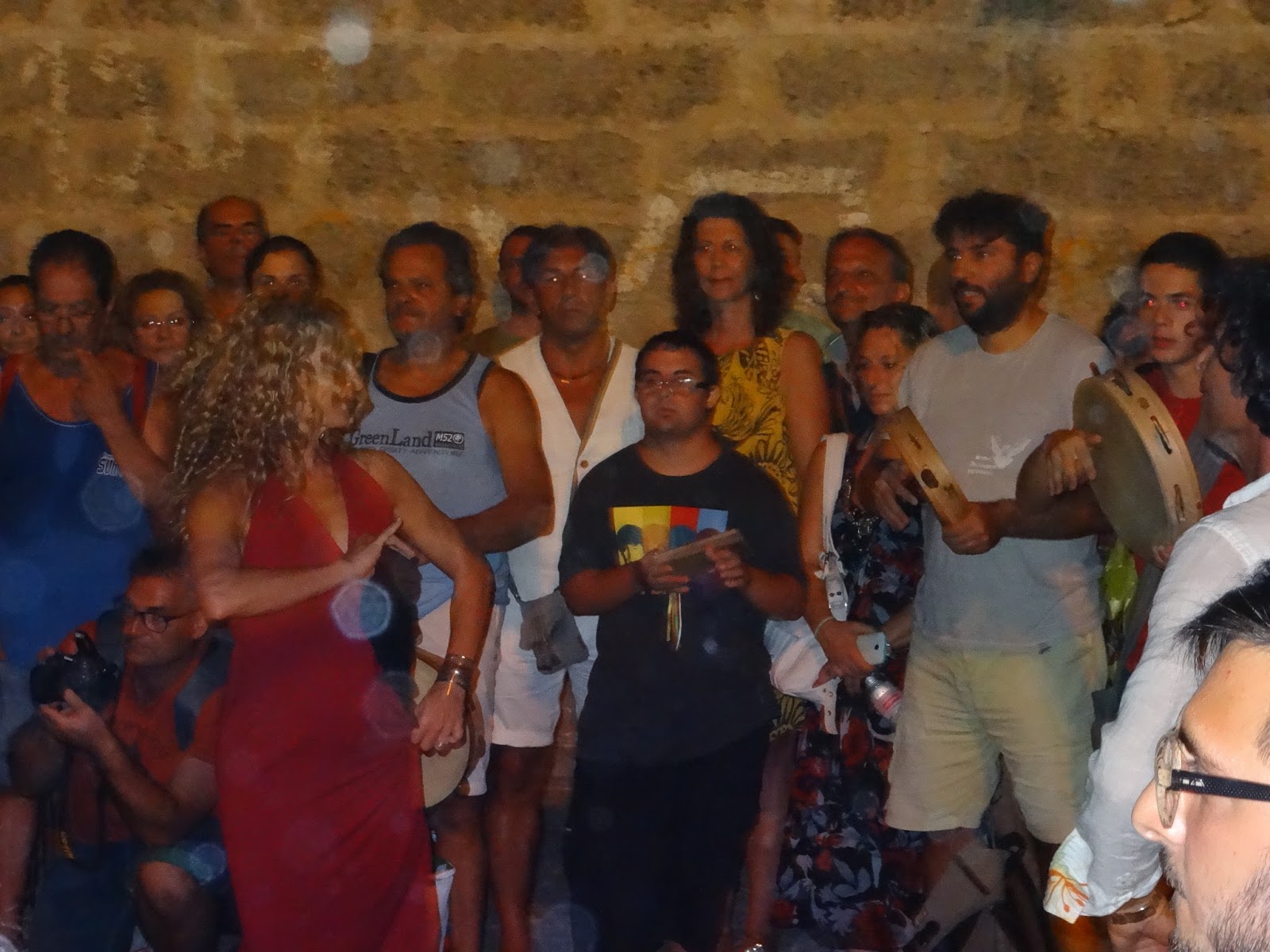
 The night of the 15th August in Torrepaduli, around the sanctuary of San Rocco, people dance a unique kind of pizzica, the so-called “pizzica scherma”.


The dance carries on all the night long till the sunrise of the new day.

I had never seen it before.

In addition, Erika, my sister, fond of folk dance, strongly wished to go there.


How I could let her down?

Therefore, we leave at 8.30 pm of the 15th (Ferragosto) in order to be there at around 10 pm.

Torrepaduli is a small village within the Municipality of Ruffano, around 60 km south of Lecce. 

Once arrived, we find a small area where to park the car.

We walk 10 minutes before reaching the main plaza.

Bright colourful lights enrich the atmosphere.


A band plays music with no interruption.

I’m so surprised when I hear the band playing Rino Gaetano, a very popular singer who died around 30 years ago.

When he was alive, he was famous, but not at all trendy as he is today.

The phenomenon of not appreciating properly its best sons when alive, happens quite often in Italy.

It seems that the country has to digest and assimilate them before paying the tribute that they deserve.


So after a break in the main plaza, we walk towards the sanctuary of San Rocco.


I see so many families outdoor, sat on their chairs, talking each other.

Sometime, they take a glance at foreigners who seem having taken their village just for one night, though.

As documented by Ermanno Inguscio with his book “La pizzica scherma di Torrepaduli. San Rocco: la festa, il mito, il Santuario” (Lupo Editore, 2007), few Francescani in the Middle-Age have built up the chapel dedicated to San Rocco.


San Rocco was born and raised in Montpelier (France).

He belonged to the rich bourgeoisie.

Like San Francesco, he divests of everything he owns to become pilgrim.

San Rocco has always been considered a miracolous Saint.

Ever since people has moved to the sanctuary of Torrepaduli to ask San Rocco help and recovery.

Under such circumstances, pizzica scherma practised mainly by gypsy men (Rom), became metaphor of fight between good vs evil.


Yesterday, Erika was expecting to catch up with some friends of her coming from Fermo (Marche).


Pizzica and tarantella is quickly spreading over the rest of the country.


Erika and I have danced, of course.

Dancing pizzica make you feeling relieved. It’s incredible how therapeutic it is.

It’s 3.30 in the morning.

I begin to yawn.

“Erika, would you mind if we go home? I’ve gotta tired”

“Yeah sure bro. let’s go home” she replies.

I love my sister.

After having driven for 1 hour, we arrive at home at 5 am.

Erika and I exchange a quick “good night”.

After a bunch of seconds I start snoring.

Tuesday, 21 April 2015

An alchemy: Paccheri with artichokes and salmon

Yesterday evening I invited Franckie and Ryan for dinner.


When I invite people at home and I cook for them, I like to cook something special.

Yesterday, I combined ingredients which apparently do not work together.

Tonight, I am going to cook paccheri (pasta), of course, with tomatoes, artichokes and salmon.

You might probably say: “artichoke and salmon together? What a weird combination!”

Well, let us see.

The bitterness of the artichoke combined with the fragrance of salmon is something you have to taste.

Therefore, I am going to show you how to make it, step by step.

Then, if you do not want to cook it, invite me. You buy all the ingredients required and I’ll cook for you. No problem at all.

My Mum has always cooked for her family.

So, I took from her the passion of cooking for other people.

From my point of view, cooking is an alchemy.

From this perspective, I see myself as an alchemist.

In other words, I like to make experiments with food.

Now, I am going to show you how to make this healthy and tasty meal.

It is very easy.

First of all, take a piece of garlic with some onion. Chop it.

Put it in an a pan.

Poor in the pan 6 spoons (2 spoons for each person) of extra-virgin olive oil.


Better if the olive oil is Apulian, bought from an Apulian producer. Buying olive oil from a shop is strictly forbidden. I’m joking…

Put in the pan 10 fresh tomatoes, the ciliegino (cherry) ones.

Keep it cooking for 20 minutes, at a very low fire.

One of the secret of cooking is slowness.

By the way, women love seeing men cooking for them.

Cooking is a powerful act of seduction (seduction comes from the Latin se ducere, which means “bring s.o. to yourself”).

Let’s come back to the meal.

Beside the soffritto, clean the artichokes and put them in a pan with some water.

Let them boil for roughly 20 minutes as well.

In this way, the artichokes will turn tender.


After that, move the artichokes to the other pan. 


Do not throw away the water of artichokes.


Cut a slim piece of ginger, chop it and add it.


Let them cook all together for 15 minutes.

Poor every 5/10 minutes some of the greenish water released previously by the artichokes.


Finally, chop the salmon and put it in the big pan.


Let it cook all together just for 5 minutes.


Paccheri take around 14 minutes to be ready.


Then, when the meal will be ready, on your table, the doors to the Paradise will get opened.


Buon appetito.

Sunday, 23 November 2014

Basilica di Santa Caterina di Alessandria

Yesterday, on Saturday evening, I went to Galatina to see the Basilica of Santa Caterina di Alessandria.


This Basilica is a pure artistic jewel set in hearth of Salento.

To describe the immense beauty of this church, the local Municipality has invited Philippe Daverio, an acclaimed art critic.

Philippe Daverio has become famous since his TV format called Passepartout, in which he travels around Italy and the world talking about art.


Philippe Daverio was invited yesterday to hold a lectio magistralis.

The art critic spoke yesterday in a crowded church.

Actually, I have listened to him outside the church with 200 more people. Fortunately, loud speakers had been set.

"We care for our cultural heritage much more than we did 30 years ago" Philippe started off.

"This Romanic-Gothic church has unique frescos. Artists from the north of Italy, mainly from Tuscany have come to Galatina to fresco the French illuminated manuscripts." 


"Some of those artists were inspired by the Giotto's principles, then applied to the Basilica di Santa Caterina d'Alessandria".


In terms of vastness of Middle-Age frescos, the Basilica di Santa Caterina is second just to the
Basilica di San Francesco d'Assisi


The Basilica was commissioned by Raimondo Orsini del Balzo, after having returned from one of his several crusades.

The church has been built up at the end of the 13th century, on a preexisting Byzantine church.


Raimondo Orsini Del Balzo supported the Angevins (French), who ruled the Vatican and the South of Italy.

Philippe Daverio said yesterday: "Europe should be more aware of the importance played by Italy within the Mediterranean scenario. The Basilica di Galatina is just suggesting us that the European foreign policy should be modified."

In other words, Apulia as well as the rest of the Bel paese, has since forever been in touch with the North Africa and the middle East.

Therefore, please let's be aware once for all, that the Apulian cultural heritage belongs not just to Italy, but to the entire world.

By the way, the etymology of Galatina comes from the Greek gala-galactos, which means "milk". This etymology probably originated from the local milk and cheese production. 

I have ended up my Saturday night in Galatina coming accross an old friend of mine, Gianni, and his wife.

Good art to everyone
Ciao


PS.
Should you wish to view more pics, please click here


Friday, 15 August 2014

Lecce, capital of Apulian Baroque

Lecce is one of the Apulian cities which tourists seem to be fond of.


Yesterday, I went to Lecce at Notte della Taranta, a folk music itinerant festival.

However, on the 23rd of August, the latest, huge concert of Notte della Taranta festival will be held in Melpignano, close to Lecce.


Notte della Taranta is one of the most popular folk music concerts in Europe.

Every year, the concert in Melpignano attracts almost 50.000 people.

It is a joyful party, where people free their spirit by dancing the Pizzica, a faster version of tarantella.

So, let’s come back to Lecce.


Lecce is a magnificent city, a candidate to be European capital of culture 2019.

It is located in Salento, area which encompasses the province of Lecce, Brindisi and partially Taranto.

The Baroque in Lecce is joyful.


Baroque, influenced by the Spanish Plateresque style, took place between the 16th and 17th century, after the battle of Lepanto.


The battle of Lepanto sanctions the end of the Ottoman threat to Europe.


The local upper class, in order to show its status, financed the constructions of new buildings and churches. 


Additionally, buildings already existing, were renewed with Baroque motifs.


The workforce was directed by two great local architects: Giuseppe Zimbalo and Giuseppe Cino.


One additional peculiarity of the local Baroque is due to pietra leccese, the local stone.

The pietra leccese  is easy to work with.

An additional peculiarity is its warm color.


The film industry has played a key role to the success of Salento, of which Lecce is the main city.  

Edoardo Winspeare is the filmmaker of movies set in Salento like pizzicata, Sangue vivo, il miracolo and Galantuomini.

These movies portray a society with a strong connection between the past and the present.

The soundtruck of his movies is obviously the pizzica.

Pizzica, which will be celebrated at Notte della Taranta in Melpignano on the 23rd of August.

Let’s meet up there, then.

If you wish to view more pics, please click here

Saturday, 9 August 2014

Alessano, the birthplace of Don Tonino

Alessano is located in Salento, 3 miles far from the Ionian sea.


In the middle age, monks from the Orient took refuge in Macurano, close to Alessano.

They were escaping from the bloodshed caused by the Iconoclasm

They lived on there peacefully, growing crops.  


Alessano is a quite village, where you can find around nice buildings and churches.


The streets are filled with flowers.


I breath air of spirituality in Alessano.

Probably, it is due to the fact that this is the birthplace of Don Tonino Bello.


According to the movie The Godfather, Don is the evil character personified by Marlon Brando.

However, concerning Don Tonino, I talk about a human being comparable to Gandhi.


During the war in the former Jugoslavia, Don Tonino with few hundreds people went straight to Sarajevo.


The Bosnian capital was at the time surrounded by snipers and Serbian soldiers.

However, like a new St. Francesco, Don Tonino brought there a message of peace and nonviolence.

Don Tonino, bishop of Molfetta, was the one who drove around the city at night time, taking on board drug addicted and alcoholics. 

He drove them to his house and let them sleep in his bed.


I dedicate this post to Don Tonino, to his message of love, peace and nonviolence.

If you wish to view more pics, please click here

Saturday, 19 July 2014

Once upon a time Torre Santa Sabina...

This time, me and Lucia go to visit Torre Santa Sabina, a village by the sea, a couple of miles far from Carovigno.

Walter and Ryan, two friends of us, invite us to go to the beach there.

The coast alternates a mix of rocks and sand. It offers several places where to sunbath and swim.

The sea is just limpid and clean.


Walter knows very well this place. Therefore, he leads us to view what originally was supposed to be a small port used since the Bronze age.


The potholes in the bedrock are still visible. Filled by wooden poles, they were used to moor ships.


Torre Santa Sabina was the dock of Carbina Messapica (the actual Carovigno) since the 7th century BC


Archeological researches have been resumed in 2009 to investigate further on shipwrecks of different ages.
The shipwrecks lies at just three metres on the bottom of the sea.


The historical richness of this place includes something else, pretty unique, I would say.

That is the tower, from which the village takes its name.

Tower "a cappello di prete" (priest hat).

With a star shape, it has its edges oriented towards the cardinal points.

This tower is one of dozens built up along the Apulian coast during the 15th and 16th century.

The purpose was to defend the coasts from the Saracens' attacks.


In the evening, we all go for a relaxing walk.

Lots of people are around.

kids play football on the beach.

The old people are sat down, looking at them remembering the green years.


Wednesday, 16 July 2014

MARTA, the splendor of Taranto

MARTA is not just a female name

In this case, MARTA stands for Archeological Museum of Taranto.


Renewed in 2007, the Museum displays a permanent exhibition which embraces Prehistory and Proto-history, Greek period, Roman age till the Middle Age


Let me say that the best part of it is the Greek period. At that time, Taras (greek name of Taranto), a Spartan colony, became rich and powerful.

Bought the ticket, I begin to follow the path.

The the first room is big, very big.

Right in the middle there is a large amphora. Just at the bottom of it, there is an advise which says that it was returned by the USA.


It was previously displayed in an American Museum, which probably bought it from the black market.

Grave robbers are a big problem for a country like Italy, which has an archeological site almost in every village.

However, the Italian governament managed to get it back. And this is what counts.


According to the exhibition, Taranto was supposed to be very rich. I have never seen so many golden artifacts like I did in MARTA: hair slides, rings, necklaces, bracelets.

The aristocratics were supposed to be plenty of money; moreover, very sensitive to be good looking


The golden artifacts are very well made. Undoubtedly, there were at the time expert goldsmiths. Additionally, I assume there was a huge quantity of gold in Taranto.


The Roman section of MARTA is an additional reason to come here and visit it.

The mosaics look so great that they seem carpets.


I have always been told that MARTA is a great Museum. Now, I know why.

Therefore, if you wish to have an idea about Magna Graecia, now you know where to go to.