Tuesday, 14 April 2015

A sunny Sunday in masseria

On Sunday the weather in Brindisi was just so beautiful: sunny and warm.


The day before, I had got an invitation from Ryan to go for lunch in one of the masseria disseminated in the Apulian countryside.

“Lucia and I will come for sure” I replied by sms.

We catch up on Sunday at 12.30 in a bar by Porta Mesagne.

We are nine of us.

Elis has booked a table in Masseria Parco di Castro.

Frankly, I begin to feel hunger, like, I reckon, all the others.

So, after a quick chat, we decide to make a move. The masseria is not that close, indeed.

We drive along the SS16. 

The masseria is located in Speziale di Fasano between Cisternino and Fasano.

I am an easy driver.

It’s my habit to drive slow. 


The reason is because I just get distracted by the landscape.

Or alternatively, because I have just seen too many times Easy Rider. 

Who knows?!


I have in my car Lucia, my companion, and Franco, a very good friend of mine.

Ryan and I call him Frankie boy because despite of his age, 49, he looks younger.

Finally, we arrive at the masseria.

We sit down on. The others order some food.

I ask for some red local wine.

The food is gorgeous.


We have some antipasti.

Then, for main course we have pasta, or alternatively, meat.

The company is great. We have some good laugh.

Laughing is therapeutic. I laugh as much as I can.  (My laugh is roaring, though. What can I do?)

According to the ancient Romans, laughing was sign of silliness: risus abundat in oram stultorum.

From this perspective, I guess the ancient Romans were just eager to conquer the world instead of enjoying their short life.

After lunch, I get out to sit down and get inebriated by the sunshine.


Masseria is a place where till 40 years ago, the landowners used to host peasants hired to work the land or just to pasture the animals.

In other words, masserie are the symbols of the peasant civilisation.

Nowadays, most of them have been converted to restaurants and B&B.

It is time to leave.

We pay our bill, 25 euros each, and get off.


I take a quick look at the chapel.


It is 5 pm.

We gotta go.

Some donkeys seem to cheer us up.


Eventually, we decide to move to Torre Santa Sabina for a quick walk by the sea.

We won’t be returning to Brindisi before 7 pm.


Today we celebrated the “art of conviviality”.


And we, in Apulia, are master of it.


Saturday, 4 April 2015

The Holy Saturday in Canosa di Puglia

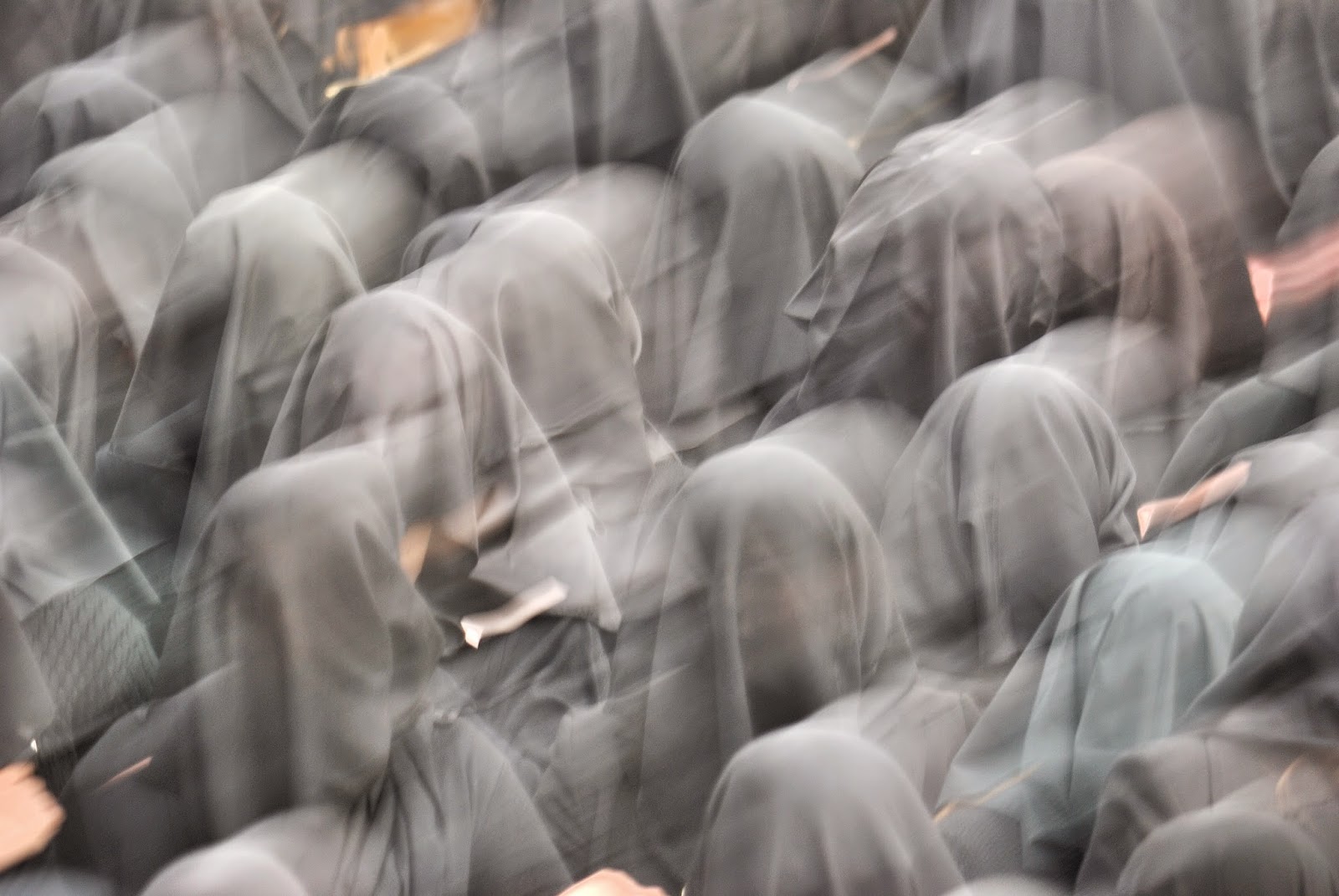
A couple of months ago, I have been told about a procession held during the Holy Saturday, when women cover themselves of black, face included.


This rite, called processione della Desolata, is celebrated in Canosa di Puglia.

These women are dressed of black as sign of desolation for the crucifixion of Jesus.

I looked forward to witness this event.


The procession of people follows the simulacrum of the Holy Virgin, portrayed with a sword stuck into the hearth.


I arrive in Piazza della Repubblica at 9.15.

My sister Erika has come along with me.

The piazza is already crowded.

I assume that it will be pretty difficult to find a place from which to take pictures.

However, I do not despair.

Walking by a small tower, I think to myself: "Who knows If I am allowed to come up".

Who cares!

So, I start climbing.

It is not so easy. I am not that fit anymore.

Finally, after having struggled for few but long seconds, I succeed in reaching the top of the tower.

It is almost two meters high.

I cheer up the people present.

"Are you a journalist" I ask.

The lady with the microphone replies: "I'm, indeed. We are reporting the procession on streaming. I work for la terra del sole".

I imagine the happiness of those who have migrated from this land, watching the processione della desolata on streaming.

The procession is getting closer and closer.

The ladies dressed of black sing a litany which touches the soul.

It is indescribable.


After having overcome the tower, the sound gets lower and lower.

However, I stay for a couple of minutes in a contemplative status.

What I have just witnessed seems to me like a tragedy.


The Greek philosopher Aristotle, had said that watching a tragedy is tremendously important, because it cleans up the soul.


How true and actual is this thought.

The journalist comes back asking me if I wish to be interviewed.

"Of course" I say, "why not".

She introduces me as a journalist who comes from Manfredonia. Fair enough.

"Why did you come here?" she asks.

"I'm here because I wished to take part to the celebration of the Holy Saturday here in Canosa. When I firstly heard of women dressed like some women do in the Arabic countries, I said to myself, you can't miss it."

The comparison to certain Arabic costumes let the journalist choke.


"Canosa is incredibly rich of art as well as of history" I carry on.

The journalist seems to be very proud of it.

Let me just point out that this town has three museums.


Beside the church of San Sabino, it is allocated the mausoleum of Bohemond I, Prince of Antiochia.


Bohemond I, Norman, son of Robert Guiscard, is known for having undertaken the 1st crusade.


A guide let us have a look at the inside of the Mausoleum.

The door is covered by decoration which vaguely look Arabic.


I may look heretical, but I guess that something of the Arabic costumes are still in the Apulian cultural heritage.

The below fan (11/12th century), exposed in one of the museum of Canosa, is decorated in Kufic.

It reports the Kufic word Al-Yumm, which stands for "happiness".


Apulia is a land where several cultural influences have taken place.

In my opinion, the Frederick II touch is still occurring in Apulia.

Born in Jesi (Marche), raised in Palermo (Sicily), Frederick II went down in history as puer Apuliae.

So, Frederick II would have been glad of watching today the processione della Desolata


PS.
Please click here, should you wish to view more pics.


Saturday, 28 March 2015

The Maria's colours

A couple of days ago, I have received an e-mail about a paintings exhibition in Maglie (Lecce), which will start today at 5.30 pm.


The artist is Maria Jose Garcia.

She comes from Guadalajara, close to Madrid.

Maria works in Brindisi within the United Nations Logistic Base.


So, I e-mail Maria asking her if she would be interested in being interviewed for In Apulia.

She accepts without hesitation.

Therefore, we arrange to meet up near the canteen within the UN base.

Once there, we introduce each other.


I am struck by her eyes: bright as the colours of her paintings.


I explain her the mission of my blog.

However, I wish to find out more about her passion for painting. 

“I have been living in Amsterdam for 14 years” she says.

“I had great time there. Nevertheless, I have never got used to the darkness of that latitude”.

“I adore to paint the nature” Maria says. “Usually, I take a picture of the subject, then, I paint it”.


Talking about the History of Art, Maria likes very much the Post-Impressionism movement

The below painting is an example.


Additionally, Maria loves Sorolla, Van Gogh and Gauguin.

Maria lives in Lecce.

“When I ride my bicycle” Maria adds “it hurts me to see plastic and rubbish around the countryside. 

It is a shame to ruin such a fantastic landscape. In The Netherlands there was more respect for the environment”.


Concerning the disease which is affecting the olive trees in Salento, caused by Xylella, Maria wishes that a remedy will be soon found in order to tackle the spreading of it.


It is almost time to come back to work.

We leave the canteen with the strong feeling that we have had a nice chat.

So, feel free to come to Maglie and have a chat with Maria Jose Garcia.

The exhibition will be held in the "F. Capece" gallery in Maglie, from the 28th of March till the 6th of April. 

Opening hours: 5.30 - 9 pm


Friday, 20 March 2015

Mesagne, "La verita' del pentito"

Mesagne is a town with Messapian roots, located at just 11 km. (around six miles) in the province of Brindisi.


I have been in Mesagne two days ago in order to assist to the presentation of La verità del pentito, a book written by Giovanna Montanaro (Sperling & Kupfer, 2013).


The event has been held within an underground olive press, pretty close to the local Municipality.

Libera, a national anti-mafia movement, founded by Don Ciotti, has promoted the meeting.

Mario Dabbico, the coordinator of Libera Brindisi, is a gentle but passionate man.


I pay great respect to Mario and to his faith in values such as peace, legality and education.


I am so entranced by being in a such ancient olive press: heritage of the peasant civilisation.


Invited to discuss about justice and legality is the magistrate Marco Di Napoli (Procuratore capo della Repubblica di Brindisi).


Giovanna Montanaro narrates the story of a bad boy, Gaspare Spatuzza, killer of Brancaccio (Palermo).

Spatuzza has confessed of having been of one of the two killers who actually murdered Padre Puglisi, a free priest.

It is a sad story, though.

Spatuzza, life sentenced due to his involvement in more than 40 murders, had undertaken years ago a spiritual conversion which led him to reveal the truth about the murder of Paolo Borsellino, 
colleague and friend of Giovanni Falcone.


Spatuzza had got hired by the Graviano family, which ruled Brancaccio in Palermo.

The Procuratore Marco DI Napoli, questioned by the audience, explain what motivate people to become mafioso: “Usually, people like that carry on a handicap since the very young age.”.

“Once, one Mafia guy told me” the magistrate continues “that he was hired by such organisation  because he knew how to ride a motorbike”.

Another one said: “Sir, I just know how to shoot”.

In other words, the mob usually do not have great skills.

On the other hand, the leaders are tremendously smart, according to Marco Di Napoli.

During the ‘80ies and ‘90ies, Mesagne was the capital of the Apulian mafia: Sacra Corona Unita (SCU).


The SCU leader was Giuseppe Rogoli.


He tried to establish the Apulian mafia after having got the approval from 'Ndrangheta (Calabrian mafia).

The project of SCU was to set a network of the several Mafia family settled down in Apulia (from Foggia till Lecce).  

However, the plot was undermined. first of all, by internal frictions among the SCU leaders.

Additionally, the judges had inflicted many life sentences to the SCU leaders, Rogoli included.


Talking about her book, Giovanna Montanaro points out that the murder of Paolo Borsellino is still obscure: 

1) the explosive used to kill Borsellino and his escort was Czechoslovakian;  

2) the Judge’sagenda has never been found; 


3) On the top of it, Borsellino was well aware of his imminent death.


The suspect that someone within the Italian institutions did not want Paolo Borsellino living long is strong.

Therefore, If you want to learn more about it, I strongly recommend you to reed this thrilling book.

Eventually, the meeting ends up quite late.


I leave not before having asked Giovanna Montanaro to sign my copy of La verità del pentito.


She is a charming lady.

Additionally, I promise her to e-mail her some pictures which I have taken tonight.

I love this job!

Sunday, 8 March 2015

Francesco Morelli, poet of Squinzano

On Friday evening, the Centro studi Sigismondo Castromediano e Gino Rizzo of Cavallino (Lecce) has hosted the presentation of the book Aedo delle Muse. F. Morelli, fra Otto e Novecento written by Emilio Filieri.


To discuss with Emilio Filieri, have been invited Antonio Lucio Giannone 


and Fabio D’Astore, both of them Professors of Università del Salento.


The debate was gladdened by the Sabrina Liù Luciani’s Celtic harp, who has played music of Reniè, Rousseau, Andrès, Einaudi and Pescini.


Francesco Morelli (1878 – 1965) was born in Squinzano, north of Lecce.


He has composed poems in dialect, between the 1909 and 1960.

He wrote poems to celebrate some special moments of life such as wedding, holidays, baptism etc.

Morelli can rightly be considered a poet of the Nineteenth century, pretty far by the existentialism poetry of the Twentieth century.

His poems recall historical and religious topics. 

He has even composed a poem on Kennedy.

The poem Lu Teatru is interesting because of its anthropological perspective on Squinzano.

Indeed, he mentions Tito Schipa while performing in theater.


Additionally, Morelli mentions Frassaniti, who actually was the first reviewer of Futurismo.

In Li Maccaruni Morelli praises pasta, a true symbol of belpaese.

No food give the same satisfaction as Li Maccaruni do.


At this stage, the speakers stop talking: it is the round of Sabrina and her Celtic harp.


The conference-room gets delighted by the sweet sound of the harp.


Actually, Sabrina has got a successful career on national basys so far.

It seems to me that she fully deserves her success.

A beautiful lady sat beside me has given a start while listening to her music.


The spearkers resume the dialogue describing Morelli and his work.


Trilussa had magnified the variety of the subjects treated by Morelli.


Morelli is an autodidact.

He attended the High school for just two years.

He was forced to quit it because his family wanted him to look after their property.

From his poems, we desume that he was not interested in politics at all.

Morelli seems to have got inspiration from Carducci and Pascoli.

However, he had definetely searched for a personal way of expression.

I am glad for having been here.

The municipality of Cavallino cares for culture.

Therefore, I have the strong feeling that I will come back here soon.


Friday, 27 February 2015

Taranta power rocks S. Pietro Vernotico

San Pietro Vernotico is a small town located between Lecce and Brindisi.


I went there yesterday because the local public library "Giuseppe Melli" had arranged an event dedicated to the folk music (Incontro con la musica popolare)

I was astonished by seeing the parterre of the theater almost full.

Around 300 people were admiring the dancers of pizzica, led by Ramona Visconti.


The local mayor, Pasquale Rizzo, is invited on stage. He says: "I encourage all the citizens to invest on culture. The community has to believe in this project in order to let it comes true.".

Great vision, Sir Rizzo.

Then, it is the round of the folk band Santu Pietru cu tutte le chiai, active since the '70ies.

Folk music is an immense resource for the South of Italy.

Unfortunately, this immaterial treasury begun to languish since the '50ies, the years in which Italy went crazy with consumerism and industrialization.


Pier Paolo Pasolini had desperately warned the Italians of the cultural genocide which was just occurring.

The thousand-year old peasant civilization replaced by the consumerism.

It was not a great deal.


Currently, folk music is alive more than ever. It is getting popular and popular among the youngest generation.

Pizzica and tarantella are for Italy what flamenco is for Spain.


Now, It is the round of Eugenio Bennato.


Once on stage, Eugenio talks about his passion for folk music.

He recalls his Apulian maestros such as Cantori di Carpino and Matteo Salvatore.


Additionally, Eugenio Bennato pays homage to Domenico Modugno: "Modugno had reinvented the folk music".


After having said that, he starts singing a Modugno's song, Malarazza, a fantastic Sicilian song.


All the dancers surround Eugenio, like embracing him.


I have the feeling that Eugenio is very much moved by the warm welcome of San Pietro Vernotico.


Eugenio ends up his concert not before having sung Questione meridionale, Brigante se more and finally Mediterraneo.

long life to you Eugenio Bennato!


Please click here, should you wish to view more pics