Showing posts with label Cisternino. Show all posts

Thursday, 28 May 2015

The biodiversity banking of "Giardini di Pomona"

I giardini di Pomona is a biodiversity banking located in Cisternino, in valle d’Itria (Apulia).


I was so curious to find out more about this project. So, I kept in touch with Paolo Belloni, its founder.

I went to visit him few days ago.

I reached him at 10.30.

We shake hands and sit down under tall pine-trees.

I’m struck by his gentle smile.


“I have established the association i giardini di Pomona in 1993.

We have created an informal network to exchange information about biodiversity. 

We have travelled a lot around Italy, coveringaround 20.000 km”. Paolo says.


“In 1950 take place the introduction of chemistry in agriculture. That’s the begin of the end”. He adds.

Paolo continues: “The first great event promoted by I giardini di Pomona is held in the monastery of Torba (Lombardia), where around  200 kind of fruits are displayed. 

Unexpectedly, 3000 people come to visit us during the week end”.

“We saw people, especially elderly one, being touched at the sight of fruits which they thought was disappeared. Fruits which reminded them the old times, when they were kids.” He says.


“The richness of biodiversity belongs not to me or to Pomona but to anyone”. Especially, the next generations.


Paolo was looking for a place to settle down and continue his experience.


“After having visited so many places in the South of Italy, he fell in love with Cisternino and its inhabitants. In other words, Paolo had appreciated the attachment to the land of the local peasants”. He says.


Paolo adds: “Last but not least, the new things happen always in what can be considered the border of an area. Apulia is a border region, the most Eastern Italian region”.

Since he is in Cisternino, Paolo is working on figs and pomegranates.

I giardini di Pomona hosts one of the biggest Mediterranean figs collection.


Paolo says that figs will be the fruit of future.


Indeed, figs (like banana and persimmon) do not require pollination by bees. As you are aware, the risk that bees disappear from the planet is real.

“We have lost the pleasure of taste”. Paolo says.

Fruits imply social relations, technique of manufacturing and storing.

In June 2006, Science has published a research carried out by three archaeologists, who had discovered dehydrated figs of 11.000 years ago.

Therefore, this would mean that are older than green peas and grain.


Paolo suggests me to read a book which has had a great impact on his life Guns, Germs and Steel written by Jared Diamond.


Paolo has travelled a lot across India.

India has changed his life.

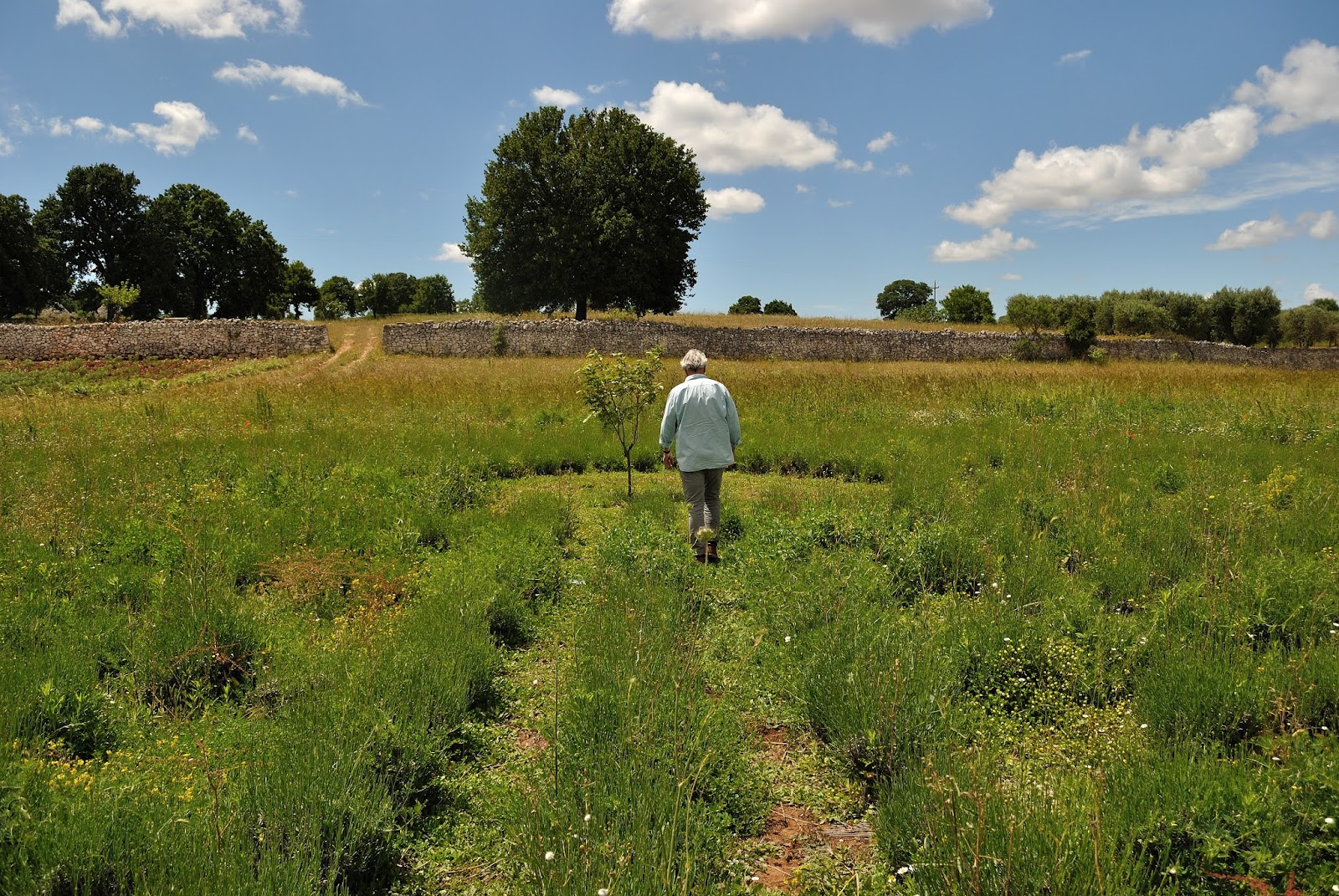
He shows with pride his botanic conservatory.

It’s huge.

For those who are interested, a permaculture course has been scheduled the 19th and 22th of June.

That could be an opportunity to discover I giardini di Pomona and shake hand with Paolo.


Tuesday, 14 April 2015

A sunny Sunday in masseria

On Sunday the weather in Brindisi was just so beautiful: sunny and warm.


The day before, I had got an invitation from Ryan to go for lunch in one of the masseria disseminated in the Apulian countryside.

“Lucia and I will come for sure” I replied by sms.

We catch up on Sunday at 12.30 in a bar by Porta Mesagne.

We are nine of us.

Elis has booked a table in Masseria Parco di Castro.

Frankly, I begin to feel hunger, like, I reckon, all the others.

So, after a quick chat, we decide to make a move. The masseria is not that close, indeed.

We drive along the SS16. 

The masseria is located in Speziale di Fasano between Cisternino and Fasano.

I am an easy driver.

It’s my habit to drive slow. 


The reason is because I just get distracted by the landscape.

Or alternatively, because I have just seen too many times Easy Rider. 

Who knows?!


I have in my car Lucia, my companion, and Franco, a very good friend of mine.

Ryan and I call him Frankie boy because despite of his age, 49, he looks younger.

Finally, we arrive at the masseria.

We sit down on. The others order some food.

I ask for some red local wine.

The food is gorgeous.


We have some antipasti.

Then, for main course we have pasta, or alternatively, meat.

The company is great. We have some good laugh.

Laughing is therapeutic. I laugh as much as I can.  (My laugh is roaring, though. What can I do?)

According to the ancient Romans, laughing was sign of silliness: risus abundat in oram stultorum.

From this perspective, I guess the ancient Romans were just eager to conquer the world instead of enjoying their short life.

After lunch, I get out to sit down and get inebriated by the sunshine.


Masseria is a place where till 40 years ago, the landowners used to host peasants hired to work the land or just to pasture the animals.

In other words, masserie are the symbols of the peasant civilisation.

Nowadays, most of them have been converted to restaurants and B&B.

It is time to leave.

We pay our bill, 25 euros each, and get off.


I take a quick look at the chapel.


It is 5 pm.

We gotta go.

Some donkeys seem to cheer us up.


Eventually, we decide to move to Torre Santa Sabina for a quick walk by the sea.

We won’t be returning to Brindisi before 7 pm.


Today we celebrated the “art of conviviality”.


And we, in Apulia, are master of it.