Wednesday, 28 September 2016

A wine opened my mind

Have you ever had the feeling of travelling with your mind by drinking a glass of red wine?


Yesterday night, I came back in Apulia after a couple of days in Florence, where I have been at Galleria degli Uffizi contemplating Caravaggio, Piero della Fracesca, Botticelli, Tiziano, Giotto, Mantegna et cetera.

It was 11 o'clock pm, we didn't have dinner yet, so I asked Lucia "Would you fancy pasta alio, olio and peperoncino"?

"Yes, sure" she replies. I'm a lucky man, I know.

I start cooking, meantime, I open a bottle of Elce Primitivo of Poderi delle Mura, run by Vito Calia and his bride.


After having drunk the first glass, I could not refrain from sending a message to Vito "Ciao Vito, sono tornato stasera da Firenze. Ho letto la tua mail ed ho subito colto il tuo invito aprendo una delle bottiglie generosamente donatemi: il tuo vino apre la mente. Il gusto, il sapore dischiudono orizzonti inesplorati. Complimenti!"

The problem you may encounter when drinking such a wine is that you would drink the entire bottle. 

Fortunately, Lucia, my wife, calls me from the bed "come to sleep. It's late". So, it came that I drink just half bottle of this fruit juice.

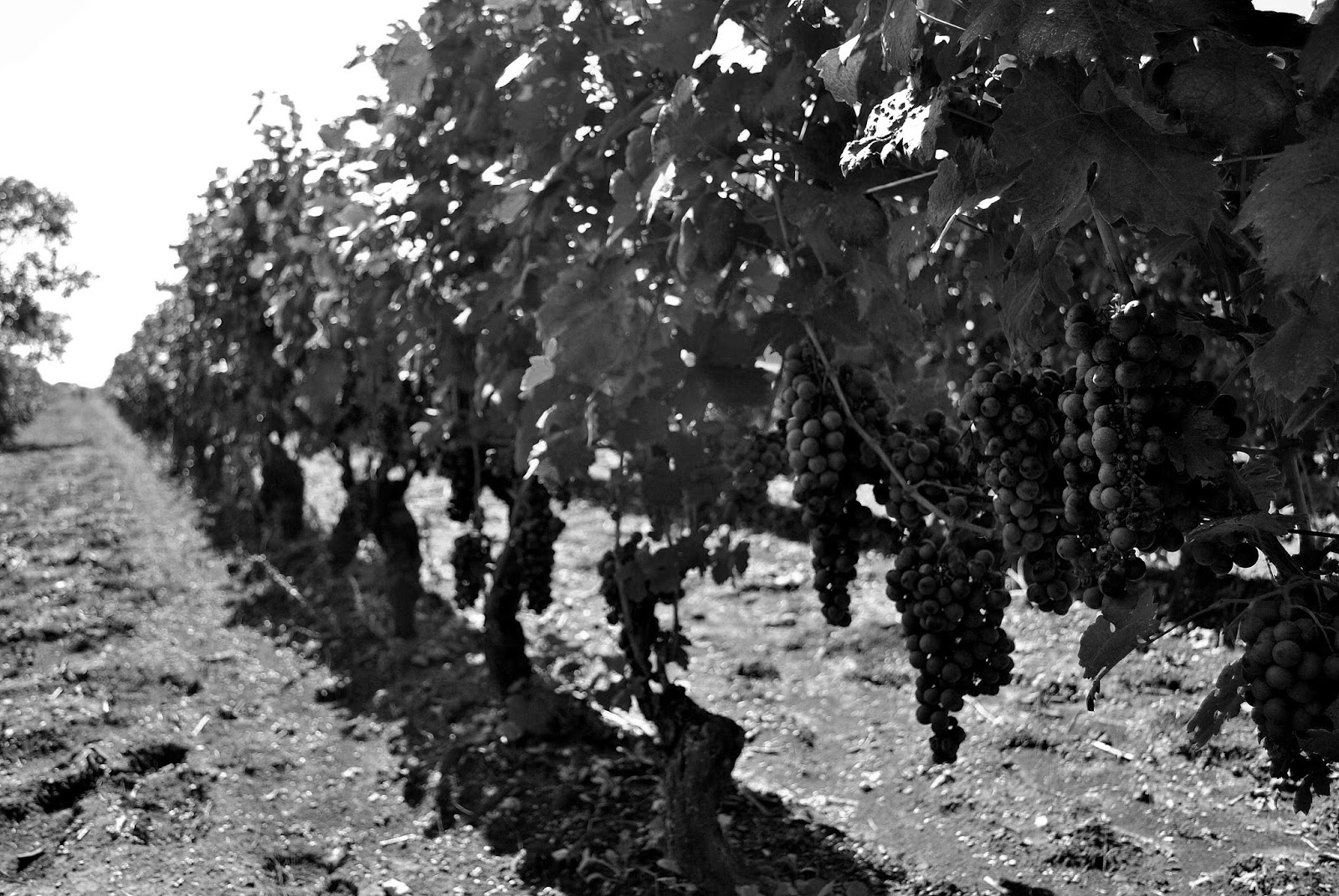
Vito owns a vineyard of just three hectares in Altamura and produce a ruby red Primitivo wine and a White Elce wine (70% Malvasia).


I interviewed Vito a week ago. 


I was so curious to know the story behind this wine as it seems that Vito is the only wine maker in Altamura who has decided to promote his wine. Indeed, he's only goal is quality, quality and again quality.

He picks me up at 12.

"Hi Vito, nice to meet you" I say. 

"Ciao Antonio, please, get in" he replies.

We head straight to the Vito's vineyard, located at contrada Parisi, Altamura.

"I inherited this vineyard from my dad who died in 2003. I wine-make since I was a kid. I didn't go on holidays in summer because I had to help my dad to look after the vineyard" he says.


He continues "When I grew up, my main job was as estate agent, which I've carried out for 18 years. Then, in 2013, the crisis arrived. I blessed that crisis because finally my wife and I took the decision to became professional winemaker, focusing just on our wines."

I listen to Vito and I realise how genuine he is.

What probably strikes me more is the passion that his words emanate.

He tells me that this year he has decided to make his wine stronger (15% alcohol instead of the past 14%) by sacrificing some quantity and delaying the harvest at the end of September.


Ladybirds seem appreciating it. 


"Looking after my vineyard means also defend it from diseases such as peronospora (late blight), which may take place especially in May and June. You know, I plant a rose at the head of each row. Roses work like sentinels when peronospora occurs, because they get sick first, so I'd have the time needed to intervene" Vito adds.


"I'm for a clean agriculture" Vito declares. 

"It's seven years that I don't use anymore copper sulphate (vitriol) because I don't want metal flooding the soil" He says.

I invite you to try his wine.

It won't let you down. Guaranteed.


Sunday, 11 September 2016

Barletta and his sons

Friday 2 September, I have met in Barletta a good friend of mine, Massimo Lunardelli.

I know him since I was in Turin,  20 years ago.


He was invited in Barletta to present his documentary Carlo Cafiero, il figlio del sole as the 1 September occurred the 170s anniversary of Carlo Cafiero's birth.


Cafiero was an anarchist. Born in Barletta, he came from one of the most prominent Apulian families. 


To pursue his ideals, Cafiero drove his family to the brink of bankruptcy:  he had subsidised the building of a fantastic villa in Locarno (Switzerland), fronted onto the lake, where Bakunin and other European anarchists convened.

One of the facts unveiled by the Massimo's doc is that Bakunin contributed to drive Cafiero crazy, because of his continuos request of money. Just to make an example, once Bakunin arranged fireworks, again with Cafiero's money, to welcome his own wife. 

Finally, Cafiero will be admitted to mental hospital and interdicted by his own family, in order to avoid that he fully squandered the family's assets.      


Cafiero was close friend of Giuseppe De Nittis, renowned impressionist painter who gained glory and fame in Paris. 


"Would you like to come along with me and visit the De Nittis gallery here in Barletta?" I ask Massimo.

"Yes, sure" he says.


We catch up just outside the Della Motta's building, where the permanent exhibition is hosted.


"In terms of foreign tourists, many French come here. Followed by Germans" The guide admits.

The De Nittis' paints are incredibly fascinating. 

The colours, the light are impressive.


After having seen the exhibition, we get out hunting for some food.

"You know, I'm reading an intriguing book, I Beati Paoli, by Luigi Natoli, published by Sellerio" I address Massimo.


"I Beati Paoli were a secret sect operating in Palermo in 18th century. They meant to defend the poor against the injustices perpetrated by blue-blooded" I continue.

I add "Someone says that mafia roots in such a sect. It may be, nevertheless, the mafia's purposes are gallantless compared to those pursued by Beati Paoli. There is no doubt about it"

It's afternoon. Massimo is tired so he prefers to retire to his B&B and rest for a while.

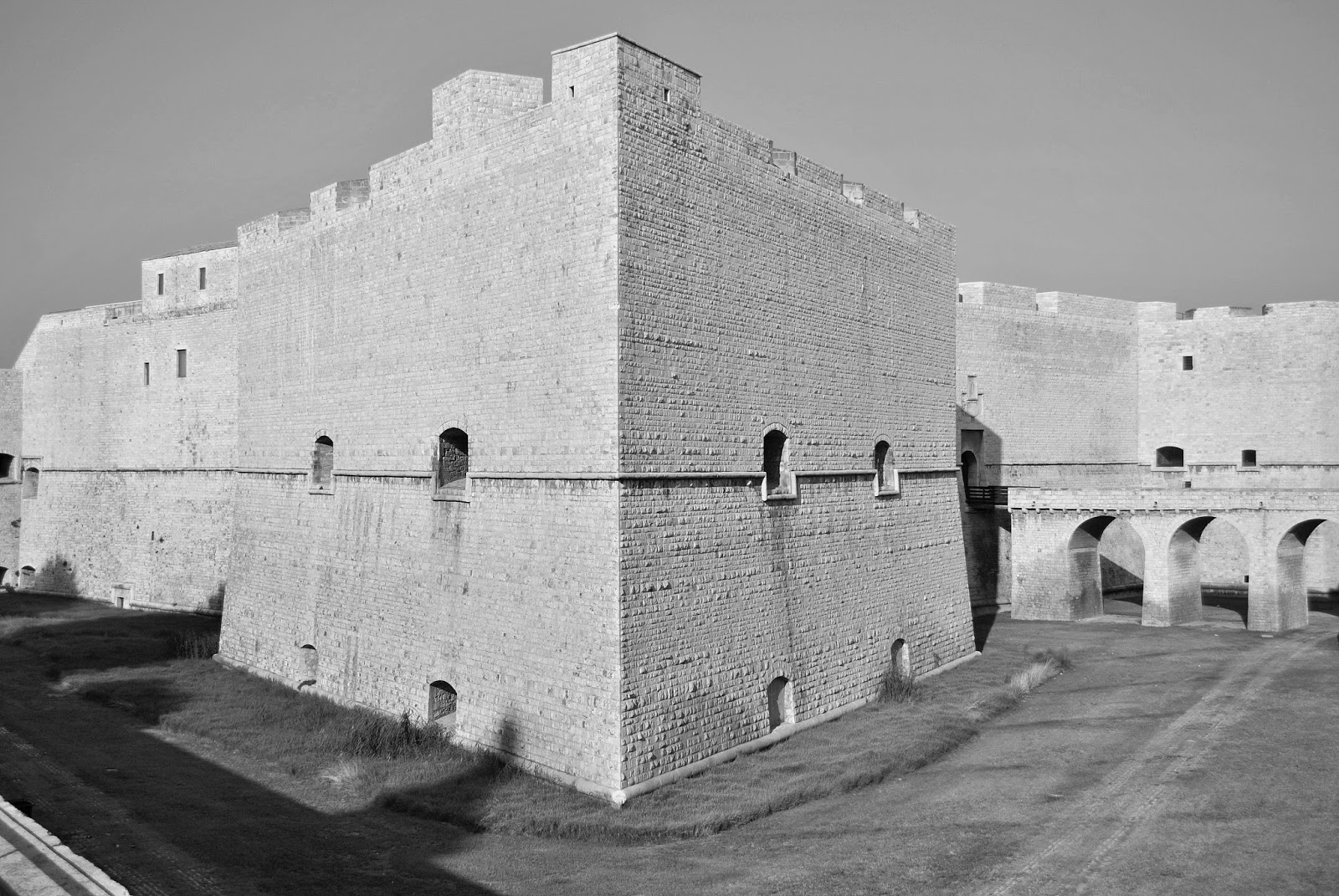
Lucia and I, head to the magnificent castle of Barletta, where is hosted an exhibition dedicated to Hannibal.


Indeed, nearby Barletta, it occurred the battle of Cannae, fought between Romans and Punics led by Hannibal. It's considered the greatest battle (read carnage) of ancient times.

There is an artefact retrieved around Campobasso (south of Italy) which catches my eye. 

It symbolises Tanit, a Punic goddess.

  
It's 7 pm.

Massimo joins us again.

I propose to go to admire the so-called giant of Barletta, a huge statue brought by the sea to the bank between Barletta and Manfredonia. 


Researchers are still unable to identify whom the statue represents.

Other Massimo friend's join us.

We are at the cappero pub, talking till late.

The plaza is plenty of people, not noisy though. 

It's 11 pm. We feel tired. It's time to leave.

I say goodbye to Massimo and others "Ciao Massimo. Take care of yourself".

Sunday, 4 September 2016

Manfredonia, Saint Andrew and procession at sea

Every year on 1 September, the community of Manfredonia celebrates Saint Andrew, protector of fishermen.


This feast follow three days dedicated to Santa Maria di Siponto, portrayed by a Byzantine icon, deeply venerated by the local community.


The celebration of Apulian Patron Saints represents more than just a religious event. It's actually a glue which holds the community together.   

I have come back to Manfredonia the 31 August to stay with my family. 

On 1 September, I take my wife to the Saint Andrew's procession at sea. 

We leave my parents' house at 4.30 and go to the harbour.

Hopefully, we will allowed to get on board.


At 5 pm is expected to begin the procession which will carry the Saint Andrew's statue around the gulf of Manfredonia.


Once at the arbour, I see a fishing boat populated by a big family.

"Good afternoon, Sir. May we join you"? I address the captain.

"Yeah sure" he replies.

A lady gets out the boat, takes my wife's hand and lead her on board.


Fishermen welcome tourists on this special occasion.

Anyone who wants to join them is benvenuto.


Another family with two children embark.

We all look forward to sail away.

I take chance to ask a couple of questions to Giuseppe, member of the crew and captain's son.  


"We fish mainly red mullets, octopus, squids, sepias, basses, gilthread brims and mazzancolle (a kind of shrimp)" He says.


Manfredonia still hosts one of the largest fleet on national scale. Actually, it counts around 250 fishing boats.


Few years ago they were 400. 

Indeed, The European Union is providing funds to all those who dismiss their own boats.

The Mediterranean is deeply suffering the impact of intensive fishing.  

Giuseppe continues "We didn't take part to the procession for a couple of years because of the death of my grandpa". 

Dozens of boats and motorboats follow the one which carries the Saint.


At certain stage, all of them get close at each other and stop.

A wreath is launched from the main boat in memory of those who have lost their life at sea.


A rolling clapping rises to the sky.

Once back to the port, we get out and leave not before having cheered up the entire crew.

I exchange my contact details with Giuseppe.

"Call me in case you need anything" Giuseppe says.

I'll definitely call him when I'll need a couple of kilos of fresh fishes.

Lucia and I don't know why, probably because of the kindness of this humble people, or because of the smell of sea, however, we feel our hearth warmed up.

As Jimi Hendrix used to say "experience it".

Monday, 29 August 2016

Re-discovering Via Appia

Via Appia is the Roman road which links Roma caput mundi with Brindisi door to the Orient.


Built up between 4th and 3rd century BC, via Appia went down in history as regina viarum.

The extension of via Appia came along with the Roman military expansion. 

533 kilometres long, the road is covered of smooth volcanic stones (basoli). Cambered in the middle to let the water run off, it was built with ditches on both sides, protected by retaining walls.  


The map shows Via Appia (white), which main places were Capua, Beneventum, Silvium (Gravina in Puglia) and Tarentum


A couple of months ago, Feltrinelli has published Appia by Paolo Rumiz. 

This book is the result of a long walk undertaken by Paolo Rumiz and his companions (Riccardo, Alessandro and Irene) who have covered via Appia on foot.

Italy has an immense cultural and archaeological heritage, it's so huge that the Italian institutions seem not always able to preserve it.

As result of this, Philippe Daverio has urged the world to get involved in assisting Italy to save its immense cultural heritage.

Indeed, he has promoted years ago the project Save Italy, stating that the Italian cultural heritage belongs to the whole western world, not just to Italy.

According to enhancemyvocabulary.com, 60% of English words have Latin roots.

As occurred to via Appia, Italy has deliberately sold off its cultural heritage to private interests, linked mainly to property investment.

Antonio Cederna was the first to defend via Appia against politicians, speculators, architects and functionaries implicated in the via Appia plunder.


On 8th Septemebre 1953, Il Mondo published the Antonio Cederna's j'accuse "Via Appia should have been religiously saved because for centuries talented men from all around the world have loved, described, painted, sung it […] Via Appia should have been saved like the Acropolis of Athens".

On 25 August 2016, Masseria Jesce (Altamura), a fantastic masseria which was once a roadhouse of via Appia, has hosted Paolo Rumiz and the filmmaker Alessandro Scillitani to discuss about their trip discovering and mapping Via Appia.


"A journey like this, made on foot, gives you the feeling that the space turns expanded, deep". Paolo Rumiz begins.


"By living a sedentary life, we do not cultivate the skill of reading the body language of people we encounter. Talking about this journey, when we came across the locals, they first looked at us suspiciously, then turned calmed, finally they became interested in what we were doing". He continues. 


"The best moment to undertake a long walk is when your head and hearth is full, when you have had enough" In other words, walking is therapeutical, and I fully agree with Paolo Rumiz.

He says "During a meeting in Matera, someone said that this journey had a strong political implication, in the sense that it shifts the barycenter to the South of Italy". 

"Via Appia is unique. It makes sense to walk from Rome to Brindisi and vice versa. In other words, the Roman legions came down to Brindisi as well as in the Middle-age the crusades walked along via Appia to reach Brindisi and departing for the Holy land. On the other hand, Catholicism arrived in Rome from the South."

"We have met so many peasants. It was great to talk with them. I remember one of them in Gravina in Puglia. He thought we were grave robbers. "Here the soil conceals so many graves ascribable to Silvium times" he justified himself". Paolo says.

"The South requires a new narration, free of stereotypes. It must be done also because of the current historical and geopolitical situation". 


Alessandro has made a documentary from this journey.


"It took us 30 days to cover via Appia. I was struck by the sound of dialects, by random encounters, by the beauty of the landscape. I have filmed the communities we came across" Alessandro says. 

The talk goes on till midnight.

Outside is dark, and a fresh air grabs our senses.

We are invited to visit the crypt of masseria Jesce, adorned by frescos which echo the Byzantine ones.

In this awesome scenario, a musician duo is going to play music to entertain the audience.

They are Massimiliano Di Carlo&Veronika Otto, respectively from Ascoli Piceno and Berlin.


Their mission is discovering songs from old people and propose them to their audience.

Massimiliano begins singing a Mongolian song, made by just one note. It's an ancestral sound.

Then, they offer us a fantastic tammurriata, explaining us its cultural roots. Just to clarify, tammurriata is the Neapolitan version of  tarantella, "a sound brought by ancient Greeks in the south of Italy. It spread till Ancona, though" Massimiliano points out.

Finally, the duo offer us a typical song called Saltarello, a kind of tarantella typical of center Italy.

After their fantastic performance, I get closer to Massimiliano and ask his name "you know, I write a blog and I'd like to mention you guys because you really do a great job".

While talking with Massimiliano, Paolo Rumiz gets closer and listen to us.

"Of course, I will write about Paolo Rumiz and his great book either" I say.

Paolo Rumiz replays "Well, Massimiliano needs to be reported more than me".

I answer: "Well, I need it too".

Both of them burst laughing. I laugh too.

It's 1 o'clock. Outside it's getting cold but the fire burns inside me.

Tonight I have had great time and learned a lot.


Monday, 22 August 2016

Journey to Sicily

While heading to Sicily, I feel completely inebriated by the fashion which this island emanates, core of the Mediterranean culture, the joint between Africa and Europe.


Lucia and I, board on ferry at Villa San Giovanni, nearby Reggio Calabria.


We're heading to Messina, leaving Calabria at our back.

The time we have planned to spend in Sicily is 7/8 days.

Therefore, we decide to travel around the Eastern Sicily. 

Once arrived in Messina, we drive straight to Taormina.

It's hot here. We are at the longitude of Maghreb.

So, before arriving at Taormina, which beach we imagine will be crowded, we stop by Santa Teresa di Riva (pictured).


I'll remember forever how hot was the gravel beach. In fact, I'm forced to dress my flip flop to walk around.

And what about that diaphanous sea? So fresh, so reinvigorating…

We are delighted to be here.

Additionally, there are free showers installed on free beach, available for anyone.

I pay great respect to that municipality, who provides free services to welcome travellers.    

After having swum and sun bathed for a couple of hours, we resume our journey.

Once arrived in Taormina, I realise that the town is located on the mountain, not by the sea as I would have expected.

In order to visit Taormina, I am obliged to park the car in a multilevel car parking.

Then, we get the lift and reach the 7th floor.

Once out, Taormina discloses itself in front of our eyes.


Taormina is a so beautiful place to visit.


Indeed, Taormina is invaded by tourists, particularly by French, a constant in our journey.

From my perspective, the most beautiful thing to see in Taormina is the Greek theatre.
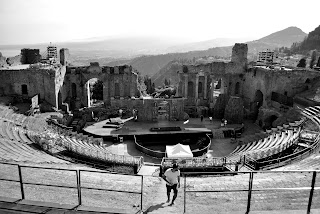

What awesome view: beyond the proscenium I see the Vulcan Etna on the right, whereas the sea is on the left. 

Probably I had never seen anything like this before.


After having spent three hours there, we decide to move on.

It's 7 pm, we have booked a room in a B&B in Acireale, which is 45 kilometres away.

I drive, even though my mind has still impressed the bella Taormina and its amazing theatre.

We pass through Giardini Naxos, which is known to be the oldest Greek settlement in Sicily (8 century B.C.). 

Then, we drive through Giarre. 15 more kilometres more and we reach Acireale.

Once there, we arrive at B&B, take a quick shower and get out looking for Baroque architecture to delight our eyes.

The rhythm of this holiday will always be like this: walking, driving, swimming, visiting museums, sleeping all over again

It took me almost one week to fully recover after the journey.


The day after, we leave Acireale pretty early because we wish to see Aci trezza, the location where Giovanni Verga set his wonderful novel I Malavoglia.


We were expecting a village of fishermen untouched by modernity and concrete.

Unfortunately, the reality is different. 


To console ourselves, we stop at a bar along the sea and have a granita al limone, a typical Sicilian one made with local lemons.


We don't want to waste time, so we quickly move to Catania, where we have booked a room in a B&B.

Catania is one of the greatest surprise of the trip.

Elegant, baroque, historical, alive and plenty of art.

We gain our room in Catania, rest for a while, take a shower and get out at 5 pm.

The city centre is amazing. An elephant dominates Piazza del Duomo, the main plaza in Catania.


What strikes me is the fact that an animal that lives in other continents turns to be the symbol of an European city.


50 metres far from the elephant, we find a monumental fountain made of Carrara marble. 

It's called fontana dell'Amenano.


In Piazza San Francesco, 500 metres from Piazza del Duomo, there is a marvellous Greek-Roman theatre. It has been restored and re-opened a couple of months ago.


Catania seems to me a city where the local institutions work hard for the sake of community.


I found in Catania a place of book crossing made available by the municipality.


"We have started with a bunch of books, then people made this project growing by donating their own books. Currently, we have thousands of book. Anyone is welcome here and may exchange  books" a lady says. 


Another place worth to be seen in Catania is the fish market.


Try to be there at around 8.30/9 am.


We have little time because tonight we are going to sleep in Siracusa.

So, we quickly move on and go to see the Castle Ursino, which hosts a temporary paint exhibition on Madness, which encompasses so many Ligabue's paints.


We get out the Orsini castle and head to the Bellini theatre. 


Bellini, born in Catania, died in France when he was 34 years.


The theatre, dedicated to the author of Norma, is just fantastic.

The ticket includes a guide who narrates its history. 


Finally, due to limited time, we leave Catania not before having admired Palazzo Biscari, the most astonishing private palace of this astonishing city.


Even J. W. Goethe visited this palace during his journey to Italy


Our guide is actually a descendant of Prince of Biscari, who built it up after the earthquake of 1693. 

The guide is called Ruggero Moncada di Paterno'.


He is an affable gentleman, who speaks Italian, French and English, according to the tourists he copes with. 


We leave Catania which has impressed us a lot and head to Syracuse.

From an historical perspective, Syracuse was a powerful city which fought against Athens as well as Rome.

His most famous son is Archimedes, scientist and mathematician.


During the siege of Syracuse, Archimedes invented burning glass to set on fire the Roman ships.

Disgracefully, he was killed by a Roman butcher.

There is a lot to see in Syracuse.


The ancient part of the city is called Ortigia


In Ortigia you'll find the Santa Lucia's church hosting the Caravaggio's seppellimento di Santa Lucia.

If you go there and want to eat something unique, asks for pasta con le sarde


Nevertheless, as sarda is an oily fish, bear in mind to not eat it for dinner as it requires a lot of time to be digested.

We visit the Syracuse archaeological park.

There is the Ara di Ierone as well as a huge Greek Theatre.


However, I believe the most fascinating thing to see is the Ear of Dionysius, a quarry which was so called by Caravaggio.


After having admired Syracuse, we move on and go to visit Ragusa, Modica and Noto, earth of Sicilian Baroque, An Unesco world heritage site.


In Ragusa, I have bought an interesting book called Storia di un amicizia, which talks about the meetings of a local photographer, Giuseppe Leone, with three Sicilians, who are among the greatest Italian writers: Leonardo Sciascia, Gesualdo Bufalino and Vincenzo Consolo.  


If you wish to find out more about Sicily, and its contradictions, you must read the Sciascia's books.  


During an interview, Leonardo Sciascia said "I have covered an institutional role both in the Municipality of Palermo and in the Italian Parliament. In both cases, I have always had the feeling that who rules is somewhere else, the decisions are taken outside the institutional sites". 


Additionally, I wish to report what Gesualdo Bufalino said about mafia and how to fight it "books, books and again books! Plus, many teachers in primary schools".


The last thing I wish to talk about this wonderful journey, is the mosaic of the Roman Villa del Casale in Piazza Armerina.

This mosaic is famous all around the world both because of its magnificence and for being almost untouched.


The artists who made this amazing mosaic came from North Africa.

It took 50 years to complete it. 

Basically, two generations, father and sons, have worked on it.

For all these reasons, Sicily may rightly be considered the ombellico del Mediterraneo.

The last thing I want to say about Sicily and its inhabitants is to highlight the humanity shown in handling the exodus from Africa. 


The compassion of people in Lampedusa is well described by the documentary Fuocoammare, shot by Francesco Rosi, which has won the Berlin festival 2016.


Come to Sicily for a while in order to stay human.

It will be the antidote to these dehumanising times.