Friday, 15 August 2014

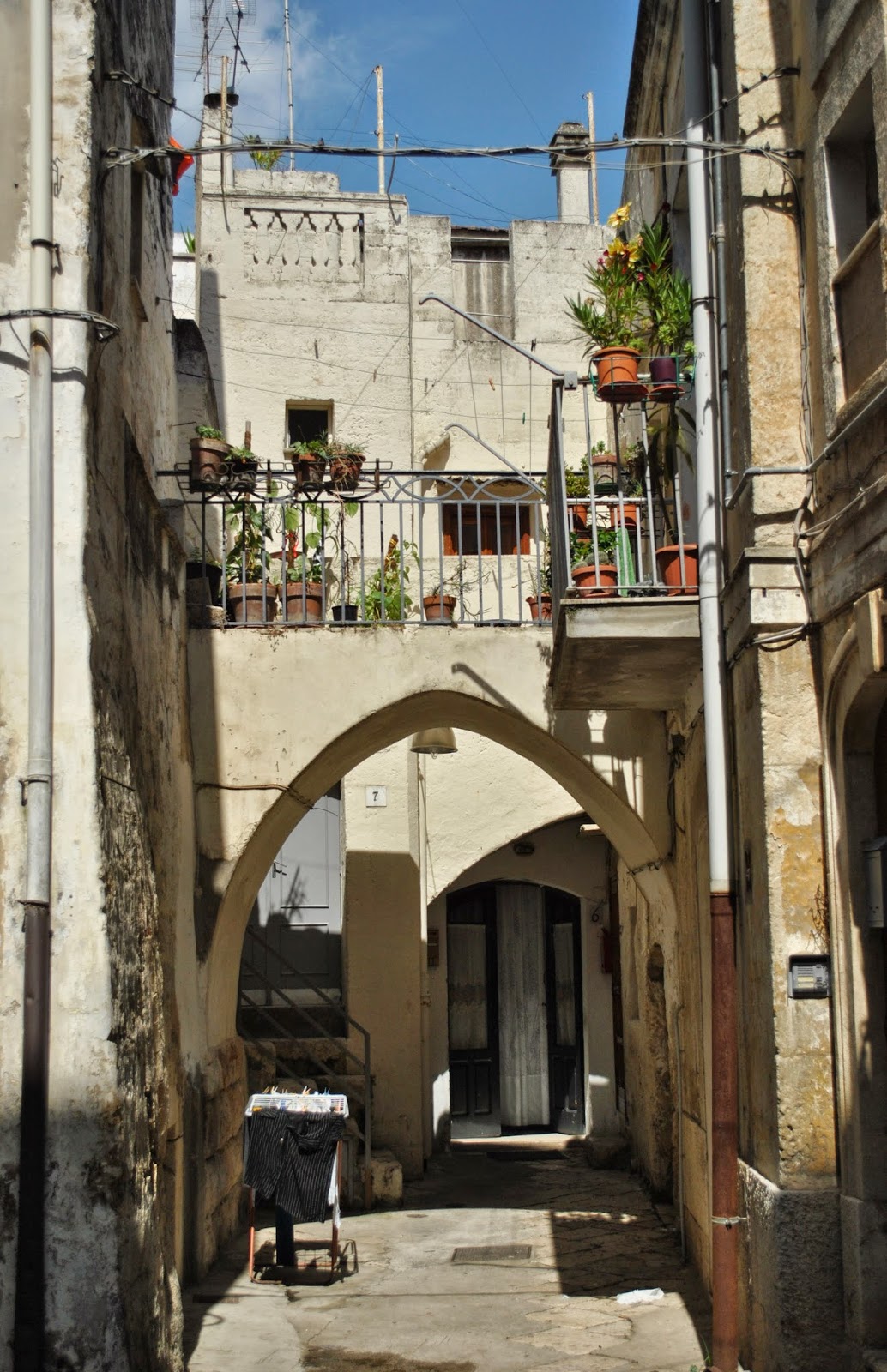
Lecce, capital of Apulian Baroque

Lecce is one of the Apulian cities which tourists seem to be fond of.


Yesterday, I went to Lecce at Notte della Taranta, a folk music itinerant festival.

However, on the 23rd of August, the latest, huge concert of Notte della Taranta festival will be held in Melpignano, close to Lecce.


Notte della Taranta is one of the most popular folk music concerts in Europe.

Every year, the concert in Melpignano attracts almost 50.000 people.

It is a joyful party, where people free their spirit by dancing the Pizzica, a faster version of tarantella.

So, let’s come back to Lecce.


Lecce is a magnificent city, a candidate to be European capital of culture 2019.

It is located in Salento, area which encompasses the province of Lecce, Brindisi and partially Taranto.

The Baroque in Lecce is joyful.


Baroque, influenced by the Spanish Plateresque style, took place between the 16th and 17th century, after the battle of Lepanto.


The battle of Lepanto sanctions the end of the Ottoman threat to Europe.


The local upper class, in order to show its status, financed the constructions of new buildings and churches. 


Additionally, buildings already existing, were renewed with Baroque motifs.


The workforce was directed by two great local architects: Giuseppe Zimbalo and Giuseppe Cino.


One additional peculiarity of the local Baroque is due to pietra leccese, the local stone.

The pietra leccese  is easy to work with.

An additional peculiarity is its warm color.


The film industry has played a key role to the success of Salento, of which Lecce is the main city.  

Edoardo Winspeare is the filmmaker of movies set in Salento like pizzicata, Sangue vivo, il miracolo and Galantuomini.

These movies portray a society with a strong connection between the past and the present.

The soundtruck of his movies is obviously the pizzica.

Pizzica, which will be celebrated at Notte della Taranta in Melpignano on the 23rd of August.

Let’s meet up there, then.

If you wish to view more pics, please click here

Wednesday, 13 August 2014

Ceglie Messapica, where the inner city is white like a pearl

Yesterday, I visited Ceglie Messapica for the first
time.


So, I have to admitt that I was highly impressed by its beauty.

I went to Ceglie Messapica to watch the concert of Goran Bregovic, event held within the Ghironda summer festival.


Ghironda is an International festival of arts from the five continents

.

This edition is dedicated to Nelson Mandela.

On the Ghironda web site it’s reported a Mandela’s eloquent quote: “It’s music and dance that make me feel at peace with the world”.


The concert would have commenced at 10 pm, however, I was already there at 7.30 pm. 

The sunshine was still bloody hot, hammering on my poor head.

Indeed, I wished to take pictures of Ceglie before the sunset. When there is the “magic light”, as my English tutor of a documentary course used to call it.

The magic light gives a spectral touch to the Ceglie inner city, which strikes me because is white like a pearl.


People there is very friendly.

While enquirying with the locals where to eat well with little money, two men gave me a lot of tips about.

They were licking their icecreams. The funny thing was that they were so captured by talking that their mouth turned to chocolate.

They looked to me like two kids who did not have a care. They were involuntarily showing me their childish side. It was great…


While walking and taking pictures, I realized that there were lots of turists around, Italians and foreigners. I heard people from Eastern Europe and English as well.

Ceglie Messapica is part of valle d’Itria, one of the most renowned places in Apulia.


Trulli are rightly considered the symbol of valle d’Itria. 

So, Trulli are spread around the countryside of Ceglie  as well.


Last but not least , if you wish to spend your holidays in Ceglie, you have to visit the castello Ducale, built up in the 11th century, and renewed in the 15th century.

It is a magnificent building, worth to be visited. 


So, if you wish to come here but you need additional information, do not refrain from giving me a buzz…

If you wish to view more pics, please click here
Take care


Monday, 11 August 2014

Polignano a Mare, where environment and culture meet up


Polignano a Mare is one of the nicest town in Apulia.

The sea is deeply blue.


It is built along the seacoast, on the rocks.

Underneath, there are amazing caves which can be visited.

Actually, some restaurants are right into the caves


From my point of view, the most pictoresque beach is cala dei Turchi, located in the inner city.


Polignano is the birtplace of Mr. Volare, Domenico Modugno.

In my opinion, the context in which you grow up affects very much your personality.


Every time I walk around Polignano, I feel a positve energy, good vibrations. 

People smile, talk, joke...I like the atmosphere here very much.


Additionally, Polignano has  a sparkling cultural life.

Polignano hosts the unique Museum of contemporary art in Apulia, the Museum “Pino Pascali”.

The museum is dedicated to Pino Pascali, an artist from Polignano. 


He moved to Rome to study art. So, he grew there artistically. 

He died in 1968, when he was only 33 years old.

Pino Pascali was an eclectic artist. 


He shared a lot with the Arte Povera (litterally "poor art") movement.

In the early 60ies, he used to walk around Rome at night time, in order to collect anything which could be used to create his works.


Nowdays, His works are exhibited all around the world: the Tate Gallery in London, the Musuem of Osaka and so on.


The Museum “Pino Pascali” has recently bought one of his works, treno (1964).


The entire community, supported both by the local Municipality and Apulian region, has raised € 80.000 to purchase it from an Italian private collector.

However, the market price of treno was esteemed to be much more expensive, around € 110/120.000.

So, if you come to Polignano on holidays, a visit to the Museum “Pino Pascali” is a must.

If you wish to view more pics, please click here

Have fun


Saturday, 9 August 2014

Alessano, the birthplace of Don Tonino

Alessano is located in Salento, 3 miles far from the Ionian sea.


In the middle age, monks from the Orient took refuge in Macurano, close to Alessano.

They were escaping from the bloodshed caused by the Iconoclasm. 

They lived on there peacefully, growing crops.  


Alessano is a quite village, where you can find around nice buildings and churches.


The streets are filled with flowers.


I breath air of spirituality in Alessano.

Probably, it is due to the fact that this is the birthplace of Don Tonino Bello.


According to the movie The Godfather, Don is the evil character personified by Marlon Brando.

However, concerning Don Tonino, I talk about a human being comparable to Gandhi.


During the war in the former Jugoslavia, Don Tonino with few hundreds people went straight to Sarajevo.


The Bosnian capital was at the time surrounded by snipers and Serbian soldiers.

However, like a new St. Francesco, Don Tonino brought there a message of peace and nonviolence.

Don Tonino, bishop of Molfetta, was the one who drove around the city at night time, taking on board drug addicted and alcoholics. 

He drove them to his house and let them sleep in his bed.


I dedicate this post to Don Tonino, to his message of love, peace and nonviolence.

If you wish to view more pics, please click here

Wednesday, 6 August 2014

The salt of Margherita di Savoia

Margherita di Savoia is synonymous of salt.


Indeed, Margherita has the largest salt mine in Italy, and the second one in Europe.


The salt was collected there since the 3rd century AC.


Everytime I drive along the road which goes by the saline, I breath such a reinvigorating air.


In addition, I have on one side the Adriatic sea with the Gargano on the horizon.


Then, on the other side the mine salt.


The nature reserve of Salina of Margherita di Savoia has been established in 1977.

The wetland hosts a wide variety of flora and fauna.


Specifically, it hosts a broad number of birds, among them there is the greater flamingo, which nests on permanent basis within the Saline.

Margherita was given this name in honour of Queen Margherita of Savoy. 

Before it was named Saline di Barletta, due to its proximity to Barletta.

In Margherita there is a well known health spa, where there are units for inhalation treatment, mud therapy and much more.


The most characteristic holy day in Margherita is the one in honour of St. Michael, which is held on the latest Sunday in September.


Once, I was forced to witness the celebration of St. Michael because the road was temporarily closed due to the Procession.


Hundreds of people were heading to the church, which is located beside the Torre di Pietra.

I was amazed by the litany sung by the women, followed by the marching band.


The blue sky, the white bed of salt... 

The colours around the Saline are just so picturesque, ideal for those who love to take pictures.

If you wish to view more pics, please click here

Sunday, 3 August 2014

Altamura is not just…bread


Altamura is a very nice town located in an Apulian area named Murgia, on the top of a hill.


It is very much close to Basilicata.

People from Altamura are hard workers.


Tommaso Fiore was born in Altamura. He was a writer and an antifascist politician. In 1952, he wrote a book named un popolo di formiche (people like ants).

In his book, Tommaso Fiore pointed out the strenght and obstinacy of people from Murgia, who live in a difficult, if not hostile, environment.

Altamura has known almost two decades (1980-2000) of full employment due to the distretto del salotto (the sofa manifacturing district).


Nowdays, Altamura is reinventing itself.

This is the Italian capital of bread. 

However, the entire set of bakery products here is superb. 

The story of a McDonald which shut down because of a local focacceria (pizzeria), represents a case history of resistence to the homogenisation. The story inspired the docufiction Focaccia Blues.


While walking along C.so Federico II, which is the main street, I come accross few lads handling a steadycam.

The guy with moustache is a local photographer who is testing this innovative steadycam.


It is innovative because it is an automatic control steadycam.

The two guys who invented it are two young engineers both from Apulia. They would like to patent their creation (www.icecam.it)

The inner city of Altamura is cluttered with claustri, which are streets with dead-end.


If you go to Altamura, I strongly recommend you to visit the National Museum of Altamura. 


the museum hosts a permanent exhibition, rich of interesting artefacts.


Probably the most curious one which I have seen is a phallic idol of 3rd millenium BC.


I am starving now, so I am going to end up my journey here not before having eaten a tasty focaccia.

If you wish to view more pics, please click here

Buon appetito