Monday, 10 August 2015

Monopoli and the rupestrian church of the Holy Spirit

A couple of days ago I received an invitation to visit
the rupestrian church of the Holy Spirit (10th century).


The Municipality of Monopoli promotes the event.

I do not want to loose the opportunity to visit a 
monument considered unique, comparable just to 
few churches located in Cappadocia (Turkey).

Therefore, on Friday the 7th I call the tourist guide 
(Giuseppe) and book the visit at 6 pm.

The meeting point is in the city centre of Monopoli 
(Piazza Vittorio Emanuele II).


Once there, we find a 
shuttle waiting for us.


“That’s great” I think to myself.

The shuttle is plenty of tourists.   

Transport and access to the church are free of 
charge.

While crossing the city on board of the shuttle, we 
notice the amazement painted on the face of locals 
“Where the hell are they going to?” They seem 
thinking.

Once arrived, we get off the shuttle and follow 
Roberto, an archaeologist who is going to describe us
the marvels of this church.


The church is located around 10 metres underground.


I remain behind, observing the others stepping down
the stairs.

Actually, I’m wondering if the idea of building a 
church into the land is somehow connected to the 
ancestral rite of Mothe Earth (Paleolithic).

Who knows? Probably I’m wrong. Or probably, this 
attachment to the land was still occurring despite the
thousands of years.

The church of the Holy Spirit is fantastic.


It has three navate (naves), despite its tiny scale.

What really strikes me is the vault a crociera and the 
columns, with at their top amazing capitals.


“The columns have just decoration purposes” 
Roberto points out.


“The church of the Holy Spirit echos the Romanico-
pugliese cathedral of Bari.” He adds.


Nori has worked here as restorer.


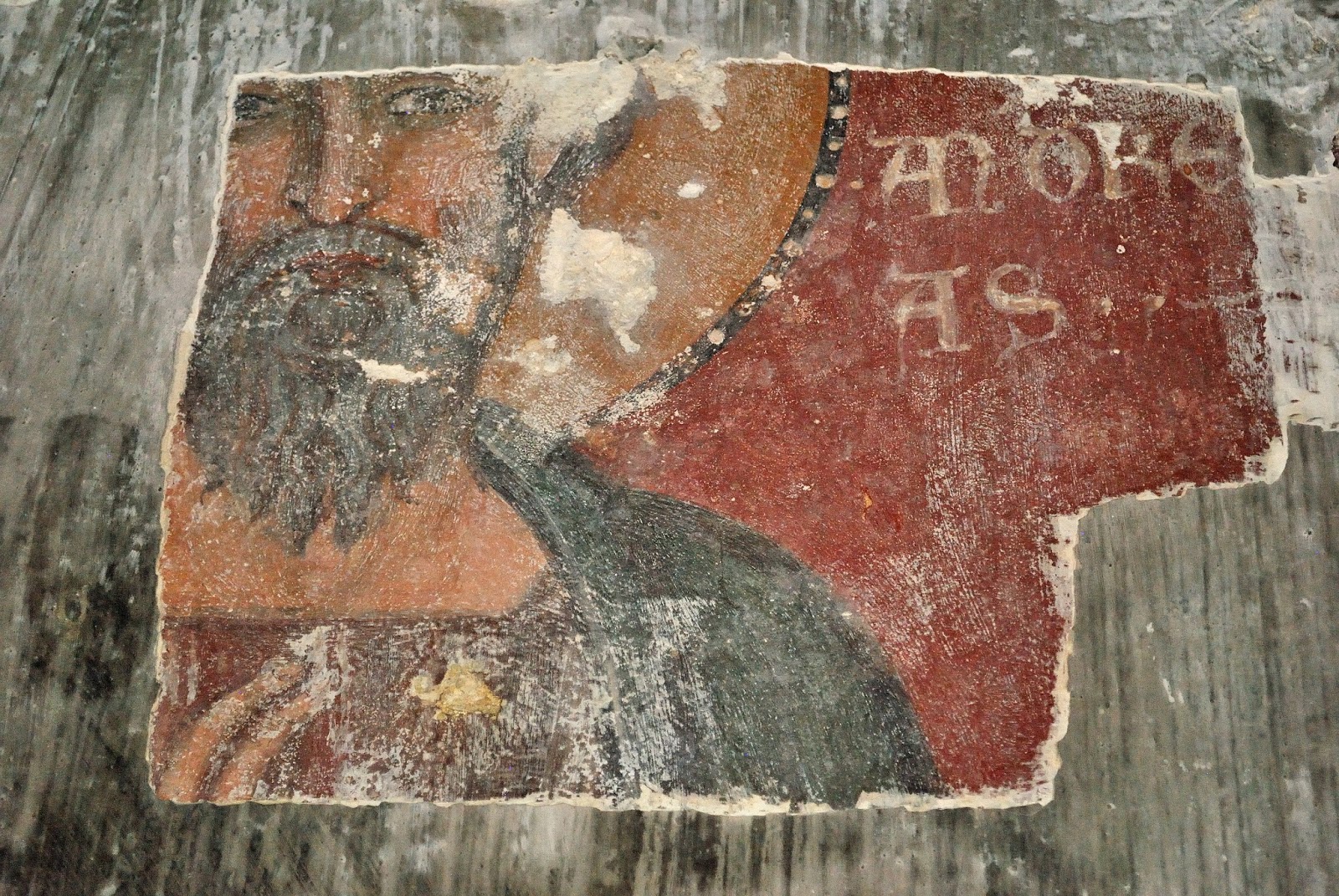
“We have discovered frescos from the 18th century” she says.


Their touch reminds the Byzantine style.


Nori adds “Of course, it seems pretty obvious that
more palinsesti are overlapped”.


“Unfortunately, it would be needed more money to 
reveal the entire set of frescos”.

The project of rescue has been managed by the San 
Domenico foundation, which has got financed for 
50% by Caripugliafoundation (Cassa di Risparmio di 
Puglia). 

The remaining 50% by the Municipality of 
Monopoli.


Works to consolidate the church have been 
completed in 2011.

“Monopoli has around 20 rupestrian churches” Nori says.

Roberto adds “Apulia counts around 300 rupestrian churches.

The time of visit is over. 

Indeed, at 7 pm there is another route, therefore, we
are urged to get on board the shuttle.

Lucia and I decide to spend the evening in Monopoli.

We head to the city centre.


After a quick walk, we 
find another rupestrian crypt (Madonna del Soccorso) which is shamefully closed.


What’s the point in having so much cultural treasury,
and not let people and tourist admire them.

Cultural heritage is the non plus ultra in terms of 
identity of a community.


Fortunately, we find out a new 
rupestrian church 
underneath Santa Maria degli Amalfitani, the only
example of Romanico-Pugliese in Monopoli.


We encounter Angela, the tourist guide of this church

“The church takes its name by those who funded it,
the Amalfitani, which were based in Monopoli to 
trade goods and products”.


According to the legend, in 1059 a crew of Amalfitani
survived a shipwreck.

As result of this, they built it up and dedicated it to
the Holy Virgin.

After having admired this church, we continue our 
walk along the port which leads to the castle.

The sky is turning pink.


Along the walls of the castle there are few interesting
restaurants.

Tourists and locals seems enjoying this Mediterranean night in Monopoli.


Monday, 3 August 2015

The rocky park of Lama d'Antico

In Apulia human beings have inhabited caves since the beginning of time.


This custom went on till the Middle-Age.


This phenomenon must be framed within what it’s called “Mediterranean civilisation”.


The rupestrian park of Lama d’Antico is in Savelletri, nearby Fasano.

We have decided to spend there the Saturday night.

Antonella, as Virgilio with Dante in the Holy Commedey, takes us through Lama d’Antico.


We get along a path with candles disseminated all the way long.


It seems to me like travelling back the ancient times, with no noise, no lights. 

Just us and the sky above our heads.

Describing the site, Antonella points out that “the further rupestrian site is in Ethiopia”.

Lama d’Antico is a vast rupestrian area, where you can admire houses, churches and laboratories excaved in the rock.

This area once was a river-bed, which channeled water from mountains (Murgia) to the Adriatic sea.


“Here people used to cultivate olive trees and much
more”. Antonella says, while stopping by a very old carob tree.

Houses are allocated opposite to the rising sun.


In this way, the ancients benefit from being warmed and enlighted by the sun.


Antonella leads us to visit the church of Lama d’Antico, which is one of the three churches existent in the park.


This is an Orthodox church (a croce greca) so beautiful, so rich of details.

This church has been made in the 12th century.

It reflectes the Romanic style.

It has been probably excavated from the top.

There are still visible few frescos, which  entirely preserve the  magic of touch of the Byzantine artist who actually made it.


God (pictured) is portrayed within an oval pattern which represents an almond.


According to the Christian symbology, almond means rebirth.


A tomb has been discovered by the altar.

 “That advise, written in Greek, reports that a woman is buried here. We assume that she had to be pretty rich to afford it” The guide states.


I add “nothing is changed. Churches still work in the same way”. The audience burst laughing.

Among us there is a couple of Bologna.

“We come every year to Apulia to spend our holidays” They say.

Along the path, we see the works of a local artist, Giovanni Carpignano.

“I pick up neglected stuff left in the countryside such as hoes. These tools belong to our identity, to the peasant civilisation” Giovanni explains.


It’s dark, completely dark.

I scrutinise the sky, plenty of bright stars.

A full rising moon cheers us.

I have dressed the shoes of ancient Apulians of Lama d’Antico.

I strongly recommend you to come over here and admire this unique landscape.

The park of Lama d’Antico has joined the project #Pugliaopendays, so on Saturday evening entrance is free.

Before leaving, we spend some time talking with Angela Brucoli, a photographer from Fasano.

She’s been delighting the audience by projecting pictures taken by her book Simboli e segni di Puglia.


She appreciates #Pugliaopendays.

Nevertheless, she disapproves the Road Show as way to advertise Apulia “It’s definitely a waste of money” she complaints.

I’d like to stay here longer, but my darling wish to come back home.

We get on our car and leave behind the park.

After having driven around 100 metres, I distinguish a couple walking in the dark.

I recognise them. They had visited the park with us.

I roll down the car window and ask “Hey guys, do you need a lift?”.

The man looks at me for a while. Then finally replies “yes, please”.

“Come on, get on board” I reply.

“Did you guys come to the park on foot? It’s dangerous, isn’t” I say.

“It is indeed. We didn’t realize it”.

Lucia, my beloved, asks them “where do you come from?”.

“Well, we come from Vicenza” they answer.

“We are arrived. We get out here. Thank you so much” They say.

“No problem. Good luck” we reply.

Now, it’s time to come back home.


Home sweet home

Wednesday, 29 July 2015

Joy Welcult and the project of an ecomuseum

Few days ago Katja from Thalassia invited me by e-mail to the seminar Joy Welcult, to be held on Tuesday 28th in the Mesagne’s castle.


The Joy Welcult project, co-funded by the European Union (ERDF) and by National funds of Greece & Italy, aims to realize an ecomuseum in both the countries.


The Apulian Region has indicated Mesagne, and its neighbour towns, the area in which the ecomusuem will be realized.


What is an ecomueum? And why creating an ecomuseum in Mesagne? 

The ecomuseum merges cultural heritage and environment.

The goal is to let the citizens be more aware of their identity.

Therefore, associations with support of public and private players, are strongly invited to give their contribute.

In this specific case, the common background is represented by the Messapian area of Mesagne, Latiano and other towns (yet to be selected) which share history and traditions.

Damiano Franco (pictured), president of GAL Terra dei Messapi says: “we wish that Mesagne and Latiano co-operate to develop the archaeological site of Muro Tenente”.


By the way, Messapia is a pre-roman civilisation, with Illiric roots.

Mauro Paolo Bruno (pictured), Dirigente ufficio beni Archeologici e Architettonici della regione Puglia, reports: “the National Confederation of Craftsmen (CNA) is leader partner of the Joy Welcult project”.


Simonetta Dellomonaco (pictured) states: “According to CETS and European Landscape Agreement, the landscape is what citizens perceive as landscape”.


“We’d like you guys to find the name of the ecomuseum” She addresses to the audience.

Within this framework, booking on-line and e-commerce will be implemented in order to support local producers to trade their goods and manufactures.

Roberta Lopalco (pictured) points out: “the Apulian Piano Paesaggistico Regionale is strictly connected to the Joy Welcult project”. 


Apulia is the first Italian region to adopt such a Piano, meant to preserve the Apulian landscape.


Francesco Baratti (pictured) has written a book about this topic Ecomusei, paesaggi e comunita'. Esperienze, progetti e ericerche nel Salentoedited by Franco Angeli.


He passionately talks about the importance of carrying out an ecomuseum in Mesagne, province of Brindisi.


However, he adds: “Italy still lacks of a national law on ecomuseum”. I think to myself that this is a shame.

The speakers would like to continue talking about it, however it’s 1.30 and people begin to be hungry.

So, after few audience’s remarks, whom contribute is genuinely invoked by the speakers, it’s time to have lunch.

I fill my glass of white wine as well as my dish of bruschetta and pettole.

While eating, I start a conversation with Paolo, an anthropologist, who works for La Manovella, an association located in Mesagne.

“You know” he says “I am a blogger as well”. “Really?” I reply. “Yes, the address is urbanslumsconnection.blogspot.com

While talking with others who attended the seminar, I discover another blogger. “My name is Jovanka. I feel fulfilled when I focus on my blog ilmiosognodiviaggiare.blogspot.com”. She says.

I am so astonished by the high number of bloggers.

It’s 2.30.

It’s time to leave.

I feel so merry after just two glasses of wine…