Showing posts with label biodiversity. Show all posts

Thursday, 11 June 2015

Pugnochiuso, homage to Oliver Rackham

Today I’m going to narrate you about an amazing place named Pugnochiuso, located in Gargano, north of Apulia.


I have been there one week on holiday.

Pugnochiuso represents for me the ideal place where to reinvigorating myself.

No cars around, an immense biodiversity, a green emerald sea. 


What else shall I ask for?!?


I know Pugnochiuso quite well as I have been working there for three years, just in summertime. It was a  seasonal job.

I was a shuttle driver.

I was paid to take tourists up and down the resort.

The air of Pugnochiuso is so balmy, so healthy due to the combination of pine trees and sea.

Each night I went to sleep, I used to leave the window opened because I enjoyed to wake up the next morning by the whistle of birds.

Indeed, I am fond of bird listening.

In the afternoon, I used to rest on the beach, or alternatively, reading my books.

While reading The Economist (March 14th-20th 2015), I have discovered the outstanding story of Oliver Rackham, an English plant pathologist and woodland archaeologist, who died in February 2015.


Oliver Rackham had helped in 1962 to save from destruction the Hayley Wood in Cambridgeshire, in UK.

He found out that the Hayley Wood had been there for at least 700 years.

The latest battle undertaken by Sir Oliver Rackham was against the trees being shipped around the world, taking their pathogens with them.

As outcome, the England’s elms had almost disappeared.

Beside that, horse chestnuts and alders are affected a lot in UK.    

We must not forget his lesson: love trees and plants, from which our life relies on.

Talking about plants, Pugnochiuso has a huge number of caper plants.

Eating capers with tomatoes and tuna drives me crazy!

I guess, I have collected around 6 kilos of capers.


I like to give a jar of capers to my family as well as to my friends.

Therefore, I have carried on in Pugnochiuso mainly eating what that place offered me: mussels and octopus.

Why? Because it reminds me the life during the Paleolithic, when human beings sustain themselves by hunting game and collecting fruits and roots.

The bay of Pugnochiuso is plentyful of fish and mussels.

Pugnochiuso resort has been created by Enrico Mattei, the glorious CEO of ENI.

It's common opinion that he was brutally killed by those who hated him and his strategies of buying oil directly from Middle-Eastern countries, by-passing the seven sisters.


Enrico Mattei fell in love with the Pugnochiuso bay.


Since more than a decade, Pugnochiuso is owned by Marcegaglia, of which the core business is steel.

I have heard that Marcegaglia would like to sell Pugnochiuso.

Well, I hope it will take place soon, because Pugnochiuso strongly needs to be re-launched in order to have more and more people enjoying this corner of Paradise on earth. 

Thursday, 28 May 2015

The biodiversity banking of "Giardini di Pomona"

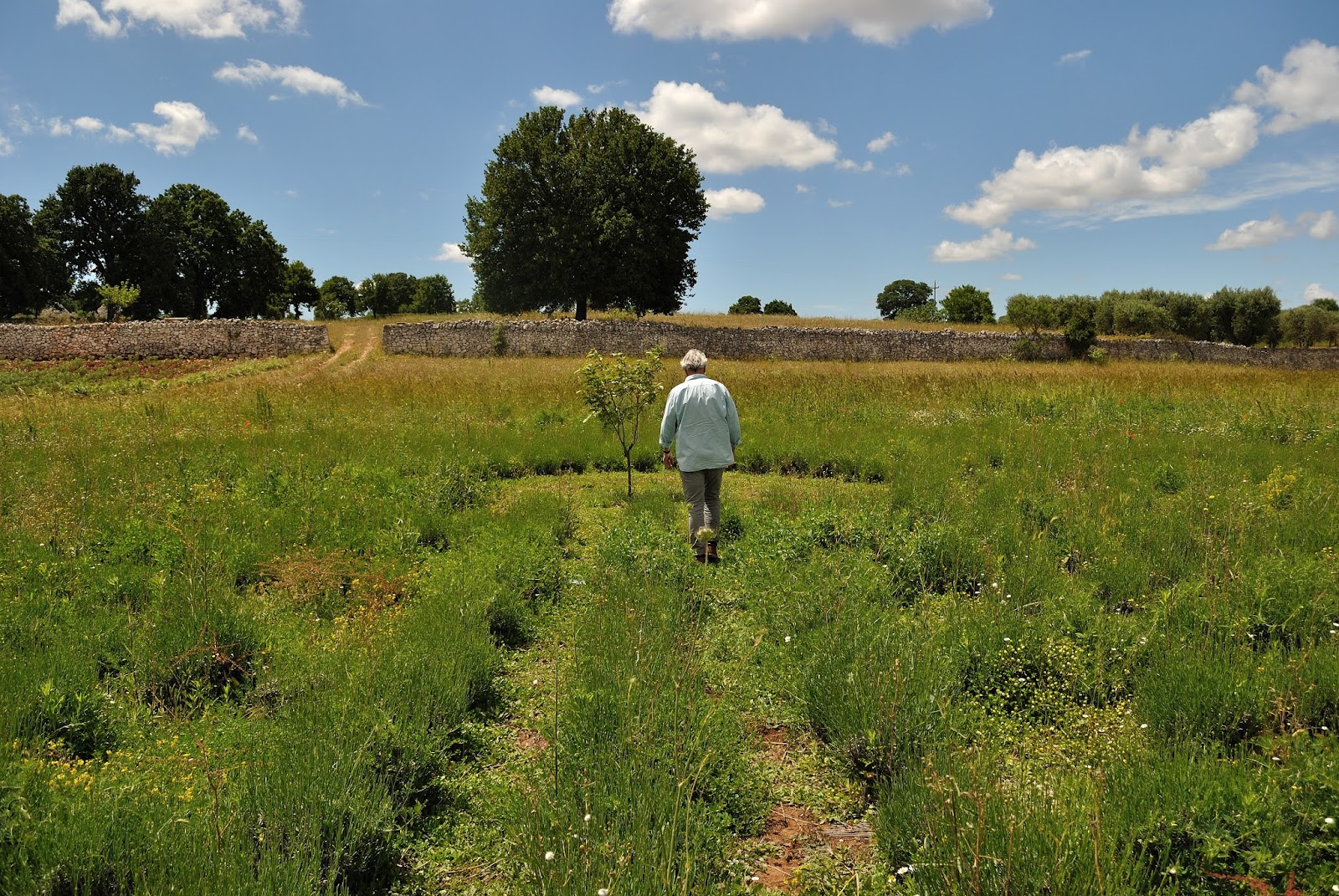
I giardini di Pomona is a biodiversity banking located in Cisternino, in valle d’Itria (Apulia).


I was so curious to find out more about this project. So, I kept in touch with Paolo Belloni, its founder.

I went to visit him few days ago.

I reached him at 10.30.

We shake hands and sit down under tall pine-trees.

I’m struck by his gentle smile.


“I have established the association i giardini di Pomona in 1993.

We have created an informal network to exchange information about biodiversity. 

We have travelled a lot around Italy, coveringaround 20.000 km”. Paolo says.


“In 1950 take place the introduction of chemistry in agriculture. That’s the begin of the end”. He adds.

Paolo continues: “The first great event promoted by I giardini di Pomona is held in the monastery of Torba (Lombardia), where around  200 kind of fruits are displayed. 

Unexpectedly, 3000 people come to visit us during the week end”.

“We saw people, especially elderly one, being touched at the sight of fruits which they thought was disappeared. Fruits which reminded them the old times, when they were kids.” He says.


“The richness of biodiversity belongs not to me or to Pomona but to anyone”. Especially, the next generations.


Paolo was looking for a place to settle down and continue his experience.


“After having visited so many places in the South of Italy, he fell in love with Cisternino and its inhabitants. In other words, Paolo had appreciated the attachment to the land of the local peasants”. He says.


Paolo adds: “Last but not least, the new things happen always in what can be considered the border of an area. Apulia is a border region, the most Eastern Italian region”.

Since he is in Cisternino, Paolo is working on figs and pomegranates.

I giardini di Pomona hosts one of the biggest Mediterranean figs collection.


Paolo says that figs will be the fruit of future.


Indeed, figs (like banana and persimmon) do not require pollination by bees. As you are aware, the risk that bees disappear from the planet is real.

“We have lost the pleasure of taste”. Paolo says.

Fruits imply social relations, technique of manufacturing and storing.

In June 2006, Science has published a research carried out by three archaeologists, who had discovered dehydrated figs of 11.000 years ago.

Therefore, this would mean that are older than green peas and grain.


Paolo suggests me to read a book which has had a great impact on his life Guns, Germs and Steel written by Jared Diamond.


Paolo has travelled a lot across India.

India has changed his life.

He shows with pride his botanic conservatory.

It’s huge.

For those who are interested, a permaculture course has been scheduled the 19th and 22th of June.

That could be an opportunity to discover I giardini di Pomona and shake hand with Paolo.