Showing posts with label Siponto. Show all posts

Thursday, 21 April 2016

Manfredonia, where contemporary art connects to romanico pugliese

Few days ago, I have come back to Manfredonia, my home town.

It was 7 pm and the sky was still bright

Before arriving in Manfredonia, coming from Zapponeta, I passed by the archaeological park of Siponto.


The park includes the basilica di Santa Maria Maggiore di Siponto (11th century) and the ruins of a basilica of the Early Middle Ages (4th century).

The first one is a magnificent example of Romanico Pugliese of which I am going to write about later.

Concerning the oldest basilica, we have inherited ruins and mosaics.


The archaeological park has just been renewed, thanks to the project called dove l'arte ricostruisce il tempo,

The project includes the permanent installation art of Edoardo Tresoldi, who has been commissioned to re-build the basilica through steel grids.


The project costed to the taxpayers 3.5 millions euro (POIn)

Talking about the Edoardo Tresoldi's installation art, Simone Pallotta says: "The Edoardo Tresoldi's project (Milan, 1987) is based upon the desire to portray the relationship between man and surrounding space".

"Tresoldi focuses on the idea of an architecture not as a solid mass but a structure which includes the landscape as an actual part of itself" he continues.

I have to confess that being within the installation is breathtaking.


According to the artist, this is the biggest installation art of steel ever made in the world. 

Since the inauguration held on the 11th of March, the installation is attracting so many tourists, Italian and foreigner.

However, some art critics argue that the installation should be removed.

Why?

Teodoro De Giorgio advises that there are no documents which prove that the original church has the shape forged by Edoardo Tresoldi.

In addition, the installation has been fixed on the ground, where fragile ruins and mosaics might have been damaged. 


"the installation is bulky" the art critic argues "therefore, the chance of reading the archaeological contest has been jeopardised".


The critic points the finger at Soprintendenza per i beni archeologici della Puglia, run by Luigi La Rocca, who has availed the project.

Finally, Teodoro De Giorgio remarks that it doesn't comply with the Italian Constitution (art. 9) which says "La Repubblica [...] tutela il paesaggio e il patrimonio storico e artistico della Nazione".

Therefore, the art critic hope for the removal of the installation.

Beside the Edoardo Tresoldi's work, there is the basilica of Santa Maria Maggiore di Siponto, which was consecrated on 1117.

I have always looked at this church superficially, never focusing on details.

This time, I slowly walk around the basilica and contemplate it.

According to Antonio De Tizio, its cubic shape symbolizes stability.


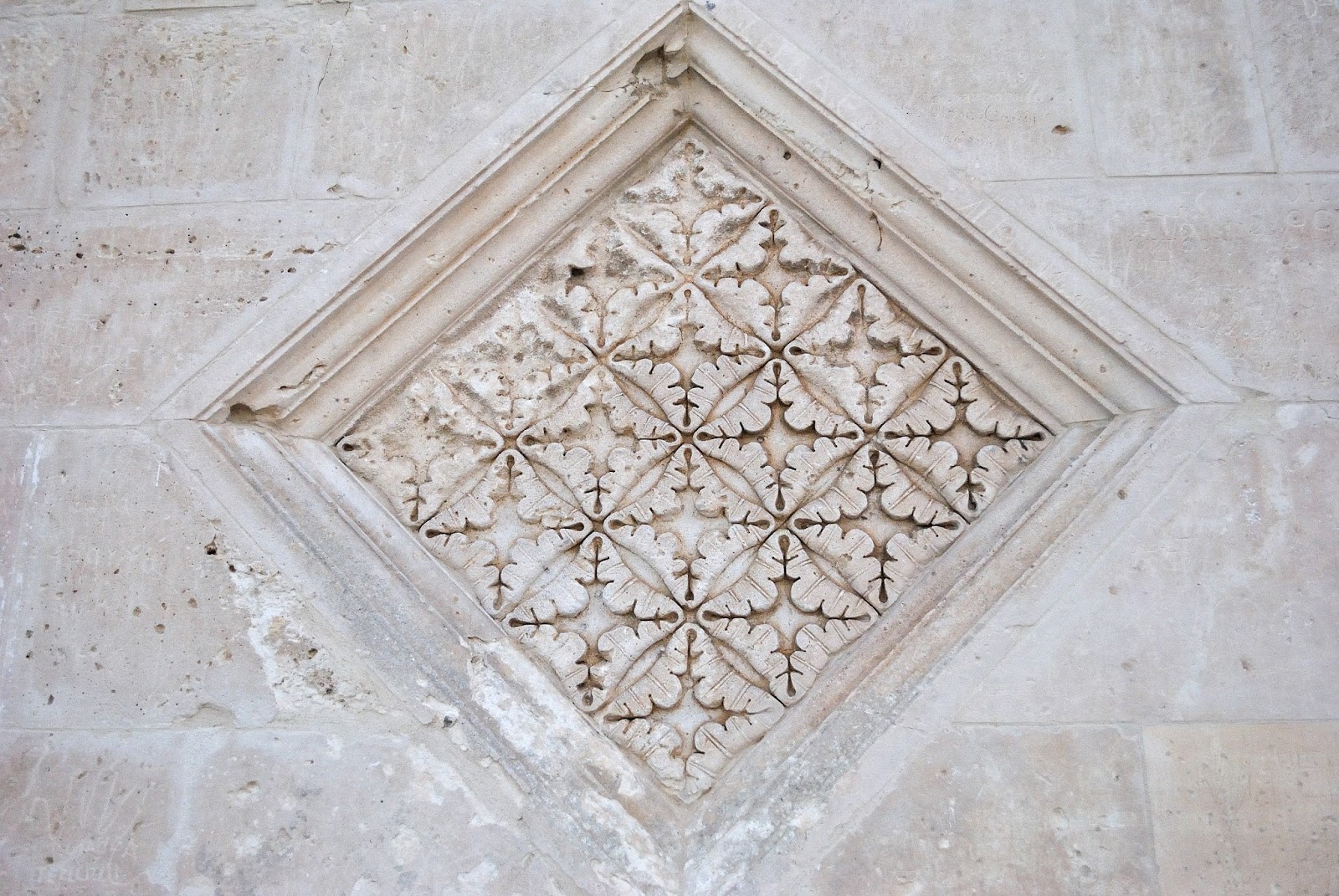
I'm mainly struck by two themes: firstly, the stiloforo lion sculpted beside the main entry. Secondly, the recurring motif of lozenges.


The lions seem having middle-Eastern traits.

Their eyes, big and well-defined, seem those of the Egyptian pharaoh.   


Then, the lozenges, a motif which occur all around the church.


Lozenges symbolize female fertility.

According to the Dean Liprini's book, pathways of the sun (pp. 34), in Christian art lozenge symbolizes the Virgin Mary.

John North states in his book Stonehenge (pp. 504) "The lozenge is a symbol commonly found, from Ireland to Persia and beyond".

Actually, the oldest lozenge representation is the one discovered in South Africa at the Blomblos cave which dates back to 70.000 years ago


One of the lozenges on the exterior wall of the basilica contains a Templar cross.


Templars, Teutonic knights  and other crusade orders choose Apulia to settle down before departing for the holy land. 

Nevertheless, if you are interested in finding out more about the Teutonic Order, then, you definitely must visit the San Leonardo abbey, few miles from Siponto, located between Manfredonia and Foggia.

San Leonardo is another story, though.

And I'm just realising that I should soon write something about it, because it's just so worth to be narrated.

Ciao

Thursday, 11 September 2014

Canosa di Puglia, the “little Rome”

When I was 23 years old, I went to London.


I spent three weeks there in order to attend an English class.

One day, my Polish friend and I decided to not go to school. We took a day off because we had planned to visit the British Museum.

Once in, we entered the exhibitions of Greece and Rome. 

Well, I was just so astounded by seeing so many objects from Canosa, in Apulia.

“I come from this area!” I proudly said to my friend, pointing the finger at the map.


Canosa is a town located in north of Apulia.

It has roughly 5000 years of history.

Canosa was called the “little Rome” because it is located on the top of seven hills, like Rome.


The grandiose appellation was given for an historical reason as well.

The Romans, defeated by Hannibal during the 2nd Carthaginian war, were rescued by Canosa.

Finally, the Romans managed to beat Hannibal and Canosa was well rewarded: it became colonia

Additionally, the Via Traiana passed by Canosa. 

While driving toward Canosa, I just realize that there are vineyards everywhere.


It is September, so it is time to harvest grapes.


The Rosso Canosa is a very good wine, made by Nero di Troia a red grape variety grown just in Apulia.


I arrive at Canosa at 12 o’clock, quite late because of the heavy rain which I have encountered.

Therefore, I have little time to see two things: the Archaeological museum hosted in Palazzo Sinesi and the S. Sabino cathedral.

By the way, Canosa has much more to offer in terms of archaeological and cultural heritage.

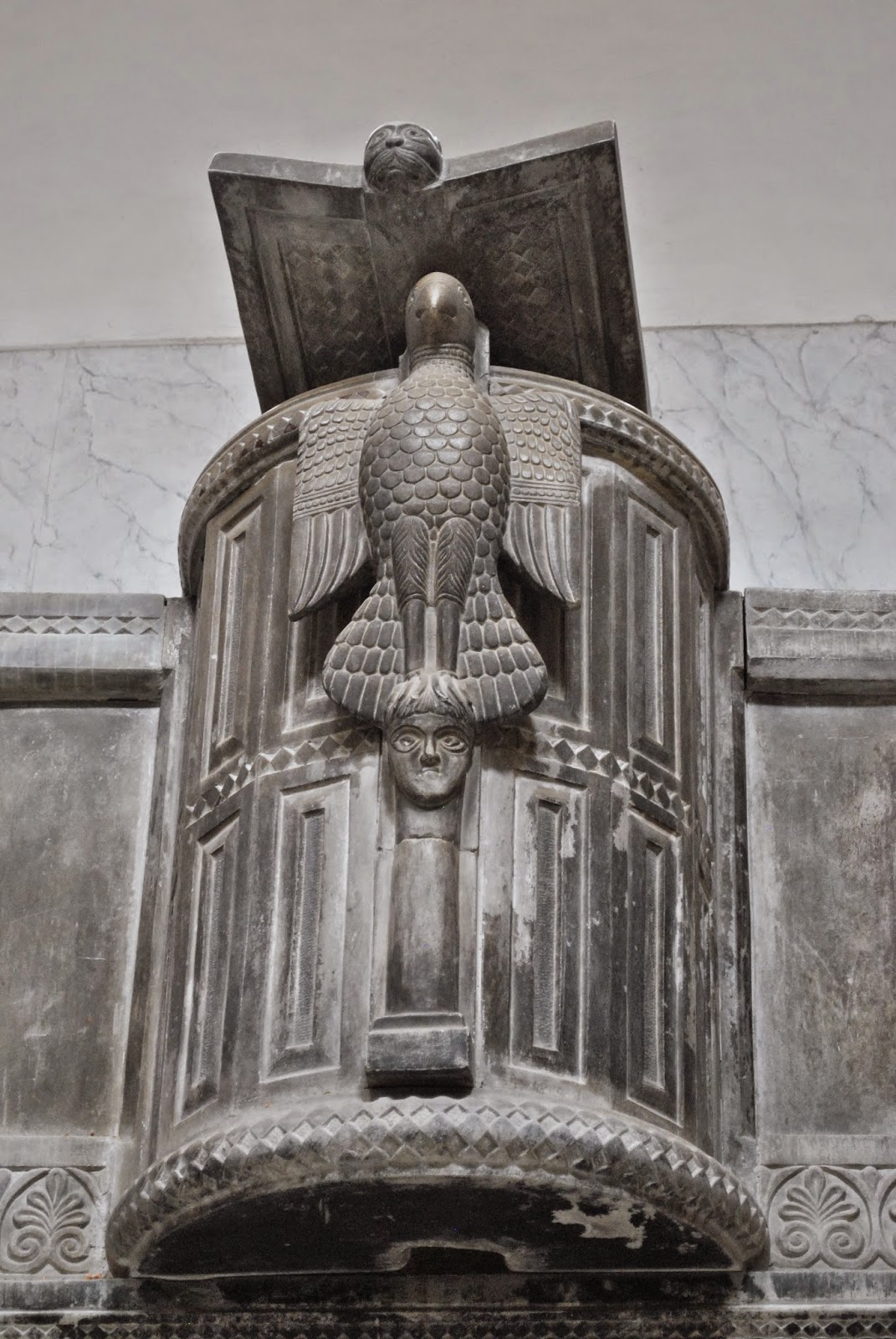
After having parked the car, I quickly move to the Cathedral, which hosts two amazing objects: the ambone and the throne with elephants.

The ambone was made by Acceptus, an Apulian Master who adorned the Cathedrals of Siponto and Monte S. Angelo as well.


On the other hand, the marble throne was manufactured by Romualdo. 

The throne has evident Oriental influence, typical example of the Romanico-Pugliese culture.


I feel shivers down my back looking at it. The throne is just so beautiful.

I would have liked to contemplate the Boemondo mausoleum, which is beside the cathedral.

Unfortunately, I do not have time. So, I promise myself to come back soon.

I get out the cathedral.

I quickly move toward Palazzo Sinesi. I look forward to see the archaeological exhibition.

I have half an hour time.

I enter Palazzo Sinesi and talk with the manager.

She says: “Canosa were manufacturing ceramic from the 8th till the 2nd century BC. In other words, it stopped with the Roman age.”


From my point of view, the nicest ceramic which I see here it is the Daunian ones. Canosa was Daunian.

The bright pink color was extracted by natural processes.  


Another unique object hosted here is the armour (4th century BC), coming from a tomb in Lavello.


Apparently, there are just 24 armours from that age spread around the world. 

Some of them come from Canosa di Puglia.

I have completed my visit. I cheer the manager and I get out.

Now, I easily walk toward the car.

I feel tired but serene.

If you wish to view more pics, please click here

Tuesday, 29 July 2014

Manfredonia, a seatown with royal roots

Few days ago I went to Manfredonia.


An old friend of mine would have got married the day after, so I participated in his stag party.

Therefore, we went to the Casbah, a nice disco pub in Siponto, one mile far from Manfredonia.

Manfredonia takes its name by the King who founded it: Manfred King of Sicily, son of Friedrick II of Hohenstaufen.


It is a sea town. It has one of the biggest fishing fleet in Italy: 250 fishing boats.


It is probably the most vibrant city within the province of Foggia.

If you take a walk along Corso Manfredi, you will find people walking and chatting at any time.


If you go to Manfredonia, I highly recommend you to visit the MAD (Archeological Museum of Daunia), which is hosted within the Swabian-Angevin castle.


The Museum hosts few interesting exhibitions, the most important one concerns the stele daune

The Daunians originally came from  a region in the western part of the Balkan Peninsula inhabited by the Illyrians


Around Manfredonia, there are two churches, brilliant examples of the Romanico Pugliese art.

The Romanico Pugliese is the synthesis of Romanic art which took place in Europe, combined with Arabic and Byzantine arts. 

For this reason, Apulia may rightly be considered the “European bridge to the Middle East”.

The first church is Santa Maria Maggiore di Siponto, cathedral of the ancient Siponto.


Completed in the 12th century, It is considered the first example of Romanico Pugliese.

This church has typical elements of Arabic and Armenian arts.


The second church is the S. Leonard’s abbey, built up in the 12th century, probably by the Templar Order.

Within the church, you can see cross paintings, which recall the Knights of the Teutonic Order (German medieval military order) which ruled the abbey from 1261 till 1475.


The most fascinating elements of the church are two gnomon holes.

So, Every year, a unique astronomical phenomenon occurs on the 21st of June (summer solstice) and on the 22nd of September (autumnal equinox).


In the summer solstice, at 12:58, when the sun reachs the zenit, the light goes through a gnomon hole, painting on the ground a flower of eleven petals.

According to the Cabala, 11 symbolizes strenght and light, both the qualities are obviously referred to God.


In the autumnal equinox, the sun light goes through a second gnomon, painting an almond, which according to the Christian tradition symobilzes the Virgin Mary.

Currently, works in progress are being carried out. So if you wish to visit it, I'd suggest you to e-mail to s.leonardo.manfredonia@iricostruttori.com

If you wish to view more pics, please click here
Blessings